A Vision of Venetian Grandeur
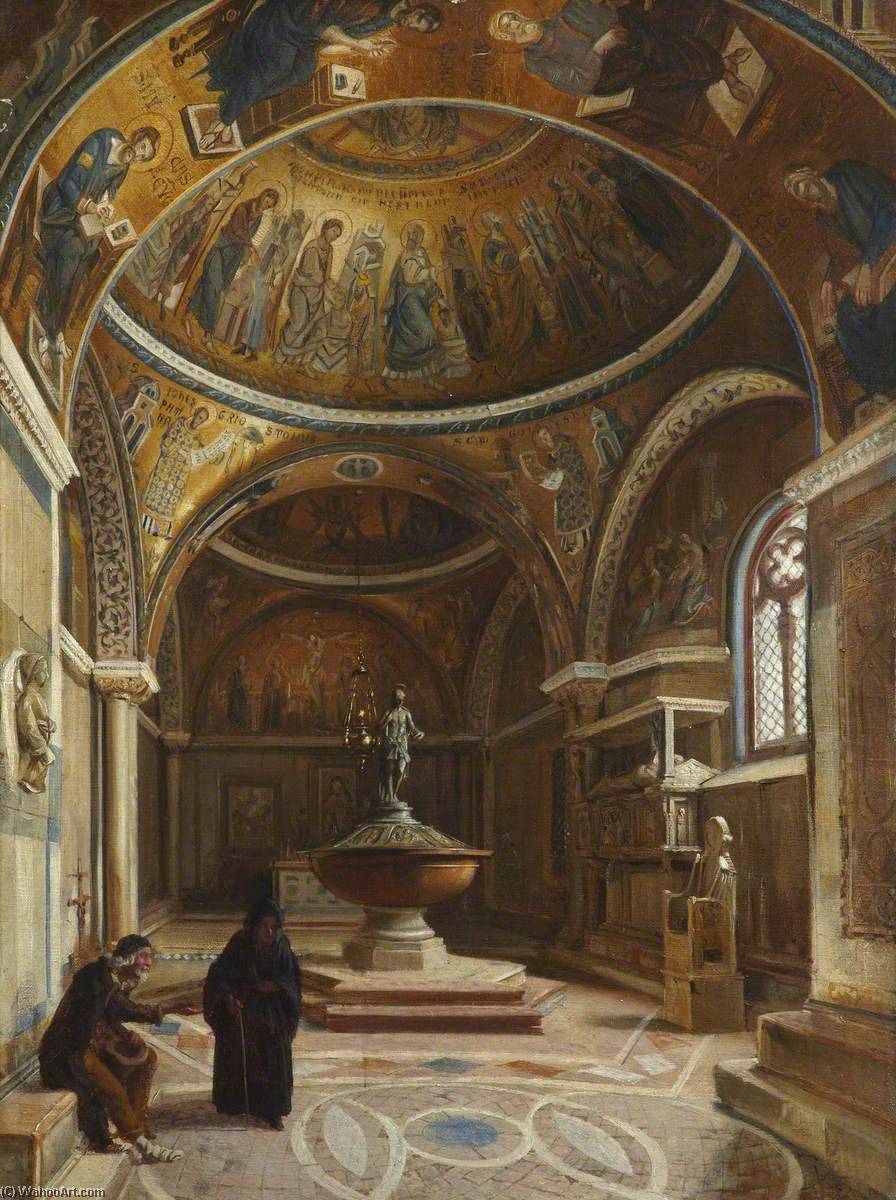
In the mid-19th century, as the world began to grapple with the rapid onset of industrialization, certain artists sought refuge in the timeless, golden echoes of the past. Thomas Stuart Smith, a master of bridging Romantic idealism with meticulous observation, captures this very essence in his 1845 masterpiece, Interior of San Marco, Venice. This painting is not merely a depiction of a cathedral; it is an invitation into a sacred atmosphere where light and architecture perform a silent, eternal dance. The viewer is immediately drawn upward by the sweeping majesty of the great dome, where intricate murals bloom like celestial gardens against the stone, reminding us of the profound human desire to touch the divine through art.
The composition masterfully balances the overwhelming scale of Venetian architecture with intimate, human moments. Amidst the vastness of the basilica, Smith places subtle figures—a solitary soul seated in the lower corner and another drifting near the periphery—which serve to ground the grandeur in reality. These small, quiet presences provide a sense of scale, making the soaring arches feel even more monumental. A central bowl, perhaps an offering or a decorative relic, sits as a focal point of stillness, anchoring the eye amidst the complex textures of the mosaic and marble. This careful arrangement creates a profound emotional resonance, evoking a sense of reverence, peace, and the quiet awe one feels when standing within a space shaped by centuries of devotion.
Technique and the Romantic Spirit
Smith’s technique in this work reflects his unique ability to marry scientific precision with the emotive power of the Romantic movement. Through delicate brushwork, he captures the way light filters through the high apertures of San Marco, illuminating the gilded surfaces and casting soft, atmospheric shadows that give the interior a palpable depth. The play of light on the various textures—from the cold, smooth marble to the rich, pigment-heavy murals—demonstrates a sophisticated understanding of luminosity. For the discerning collector or interior designer, this piece offers more than just visual beauty; it provides a window into a bygone era of craftsmanship and spiritual splendor.
Integrating such a work into a contemporary space allows for a sophisticated dialogue between history and modernity. Whether placed in a grand library, a formal dining room, or a curated gallery wall, this reproduction serves as a powerful conversation piece. It brings the warmth of Venetian gold and the contemplative stillness of 19th-century Europe into the home, offering an enduring sense of elegance and cultural depth. To possess this painting is to hold a fragment of Venice's historic heart, preserving the light of San Marco within one's own private sanctuary.