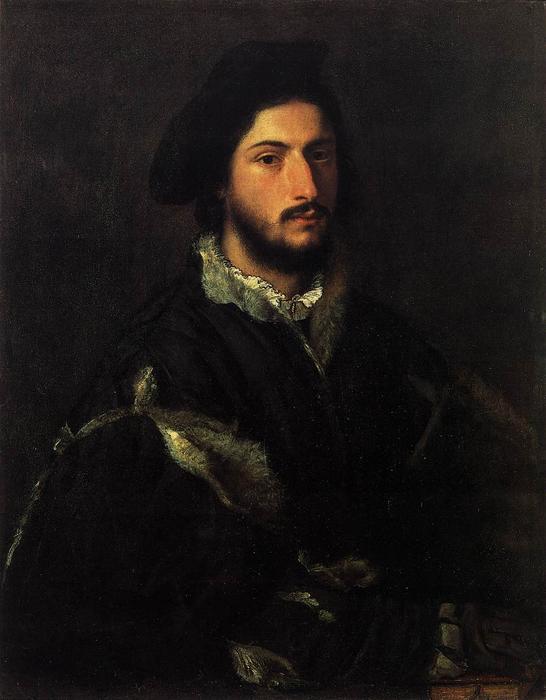
Portrait of Tomaso or Vincenzo Mosti: A Masterpiece of Venetian Dignity
The Portrait of Tomaso or Vincenzo Mosti by Titian Vecellio, completed in 1526, stands as a cornerstone of Renaissance portraiture—a testament to the Venetian artist’s unparalleled ability to convey both psychological depth and visual splendor. Housed within the Pitti Palace Museum in Florence, this canvas measuring 85 x 66 cm transcends mere representation; it embodies the ideals of humanist thought and artistic innovation that defined its era.
Style and Composition: Titian’s approach is characterized by a masterful blend of realism and idealized beauty. The three-quarter pose—a favored technique during his time—captures the subject's gaze directly at the viewer, establishing an intimate connection and conveying a sense of solemn contemplation. Symmetry dominates the composition, reflecting the Renaissance preoccupation with balance and harmony. The stark black background serves as a dramatic foil to the figure’s luminous flesh tones, emphasizing his presence and creating a profound visual impact.
Color Palette and Technique: Titian's signature chromatic palette—dominated by muted reds, browns, and blacks—is executed with meticulous detail using oil paint on canvas. He skillfully employs glazing techniques to achieve subtle gradations of color and texture, layering pigments to create an illusion of depth and luminosity. Notice the delicate rendering of skin tones, achieved through careful blending and highlighting – a hallmark of Titian’s revolutionary approach to painting.
Historical Context and Symbolism: Painted during the height of Venetian artistic patronage—specifically commissioned by Alfonso d'Este—the portrait reflects the humanist values prevalent in Ferrara at the time. The fur coat symbolizes wealth and aristocratic status, while the book held by Mosti represents erudition and intellectual pursuits – emblems of the Renaissance ideal man. The artist’s deliberate use of light directs attention to the subject’s face, conveying dignity and authority.
Emotional Impact: Beyond its formal beauty, the Portrait of Tomaso or Vincenzo Mosti possesses a remarkable emotional resonance. Titian captures not merely an image but an essence—a profound stillness that invites contemplation and conveys a sense of inner strength. It is a painting that speaks to the viewer across centuries, reminding us of the enduring power of art to illuminate human experience.
Further Exploration: For those wishing to delve deeper into Titian’s artistic legacy, we encourage you to visit Wikipedia for a comprehensive overview of Renaissance art and its influence on Venetian painting. Alternatively, explore the captivating beauty of “The Young Englishman” at WikiArt or admire “Portrait of Ippolito dei Medici” at WikiArt to experience the breadth of Titian’s artistic vision.
Finally, immerse yourself in the splendor of Renaissance art by visiting The Web Gallery of Art and discovering reproductions of masterpieces like “Portrait of Tomaso or Vincenzo Mosti” at WGA.