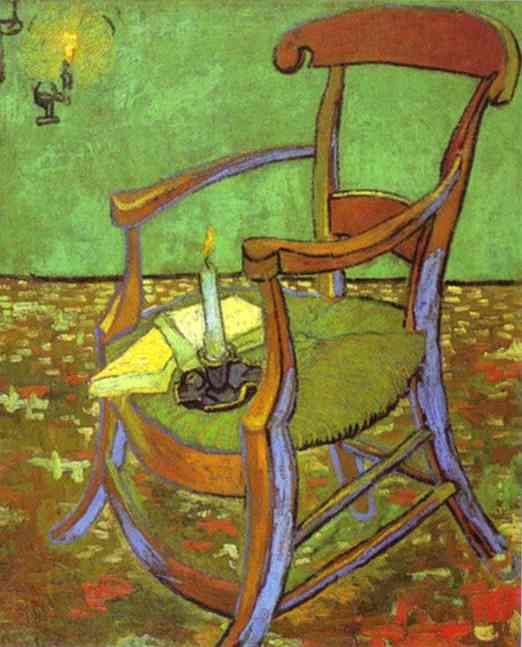
Gauguin's Chair with Books and Candle - A Reflection of Friendship and Artistic Vision
The painting
Gauguin's Chair with Books and Candle by
Vincent Van Gogh stands as a poignant testament to the creative partnership between two titans of Impressionism and Post-Impressionism—a visual echo of their shared ambition and intellectual fervor. Created in 1888 during his brief residency in Arles alongside Paul Gauguin, this artwork transcends mere depiction; it embodies a profound exploration of solitude, memory, and artistic contemplation.
A Tribute to Artistic Camaraderie
The scene captures Gauguin’s chair—a simple wooden seat bathed in the warm hues of twilight—positioned before a stack of books illuminated by a flickering candle. This deliberate arrangement speaks volumes about the dynamic between Van Gogh and Gauguin. As Hardy Lubin eloquently observes, “There are few pictures of Vincent's about which so much was written in later years.” The chair itself symbolizes Van Gogh’s own introspective nature—a quiet retreat from the bustling world—while the books represent his unwavering dedication to intellectual pursuits and artistic inspiration. It is a visual declaration of their mutual respect for each other’s creative endeavors, despite the inevitable tensions that arose during their collaborative period.
Color and Emotion: The Language of Expression
Van Gogh's masterful use of color serves as the painting’s primary vehicle for conveying emotion. He employs an earthy palette dominated by ochre yellows and muted reds—colors reminiscent of the Provençal landscape—to establish a comforting atmosphere, mirroring the warmth of a hearth fire. Notably, the vibrant yellow chair contrasts sharply with the cool blues of the surrounding walls, generating visual depth and enhancing the painting’s dramatic impact. This technique aligns perfectly with Van Gogh's broader artistic philosophy: to capture not just what he sees but how he feels—a cornerstone of Post-Impressionism’s expressive impulse. The candle flame, rendered in delicate strokes of yellow and orange, symbolizes illumination and introspection, inviting viewers into the artist’s inner world.
Post-Impressionism: Beyond Impressionistic Observation
Post-Impressionism emerged as a reaction to Impressionism's focus on capturing fleeting moments of light and color, prioritizing instead subjective experience and symbolic representation. Artists like Van Gogh sought to infuse their canvases with emotion—to distill the essence of human feeling into visual form. Unlike Impressionists who aimed for optical accuracy, Post-Impressionists prioritized expressive brushwork and bold color combinations—techniques that would profoundly influence subsequent artistic movements. As Sigm Lubin points out, “Van Gogh's work began to attract critical artistic attention in the last year of his life.”
Experience a Hand-Made Oil Painting Reproduction from ArtsDot.com
At
ArtsDot.com, we offer exceptional hand-made oil painting reproductions of masterpieces like
Gauguin's Chair with Books and Candle. Our skilled artists meticulously recreate every nuance—from the subtle texture of the wood grain to the luminous glow of the candlelight—ensuring you receive an exquisite piece of art that honors Van Gogh’s legacy for generations. To commission your own reproduction, visit
our website. Explore more about
Vincent Van Gogh and his works at
https://en.wikipedia.org/wiki/Vincent_van_Gogh.