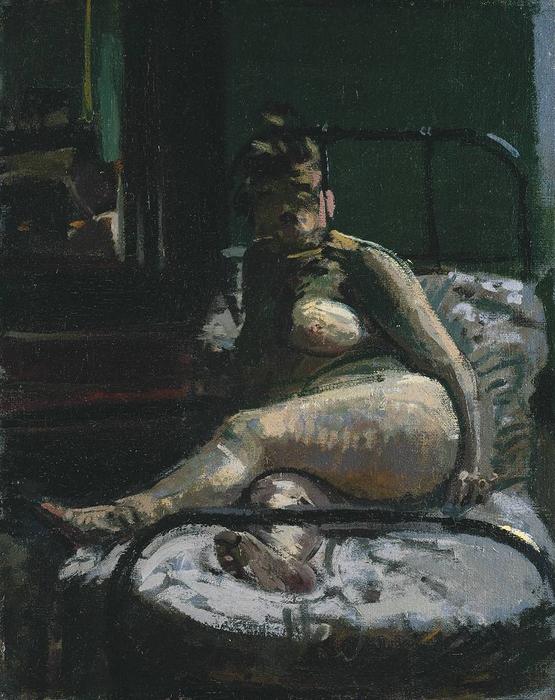
Walter Richard Sickert’s *La Hollandaise*: A Study in Shadowed Intimacy
Walter Richard Sickert's 1906 painting, *La Hollandaise*, is not merely a portrait; it’s a carefully constructed tableau of urban alienation and veiled sensuality. Housed within the Tate Britain collection, this work immediately draws the viewer into a dimly lit interior, dominated by an iron bedstead and the enigmatic figure of a woman reclining upon it. Sickert, a pivotal figure in bridging the gap between Impressionism and Modernism, masterfully employs a muted palette—primarily ochres, greys, and blues—to evoke a sense of both decay and quiet beauty. The painting’s power lies not in overt display but in its subtle suggestion, its ability to whisper stories rather than shout them.
Sickert's technique is characterized by a loose, almost sketch-like application of paint. He eschews meticulous detail, favoring instead broad brushstrokes and a fragmented approach that mirrors the fractured reality he often depicted. The woman’s face remains largely obscured in shadow, contributing to an atmosphere of mystery and anonymity. Her limbs are rendered with a deliberate lack of idealization; her posture is awkward, her legs crossed clumsily – a far cry from the idealized nudes prevalent in earlier art historical traditions. This rejection of conventional beauty aligns with Sickert’s broader interest in portraying marginalized figures and exploring the darker aspects of human experience.
The Camden Town Context: A World of Shadows
*La Hollandaise* was created during Sickert's time in Camden Town, a bohemian hub teeming with artists, writers, and performers. This period marked a significant shift in his artistic focus; he moved away from the grand salon scenes of his earlier career to capture the gritty realities of London’s working-class districts. The painting is deeply rooted within this specific milieu, reflecting the atmosphere of smoky music halls, dimly lit pubs, and the transient lives of those who populated Camden Town. The title itself, “La Hollandaise,” hints at a connection to the world of prostitution – a reference to Balzac’s novel *Gobseck*, where a character nicknamed "la belle Hollandaise" was a courtesan. This association adds another layer of complexity to the image, suggesting a narrative of vulnerability and exploitation.
Crucially, Sickert's work during this period is often interpreted as a commentary on the changing social landscape of Britain. The rise of industrialization and urbanization led to widespread poverty and displacement, and Sickert’s paintings offer a poignant glimpse into the lives of those left behind. *La Hollandaise* embodies this theme through its depiction of an anonymous woman in a state of quiet desperation, her existence reduced to the confines of a simple bedstead.
Symbolism and Emotional Resonance
Beyond its social commentary, *La Hollandaise* is rich in symbolic meaning. The iron bedstead itself represents both confinement and vulnerability – a stark reminder of the woman’s precarious situation. The shadows that envelop her face suggest a sense of isolation and hidden emotions. The single source of light, illuminating her thigh and breast, creates a dramatic contrast, highlighting her physical presence while simultaneously obscuring her identity. This interplay of light and shadow is central to Sickert's artistic vision, creating an atmosphere of ambiguity and intrigue.
Ultimately, *La Hollandaise* transcends the limitations of a simple portrait. It’s a haunting meditation on loneliness, alienation, and the complexities of human relationships. Sickert’s masterful use of light, shadow, and fragmented forms invites viewers to contemplate the woman's story—to imagine her past, her hopes, and her fears. The painting remains a powerful testament to Sickert’s unique artistic sensibility and his ability to capture the essence of modern life.
Collecting & Reproduction
Reproductions of *La Hollandaise* offer an exceptional opportunity to bring this evocative artwork into any interior space. Its muted palette and atmospheric quality complement a wide range of design styles, from contemporary minimalism to classic Edwardian interiors. Consider framing the reproduction in a dark wood or metal frame to further enhance its dramatic effect. The painting’s inherent mystery and emotional depth will undoubtedly serve as a focal point, sparking conversation and adding a touch of sophisticated intrigue to any room.