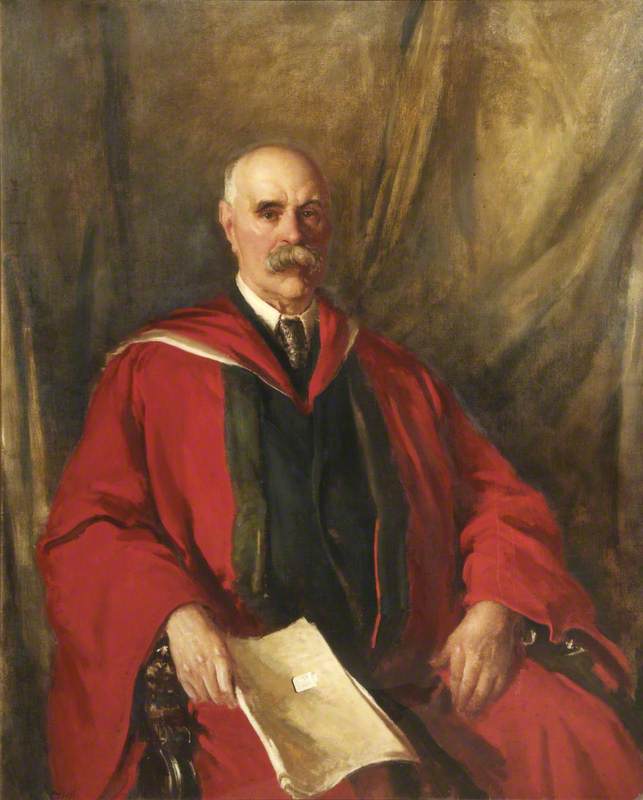
Robert Styring (1850–1944), Benefactor – A Portrait of Quiet Reflection
Walter Westley Russell’s “Robert Styring,” painted in 1939, stands as a testament to the enduring power of landscape painting and the meticulous observation of detail. Executed in oil on canvas, this artwork captures a moment of serene contemplation—a man seated formally in a chair, his hands folded gently atop a sheet of paper.
Russell’s style is distinctly Impressionistic, prioritizing tonal harmony and capturing the diffused light characteristic of Yorkshire coastlines. Unlike many artists of his era focused on grand vistas or dramatic narratives, Russell eschewed spectacle for subtlety, favoring instead an intimate portrayal of Styring—a prominent benefactor to The Queen's College Oxford.
The painting’s composition is carefully considered. The curtain serves as a visual anchor, framing the subject and subtly directing the viewer’s gaze. Two additional figures occupy the background, adding depth and hinting at an unspoken social context – perhaps Styring’s family or colleagues. Russell skillfully employs glazing techniques to build up layers of color, achieving remarkable luminosity and conveying a palpable sense of stillness.
Artist Biography: Walter Westley Russell
Born in Forest Gate, Essex, in 1867, Walter Westley Russell inherited an artistic lineage from his father, Henry Russell—a bookbinder who himself possessed considerable artistic talent. This formative influence instilled in Russell a lifelong passion for visual art and fueled his pursuit of formal training at Westminster School of Art under Frederick Brown.
Russell’s early exhibitions at the Royal Academy between 1891 and 1904 established him as a respected artist, showcasing pieces like “Pierrots,” “Tea Time,” and a portrait—demonstrating his versatility across genres. He gained considerable acclaim for his landscapes of Yorkshire and Norfolk, capturing their atmospheric beauty with remarkable accuracy.
Russell’s academic career included teaching positions at the Slade School of Fine Art and later as Keeper of the Royal Academy Schools from 1927 to 1942—a pivotal role in shaping artistic education during Britain's involvement in World War II. His dedication to fostering creativity extended beyond the classroom, evidenced by his membership in organizations such as NEAC and RWS.
Technique & Materials
Russell’s masterful use of oil paints is evident throughout “Robert Styring.” He meticulously blended pigments to achieve nuanced tonal variations—creating a rich tapestry of color that captures the subtleties of light and shadow. Glazing techniques, where thin layers of translucent paint are applied over previous coats, contribute significantly to the painting's luminous quality.
The canvas itself is primed with gesso – a mixture of chalk and glue – providing a smooth surface for optimal pigment adhesion. Russell’s careful attention to detail extends beyond color; he meticulously rendered textures—particularly in Styring’s clothing and the folds of the curtain—enhancing the painting's realism.
Symbolism & Emotional Impact
"Robert Styring" transcends mere representation, conveying a profound sense of quiet dignity and contemplative repose. The seated posture suggests thoughtfulness and introspection – reflecting Styring’s status as a respected philanthropist and intellectual.
Russell's deliberate framing—the curtain and the background figures—creates an atmosphere of understated formality, mirroring Styring’s position within Oxford University society. Ultimately, the painting invites viewers to pause and appreciate the beauty of stillness—a timeless message conveyed with remarkable grace and precision.