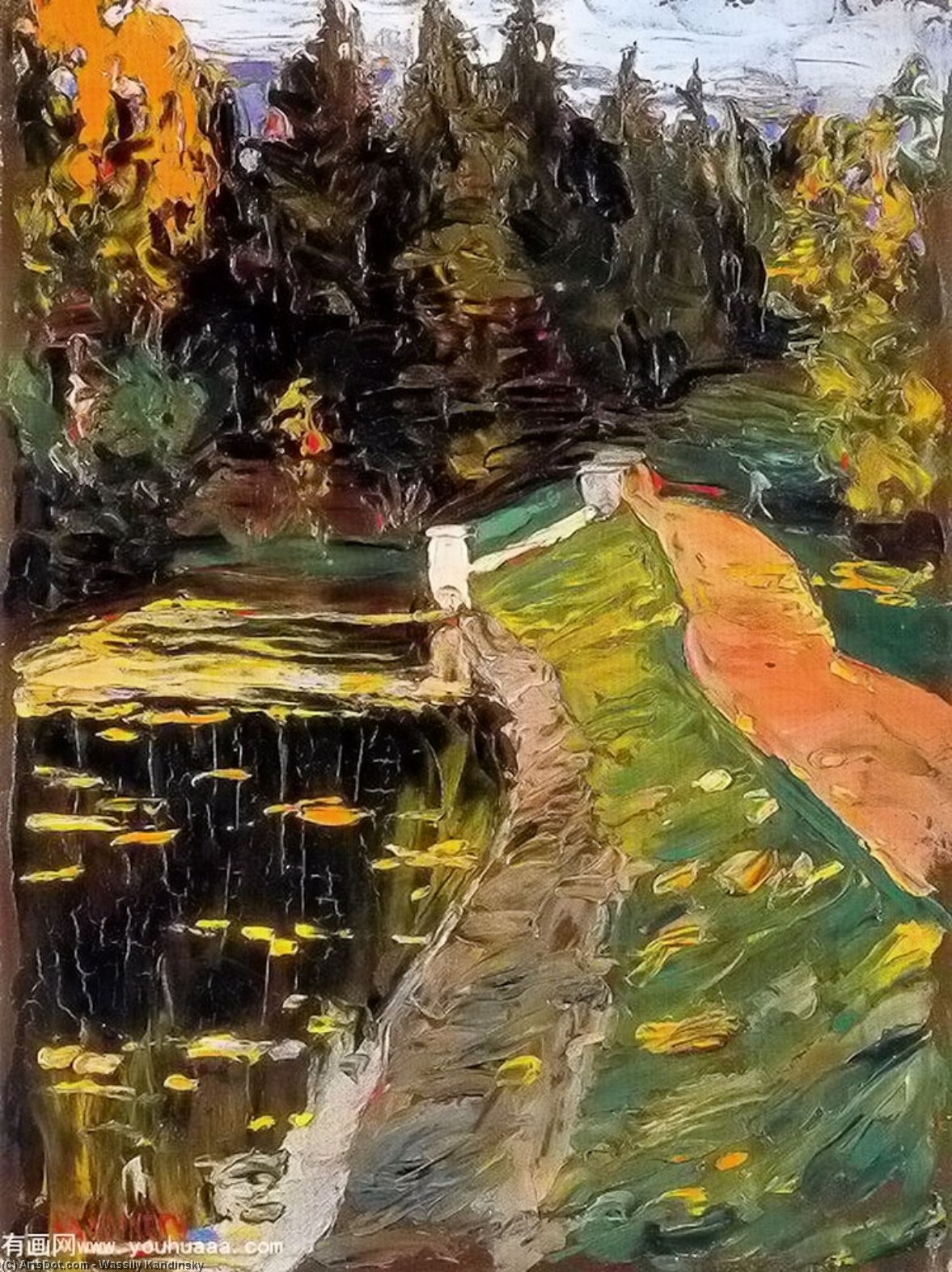
Wassily Kandinsky’s ‘Study for a Sluice’: A Dawn of Abstract Emotion
Wassily Kandinsky's 'Study for a Sluice,' painted in 1901, represents a pivotal moment not just in the artist’s career but in the very trajectory of modern art. This seemingly simple landscape – a serene body of water reflecting a white building nestled amongst trees – is far more than a picturesque depiction; it's an intensely personal and profoundly influential exploration of color and form that foreshadowed the rise of abstract expressionism. Born in Moscow in 1866, Kandinsky’s artistic journey was initially marked by a pragmatic pursuit of law and economics before a transformative encounter with Monet’s “Haystacks” ignited within him a fervent desire to translate inner experience onto canvas. This nascent impulse found further resonance in Wagner's opera "Lohengrin," fueling his ambition to move beyond representational accuracy and capture the essence of emotion through purely visual means.
Post-Impressionist Roots & Early Experimentation
‘Study for a Sluice’ firmly establishes Kandinsky within the Post-Impressionist movement, though he quickly sought to transcend its limitations. The painting's style is characterized by bold color choices and expressive brushwork – hallmarks of the period – yet it demonstrates an unprecedented focus on the *relationships* between colors rather than their objective depiction. Notice how the blues and greens of the water subtly shift and blend, creating a sense of movement and depth. The white building, rendered with simplified forms, acts as a focal point, drawing the eye while simultaneously contributing to the overall atmospheric effect. This early work reveals Kandinsky’s nascent desire to use color not merely to represent reality but to evoke feeling and spiritual experience – a core tenet of his later artistic philosophy.
Symbolic Resonance & Spiritual Intent
Beyond its formal qualities, ‘Study for a Sluice’ is laden with symbolic resonance. The “sluice” itself, a structure designed to control water flow, can be interpreted as representing the artist's own attempt to channel and direct his creative energies. The surrounding landscape – the water, the trees, the building – all contribute to a sense of tranquility and contemplation, suggesting a yearning for spiritual harmony. Kandinsky was deeply interested in the intersection of art, religion, and psychology, believing that color possessed inherent spiritual qualities. This painting exemplifies this belief, demonstrating how he sought to translate subjective experience into tangible form.
Technique & Reproduction – A Window to the Original
This hand-painted reproduction meticulously recreates Kandinsky’s original technique, capturing the nuances of his brushwork and color palette with remarkable fidelity. The artist employed a layering method, building up thin washes of paint to achieve the luminous effects characteristic of his work. The textured surface, achieved through multiple applications of pigment, adds depth and richness to the image, inviting close observation. ArtsDot’s skilled artisans have painstakingly reproduced this artwork, ensuring that you receive a faithful representation of Kandinsky's vision – a piece that will undoubtedly become a treasured addition to any art collection or interior space.