A Moment Suspended in Time
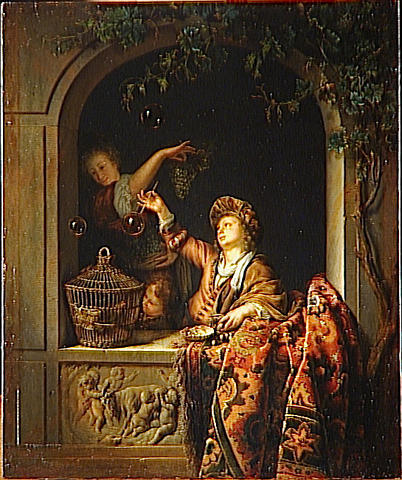
In the quiet corners of the Dutch Golden Age, there exists a particular kind of magic found in the observation of the mundane. Willem van Mieris, a master of the fijnschilders movement, captures this enchantment perfectly in his evocative work, Les Bulles de savon. The scene invites us into an intimate, sun-drenched alcove where a woman rests upon a cushioned balcony ledge, her world momentarily paused by the whimsical flight of soap bubbles. Beside her, a young servant girl breathes life into iridescent spheres that drift through the air like tiny, liquid jewels. It is a composition that feels less like a staged portrait and more like a stolen glance into a private moment of domestic tranquility, offering a sense of peace that remains deeply resonant even centuries after its creation.
The brilliance of Van Mieris lies in his ability to elevate a simple genre scene into a profound meditation on existence. Through the delicate, translucent bubbles, the artist weaves a complex tapestry of symbolism known as vanitas. These ephemeral spheres, beautiful yet destined to burst in an instant, serve as poignant metaphors for the fleeting nature of youth, pleasure, and life itself. To gaze upon this painting is to engage with the concept of Homo sicut bulla—man is like a bubble. Yet, despite this underlying melancholy, the artwork does not feel somber; rather, it celebrates the exquisite beauty found in the transient, encouraging the viewer to find wonder in the present moment before it vanishes.
Mastery of Light and Texture
For the discerning collector or interior designer, the technical virtuosity of Les Bulles de savon offers unparalleled visual richness. Van Mieris employs a sophisticated palette dominated by warm, regal tones—deep reds, burnished golds, and earthy browns—which create a sense of luxurious comfort. These heavy, opulent hues are masterfully contrasted against the cool, refreshing greens of the surrounding foliage and the soft, pale skin of the figures. The artist’s command over texture is nothing short of extraordinary; one can almost feel the plush weight of the velvet cushions, the smooth coolness of the stone architecture, and the fragile, shimmering surface of the soap bubbles that catch the light with a spectral glow.
The lighting within the piece is soft and diffused, as if filtered through a gentle afternoon haze, casting subtle shadows that lend a three-dimensional depth to the figures. This meticulous attention to detail—a hallmark of the Leiden school—ensures that every element, from the intricate patterns on the fabric to the delicate glass rod used by the servant, contributes to a cohesive and immersive atmosphere. Such a masterpiece, whether viewed as an original or a high-quality hand-painted reproduction, serves as a sophisticated focal point for any curated space, bringing with it a legacy of Dutch excellence and an enduring sense of grace.