Ver en contexto
 Comprar impresión
 Enviar
 Compartir


 Descargar
 Similares
 Radiografía
 Presentación de diapositivas
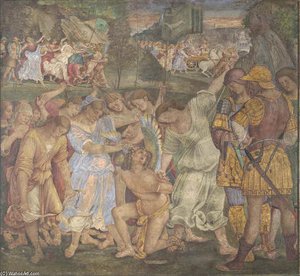
Triumph of Poverty
 Acrylic On Canvas
- WallArt
- Baroque
 43.0 x 58.0 cm
 Museo Británico
Lucas Vorsterman’s Triumph of Poverty: A Revolutionary Portrait
Frans Hals, born around 1582 in Antwerp and finding his true home in Haarlem, Netherlands, stands as a pivotal figure in the history of art. More than simply a painter, he was a revolutionary—a rebel against the rigid conventions of portraiture that dominated the early 17th century. His work embodies an unprecedented vitality, capturing not just appearances but also fleeting emotions and the very essence of his subjects. Hals’s journey, marked by a deliberate shift from meticulous detail to a looser, more expressive style, reflects an artist unafraid to challenge established norms and forge his own path within the vibrant landscape of the Dutch Golden Age.
“Triumph of Poverty,” created in 1652, exemplifies Hals’s groundbreaking approach. Unlike many contemporaries who painstakingly rendered every wrinkle and pore with painstaking precision—a hallmark of Mannerism—Hals opted for a technique characterized by bold brushstrokes and vibrant color washes. This decision wasn't merely stylistic; it represented a fundamental rejection of the prevailing artistic dogma. Hals sought to convey not just what his subjects looked like but how they *felt*, imbuing his portraits with palpable energy and psychological depth.
The painting depicts a procession of men and women engaged in various activities—farmers tending crops, laborers hauling carts, and individuals simply strolling through the town square. Hals’s masterful use of chiaroscuro – dramatic contrasts between light and shadow – enhances the scene's realism while simultaneously emphasizing the figures’ expressions and postures. Notice how the artist captures a moment of quiet contemplation amidst the bustle of daily life.
The composition itself is carefully considered, drawing inspiration from biblical narratives—specifically, the story of David and Goliath. The central figure, presumably representing David, stands tall and resolute, gazing upwards with unwavering determination. Surrounding him are others who embody humility and resilience – individuals who persevere despite hardship. This symbolism underscores Hals’s belief that true nobility resides not in wealth or status but in moral virtue.
Displayed prominently at the British Museum in London, “Triumph of Poverty” measures 43 x 58 cm and was executed using pen as the medium, complemented by brown ink, gray wash, black chalks, and red chalks. The resulting image is a testament to Hals’s exceptional skill and artistic vision—a captivating portrayal of human experience that continues to inspire admiration centuries later.
Additional Resources:
Related Artwork Inspirations:
Explore High-Quality Reproductions:
Lucas Vorsterman (1624 – 1666)
Explore los grabados barrocos de Lucas Vorsterman, maestro del grabado que trabajó junto a Rubens y Van Dyck. Descubra sus impresionantes estampas y su legado artístico.
Museo Británico (London, United Kingdom)
Descubre el Museo Británico en Londres: tesoros globales, historia y arte de culturas milenarias. ¡Una joya imperdible!
Sobre esta obra
- Título: Triumph of Poverty
- Artista: Lucas Vorsterman
- Dimensiones originales: 43.0 x 58.0 cm
- Formato: Landscape
- Estado de derechos de autor: Dominio público
- Ubicación: Museo Británico
- Técnica y materiales: Acrylic On Canvas
- Contexto del corpus: classical idealism , baroque style
- Paleta de colores: Earthy
- Color predominante: Driftwood
Datos clave
- Medium: Pen in brown, with gray and brown wash, black and red chalks.
- Subject or theme: Religious procession; depiction of human labor.
- Notable elements or techniques: Loose brushwork; expressive portrayal of figures.
- Location: British Museum
- Influences: Renaissance
- Artist: Lucas Vorsterman
- Artistic style: Realistic
Código QR