The Manifesto of Modernity: Breaking from Tradition to Embrace the Machine Age
 Speed, Power, and Motion: A Journey Through the Energetic Soul of Futurism
The Pulse of Modernity: Defining the Futurist Revolution Speed, Power, and Motion: A Collector's Guide to the Dynamic World of Futurism The Manifesto of Modernity: Understanding the Futurist Revolution At the dawn of the twentieth century, a seismic ...
To understand the seismic shift that occurred at the dawn of the twentieth century, one must first imagine the heavy, gilded stillness of the museums that preceded it. For centuries, the art world was anchored by a nostalgic reverence for classical antiquity and the serene, sun-drenched landscapes of Impressionism. However, as the gears of industry began to turn with unprecedented ferocity, a new generation of thinkers felt the suffocating weight of the past. In 1909, Filippo Tommaso Marinetti ignited this rebellion with his
Manifesto of Futurism, a clarion call that sought to shatter stagnant traditions and replace them with the raw, unbridered energy of the modern era. This was not merely an aesthetic preference; it was a profound ideological revolt. The Futurists famously asserted that a roaring automobile, in all its metallic glory, was more beautiful than the ancient
Winged Victory of Samothrace. They looked toward a horizon defined by the airplane, the locomotive, and the pulsating urban landscape, demanding a cultural rejuvenation fueled by technology, youth, and even the deliberate destruction of academic norms.
The Aesthetics of Speed: Understanding Dynamism, Technology, and Urban Energy
 Futurism
Futurism (Italian: Futurismo [futuˈrizmo]) was an artistic and social movement that originated in Italy, and to a lesser extent in other countries, in the early 20th century. It emphasized dynamism, speed, technology, youth, violence, and objects suc...
Stepping into a Futurist masterpiece is akin to stepping into the frantic heartbeat of a city in motion. The movement’s core essence lies in its obsession with
dynamism—the idea that nothing is truly static, and every object exists in a state of constant flux. Where a traditional painter might capture a single, frozen moment, the Futurist seeks to depict the very passage of time itself. This is achieved through an intense focus on speed, power, and the sensory overload of the machine age. The artists found divinity in the blur of a passing train and the rhythmic vibrations of industrial machinery. By emphasizing the kinetic energy of objects like cars and airplanes, they sought to mirror the accelerating pace of human life. For the modern collector, these works offer more than just visual delight; they provide a window into a period when humanity was first learning to dance with the relentless momentum of progress, finding beauty in the friction between man and machine.
Beyond Italy: The Global Pulse of Russian and European Avant-Garde Movements
 maria mikhaïlovna siniakova
A Pioneer of Sensual Futurism: The Life and Art of Maria Siniakova Maria Mikhaïlovna Siniakova, born in 1890 in the Zhmerynsky District near Kharkiv, Ukraine, emerged as a compelling voice within the Russian avant-garde, though her contributions were...
While the movement found its fiery origins in Italy, its pulse resonated far beyond the Mediterranean, sparking radical transformations across the European landscape. In the Russian Empire and the Soviet Union, Futurism underwent a fascinating metamorphosis, blending with local sensibilities to create uniquely potent expressions such as
Cubo-Futurism. This was not a mere imitation of Italian ideals but a radical reimagining born from a specific socio-political context. Artists like David Burliuk, a true provocateur of the Russian avant-garde, helped forge a new language that embraced the energy of the new age while remaining deeply connected to the turbulent spirit of their homeland. Similarly, in the vibrant cultural hubs of Ukraine and Russia, we see the emergence of figures like Maria Siniakova, whose "sensual futurism" offered a breathtakingly different perspective—blending technological fascination with an intimate, almost primitive connection to nature. This global expansion ensured that the Futurist spirit was not a singular note, but a complex, international symphony of innovation and rebellion.
Fragmented Forms and Kinetic Energy: Key Techniques of the Futurist Masters
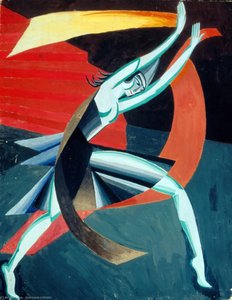 Costume design for Salome
The Costume design for Salome by Aleksandra Ekster is a captivating piece of art that showcases the artist's skill in capturing the essence of movement and energy. Created in 1917, this oil on canvas painting measures 66 x 52 cm and is a testament to...
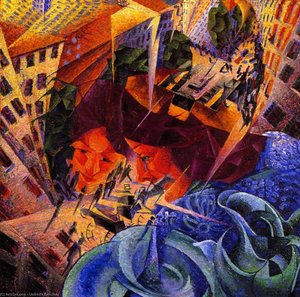
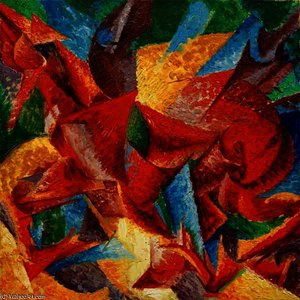
The technical execution of Futurist art is where the philosophy of motion becomes tangibly visible on the canvas. To capture the ephemeral nature of movement, masters like Umberto Boccioni, Giacomo Balla, and Gino Severini employed a sophisticated vocabulary of fragmentation and light. They utilized sharp, geometric forms—often influenced by the structural lessons of Cubism—to break down subjects into constituent parts that seem to vibrate against their backgrounds. This technique creates a sense of
interpenetration, where the boundaries between an object and its surrounding environment begin to dissolve. You might observe how a figure’s pose is echoed by trailing lines of color, or how light is fractured into rhythmic patterns to suggest the hum of electricity. In works such as Balla’s
Abstract Speed + Sound, the artist uses repetitive, overlapping shapes to simulate the auditory and visual sensation of rapid motion. It is this deliberate manipulation of form and texture that allows the viewer to feel the physical impact of the subject's energy, turning a two-dimensional surface into a theater of kinetic action.
Bringing the Revolution Home: Curating Dynamic Art for Modern Interiors
 Guillermo de Osma Gallery
A Sanctuary of the Avant-Garde: The Guillermo de Osma Gallery In the pulsating heart of Madrid, where tradition meets the relentless energy of modernity, lies the Guillermo de Osma Gallery—a profound intellectual sanctuary dedicated to the spirit of ...
For the contemporary enthusiast looking to infuse their living space with character, Futurist-inspired art offers an unparalleled opportunity to create a sense of vitality and intellectual depth. Integrating these energetic works into a modern interior requires a thoughtful approach to balance and composition. Because Futurist pieces are inherently high-energy, they serve as magnificent focal points in a room, commanding attention against the more tranquil elements of a curated home. A large-scale, multi-panel reproduction of a dynamic cityscape can transform a wide hallway or a grand staircase into a cinematic experience, with colors and brushstrokes flowing seamlessly across the walls. When selecting pieces, consider how the bold contrasts and sharp lines will interact with your existing color palette; a minimalist room might find a perfect partner in the structured geometry of a Cubo-Futurist work, while a more eclectic space can embrace the vibrant, textured impasto of a hand-painted reproduction. By bringing these echoes of the machine age into your home, you are not just decorating; you are participating in a long tradition of celebrating the beautiful, restless spirit of human progress.
At ArtsDot.com, we believe that every home deserves a touch of the extraordinary. Whether you are drawn to the structured energy of the avant-garde or the soft light of the classics, our mission is to make the discovery of fine art an inspiring and accessible journey for everyone.