
The Genesis of Art Deco: From Parisian Expositions to Global Modernity
 Art Deco in Paris
The Art Deco movement of architecture and design appeared in Paris in about 1910–12, and continued until the beginning of World War II in 1939. It took its name from the International Exposition of Modern Decorative and Industrial Arts held in Paris ...
To understand the shimmering allure of the early twentieth century, one must look toward Paris, where the seeds of a revolution in taste were sown. The Art Deco movement did not emerge from a vacuum; it was a deliberate response to the shifting tides of a world transitioning into modernity. Appearing in Paris between 1910 and 1912, this aesthetic flourished until the dawn of World War II, eventually taking its name from the landmark 1925 International Exposition of Modern Decorative and Industrial Arts. This era was far more than a mere trend; it served as a visual manifesto for an age defined by unprecedented technological progress and social liberation.
While its predecessor, Art Nouveau, found beauty in the organic, asymmetrical whimsy of vines and flowers, Art Deco sought strength in the structured, the rhythmic, and the geometric. It was a movement that embraced the clarity of the machine age while infusing it with a decadent, human warmth. From the soaring heights of New York’s Chrysler Building to the sleek lines of luxury ocean liners, the movement permeated every facet of existence. For the modern designer, this era represents the perfect synthesis of rare materials—such as ebony and ivory—meeting the industrial promise of chrome and stainless steel, creating a timeless language of luxury that continues to define high-end environments today.
Erté: The Architect of Glamour and the Mastery of Line
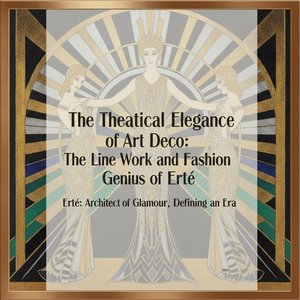 The Theatrical Elegance of Art Deco: The Line Work and Fashion Genius of Erté
The Architect of Glamour: Defining the Art Deco Aesthetic through Erté's Vision To step into the world of Romain de Tirtoff, known universally as Erté , is to surrender to a realm where geometry meets grace and where every silhouette tells a story of...
To step into the world of Romain de Tirtoff, known universally as Erté, is to surrender to a realm where geometry meets grace. As the preeminent architect of the Art Deco aesthetic, Erté did not merely illustrate fashion; he choreographed it. Born into an aristocratic Russian family in 1892, his childhood within St. Petersburg’s vibrant cultural landscape profoundly shaped his aesthetic sensibilities. He was a visionary who breathed life into the rhythmic pulse of the 1920s and 30s, acting as the high priest of a movement that sought to replace Victorian constraints with a stylized reality.
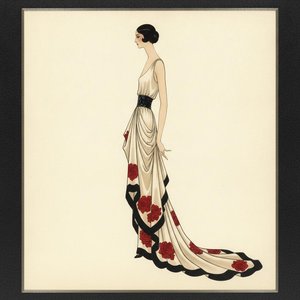
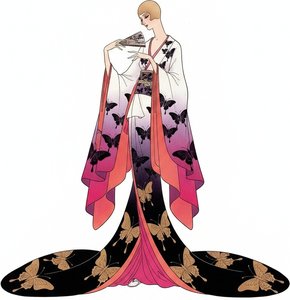
The true genius of Erté lies in his mastery of the line—a singular, commanding element that dictates the movement of his compositions. In his hands, the line is never merely a boundary; it is a rhythmic pulse. There is an almost architectural approach to the human form, utilizing elongated limbs and exaggerated proportions to create a sense of otherworldly height. Through his legendary two-decade partnership with Harper’s Bazaar, he produced hundreds of covers that defined the image of the Jazz Age. His work captures the ephemeral essence of beauty—the way light dances upon a sequin or the fluid motion of a dancer mid-turn—crystallizing it into an iconic, permanent form.
Symmetry and Sophistication: Defining the Art Deco Aesthetic
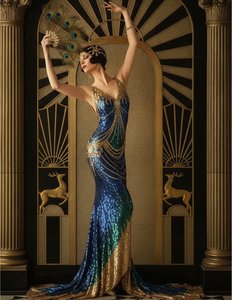 The Elegance of Erté: Capturing the Timeless Glamour and Sophistication of Art Deco Style
The Architect of Glamour: Introducing the Visionary World of Erté To step into the world of Romain de Tirtoff, known universally as Erté, is to surrender oneself to a dream of perpetual elegance. He was not merely an illustrator; he was the high prie...
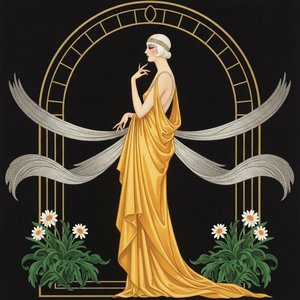
The magic of Erté’s compositions lies in their profound adherence to the principles of Art Deco: a marriage of organic fluidity and rigorous geometric structure. Unlike the unrestrained, swirling vines of the preceding era, the Art Deco aesthetic embraced symmetry and precision. In Erté's work, this manifested as a breathtaking use of balance, where figures are often framed by architectural motifs such as sunbursts, stepped pyramids, and stylized floral patterns. These elements ground the ethereal subject matter, providing a sense of stability amidst the opulence.
This era was characterized by an obsession with symmetry and a pursuit of the new. It drew inspiration from an eclectic repertoire, synthesizing the bold colors of Fauvism with the geometric rigor of Cubism, while simultaneously embracing the exoticized motifs of ancient Egypt, Japan, and the Maya. For those designing sophisticated commercial spaces, this aesthetic offers a blueprint for prestige. The ability to balance rigid geometry with luxurious textures allows for the creation of environments that feel both modern and deeply rooted in historical grandeur.
The Visual Manifesto: Fashion Illustration as Cultural Choreography
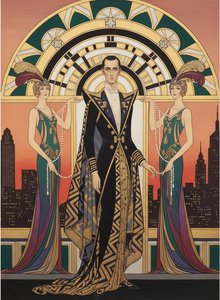 Erté: The Art Deco Visionary Who Defined Modern Glamour
The Early Life & Artistic Foundations of Romain de Tirtoff Romain de Tirtoff, known universally as Erté – a pseudonym derived from the French pronunciation of his initials – was born into an aristocratic Russian family in 1892, a lineage steeped in t...
Erté’s influence transcended the boundaries of paper and ink, spilling into the very fabric of culture. His work served as a visual guide for an entire generation, influencing everything from the stage of the Folies Bergère to the most prestigious fashion houses in Paris. He possessed a rare ability to transform the dress into a hallmark of the twentieth century, treating every silken drape and feathered ornament as part of a larger, orchestrated symphony of movement.
Through his eyes, the modern woman became an icon of streamlined strength, draped in fabrics that seemed to possess both the weight of silk and the lightness of air. His illustrations were not merely depictions of clothing; they were stories of unbridled opulence and social evolution. By capturing the way light interacts with texture and how movement affects silhouette, Erté provided the visual vocabulary for an age of unprecedented glamour. This level of detail ensures that his work remains a powerful tool for storytelling in any curated collection.
Integrating Art Deco Elegance into Contemporary Hospitality Design
For the professional designer tasked with furnishing luxury hotels, restaurants, or corporate spaces, the Art Deco era offers an inexhaustible well of inspiration. The movement’s emphasis on bold geometric forms and highly stylized decoration provides a foundation for creating impactful, large-scale environments. Whether through the use of multi-panel paintings that span wide walls or custom-painted murals that recreate historical grandeur, the principles of Erté can be applied to modern architectural challenges.
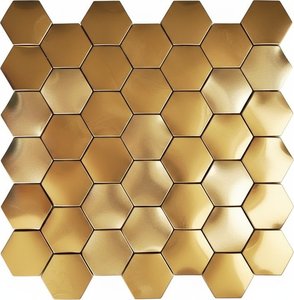
Integrating these elements requires a focus on texture and tonal range. The deep, rich colors found in Art Deco works pair seamlessly with contemporary materials like brass, velvet, and polished stone. By utilizing high-quality reproductions that emphasize visible brushstrokes and the tactile depth of oil paint, designers can introduce a sense of history and permanence into transient spaces. Ultimately, the goal is to evoke the same sense of "theatrical elegance" that Erté mastered—creating a sanctuary of grace where the frantic pace of modernity is replaced by the poised, deliberate cadence of luxury.
ArtsDot.com provides professional-grade solutions for hospitality procurement and interior design. We specialize in high-volume, high-quality hand-painted oil reproductions and large-format murals that bring the grandeur of art history to any project. From custom sizing and multi-panel layouts to bespoke color matching, our service is designed to meet the rigorous demands of the trade. Visit us to explore our extensive catalog and elevate your next design endeavor with museum-quality excellence.