The Genesis of Relief: Understanding the Mechanics of Woodcut Printing
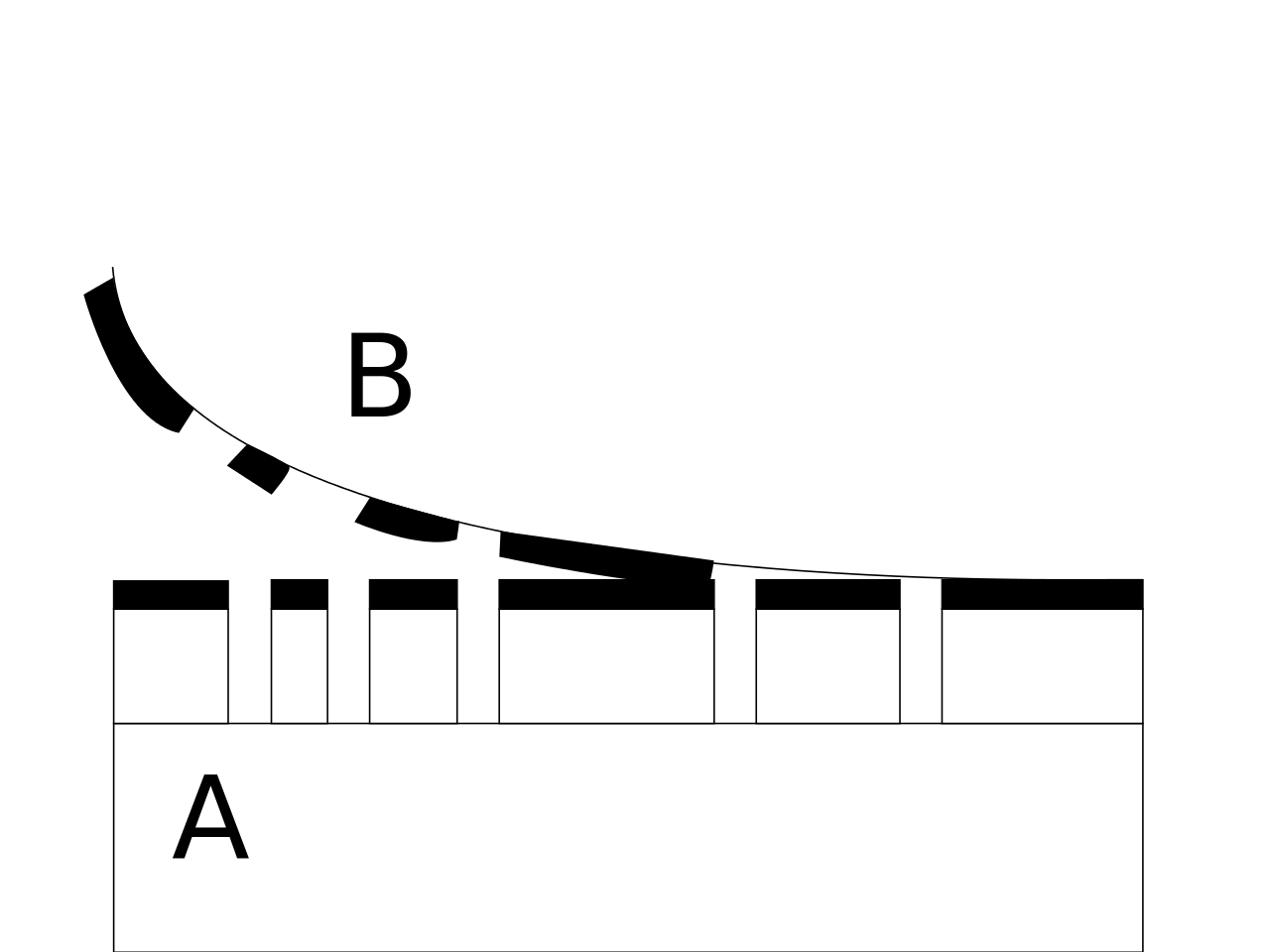 Relief printing
Relief printing is a family of printing methods where a printing block, plate or matrix, which has had ink applied to its non-recessed surface, is brought into contact with paper. The non-recessed surface will leave ink on the paper, whereas the rece...
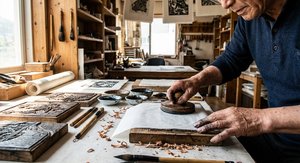
To understand the woodcut is to understand the fundamental tension between presence and absence. Unlike intaglio printing, where the artist invites ink into the recessed grooves of a metal plate, relief printing operates through a subtractive philosophy. It is an art of removal. The artist approaches a block of wood—often dense, fine-grained varieties such as cherry or pearwood—and begins the laborious task of carving away the areas intended to remain white. What remains at the original surface level constitutes the image itself. When a brayer or roller is passed over this carved matrix, it deposits ink only upon the non-recessed surfaces, leaving the gouged valleys untouched.
This mechanical simplicity belies a profound complexity in execution. Every stroke of the chisel or gouge is irreversible; once the wood is removed, the light has been permanently invited into the composition. This creates a distinctive aesthetic language characterized by sharp, decisive lines and a stark, often monochromatic intensity. There is no room for the delicate, atmospheric gradations found in watercolor or the fluid, continuous tones of oil painting. Instead, the woodcut demands a mastery of negative space, where the interplay of black ink and raw paper creates a rhythmic, structural energy that defines the very essence of the relief medium.
From Ancient China to the Renaissance: A Global History of the Woodblock
 Woodblock printing
Woodblock printing or block printing is a technique for printing text, images or patterns used widely throughout East Asia and originating in China in antiquity as a method of printing on textiles and later on paper. Each page or image is created by ...
The story of the woodblock is not merely a chronicle of artistic development, but a testament to humanity’s enduring desire to replicate beauty and disseminate knowledge. Long before the advent of digital reproduction, the roots of this transformative art form stretched back millennia to ancient China. As early as the 5th century, woodblock printing flourished, initially serving the practical needs of textile decoration on silk before evolving into a sophisticated method for reproducing text and intricate imagery on paper. This early mastery laid the groundwork for both textual dissemination and pictorial representation across East Asia.
As these techniques migrated westward, they encountered the burgeoning intellectual landscape of Europe. By the 14th century, woodcut printing began to appear in European hands, initially serving religious purposes through devotional images that were accessible to a wider, often illiterate, populace. The transition from the hand-painted manuscript to the printed page was marked by the emergence of
Blockbücher—small, illustrated books carved entirely from wooden blocks. However, the true revolution arrived with the development of movable type by Johannes Gutenberg in the mid-15th century. This innovation allowed for the seamless integration of woodcut illustrations with standardized text, a moment that forever altered the speed and accuracy of information exchange and signaled the dawn of the modern era of mass communication.
The Expressionist Edge: How Woodcut Defined Modern Artistic Intensity
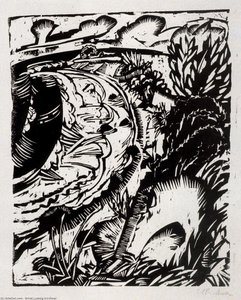
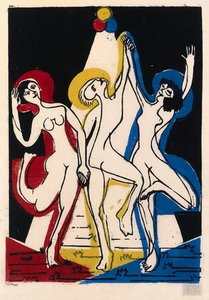
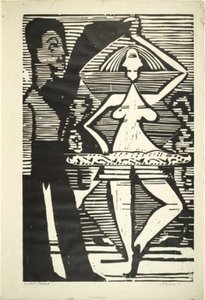 Dancing Couple
Dancing Couple – A Study in Expressionist Intensity Artist : Ernst Ludwig Kirchner (1880-1938) Date : 1933 Size : 51 x 36 cm Kirchner’s “Dancing Couple” is not merely a depiction of two figures engaged in movement; it's a visceral embodiment of the a...
In the early 20th century, the woodcut underwent a radical metamorphosis, shedding its role as a medium of reproduction to become a primary vehicle for raw, psychological expression. The German Expressionists, a group of artists grappling with the anxieties of rapid industrialization and the looming shadow of war, found in the woodcut a perfect mirror for their turbulent inner landscapes. Artists such as Ernst Ludwig Kirchner utilized the inherent roughness of the medium to reject naturalistic representation in favor of subjective, visceral experience.
Consider Kirchner’s
Dancing Couple (1933). In this work, the woodcut technique is not merely a choice of medium but an essential component of its emotional weight. The stark monochrome palette and the thick, angular strokes define the figures with an urgency that mimics the heartbeat of a generation in unrest. There is no softness here; the jagged edges and heavy blacks convey a sense of alienation and tension. This movement proved that the woodcut could transcend its decorative origins to become a powerful tool for social critique and emotional catharsis, using the very resistance of the wood grain to articulate the fractures within the human soul.
Technical Mastery: The Subtractive Process and the Language of Line
For the student of art, mastering the woodcut requires a disciplined understanding of materiality and the physics of the carve. The process begins with the selection of the block; while softwoods may allow for easier carving, harder woods like pearwood permit much finer detail and more intricate hatching. The artist must think in reverse, as the final print will be a mirror image of the carved block. This mental inversion requires a high degreeard of spatial reasoning and foresight.
The language of the woodcut is written through varying depths and widths of gouges. A shallow cut might produce a fine, hair-like line, while a deep, aggressive removal of material creates bold, structural voids. The skill lies in managing the "grain" of the wood; carving with the grain allows for fluid movement, whereas carving against it requires strength and precision to prevent splintering. This tension between the artist's intent and the wood's natural resistance produces a texture that is uniquely tactile. When properly inked and pressed—whether by a heavy printing press or the simple manual pressure of a hand tool—the resulting print possesses a grainy, organic quality that serves as a permanent record of the physical struggle between creator and medium.
Preserving the Impression: Collecting and Curating Masterful Prints
 Museum of Prints and Drawings
A Sanctuary of Lines: Delving into Berlin’s Kupferstichkabinett Nestled within the Altes Museum complex, a cornerstone of Berlin’s Museum Island UNESCO World Heritage Site, lies an institution that whispers invitations to intimacy—the Kupferstichkabi...
To collect woodcuts is to curate a collection of moments captured in high relief. Because the medium allows for multiple impressions from a single block, it has historically democratized art ownership, allowing collectors to engage with works that possess the same historical gravity as unique paintings. From the meticulous, realistic hatching of the 15th-century Master of the Joseph Sequence to the luminous, innovative woodblock techniques of Japanese-American artist Chiura Obata, the medium offers a diverse spectrum of aesthetic experiences.
For the modern enthusiast, preserving these works requires an understanding of archival stability. Prints are sensitive to light and moisture; thus, proper framing with acid-free matting is essential to create an air gap that prevents degradation. As we look toward the future of art appreciation, the legacy of the woodcut remains as vital as ever. Whether one is studying the delicate lines in Berlin’s
Kupferstichkabinett or seeking a high-quality reproduction to bring historical grandeur into a contemporary home, the woodcut continues to offer an unparalleled encounter with the essential form of artistic expression.
At
ArtsDot.com, we celebrate this enduring legacy by offering museum-grade reproductions that honor the techniques of the masters. From hand-painted oil recreations that capture the impasto texture of a masterpiece to high-quality Giclée prints for the discerning decorator, our mission is to make the profound beauty of art history accessible to all. Whether you are looking to transform a personal photograph into a classical portrait or wish to adorn your space with a meticulously crafted piece of the Renaissance, our dedicated artists and project coordinators ensure that every work meets the highest standards of academic excellence.