Introduction
To step into the world of Pop Art is to witness a vibrant rebellion, a moment in history when the boundaries between the hallowed halls of fine art and the bustling energy of the everyday street were irrevocably dissolved. It was an era that dared to find divinity in the mundane, elevating the glossy sheen of a magazine cover and the bold ink of a comic book to the status of high culture.
Emerging from the transformative landscape of the mid-20th century, Pop Art rose as a spirited response to the heavy, introspective shadows of Abstract Expressionism. As the post-war boom brought an explosion of consumerism, mass media, and celebrity worship, artists began to look outward. They turned their brushes toward the supermarket aisle, the cinematic icon, and the repetitive patterns of industrial production, capturing the pulse of a society increasingly defined by what it consumed.
These masterpieces remain profoundly resonant in our contemporary age because they predicted the visual language we inhabit today. In an era of digital saturation and endless scrolling, the movement's fascination with repetition, bright palettes, and mass-produced imagery feels more relevant than ever. These works taught us to find beauty in the ephemeral and meaning in the ubiquitous.
In this curated exploration, we invite you to walk through a gallery of ten definitive works—canvases that did far more than merely reflect their era; they fundamentally redefined the very soul of modern art.
Marilyn Diptych - Andy Warhol
 Marilyn Diptych - Andy Warhol
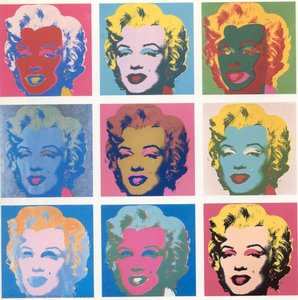
To gaze upon the face of a legend is to encounter the haunting intersection of myth and mass production. In 1962, Andy Warhol captured this profound tension in his monumental Marilyn Diptych , a work that stands as a definitive cornerstone of the Pop Art movement. Created in the shadow of Marilyn Monroe’s tragic passing, the piece utilizes the mechanical silkscreen process to mirror the relentless repetition of celebrity imagery found in mid-century media.
The visual experience is one of striking duality: on the left, a vibrant explosion of artificial pinks and yellows celebrates a constructed, neon glamour; on the right, the image fades into monochromatic decay, suggesting the inevitable erosion of fame. Through these bold, flattened planes and deliberate printing imperfections, Warhol transforms a Hollywood icon into a meditation on mortality. This masterpiece does more than decorate a space; it invites a dialogue on the very nature of the images we consume, making it an essential piece for any collection seeking to capture the pulse of modern history.
Whaam! - Roy Lichtenstein
 Whaam! - Roy Lichtenstein
To encounter Roy Lichtenstein’s 1963 masterpiece, Whaam! , is to witness the precise moment when the kinetic energy of American comic strips was elevated into the hallowed halls of fine art. As a defining pillar of the Pop Art movement , this work commands attention through its brilliant appropriation of mass-media aesthetics and the meticulous, hand-painted recreation of Ben-Day dots. Lichtenstein transforms a scene of aerial combat into a profound commentary on the stylized, detached representation of violence in modern culture. The striking interplay of primary reds, deep blues, and heavy black outlines creates a visual impact that is both visceral and intellectually stimulating. For the sophisticated collector, Whaam! serves as an incomparable statement piece; its bold, graphic dynamism brings a pulse of mid-century history to contemporary luxury interiors, offering a timeless dialogue between cultural rebellion and refined aesthetic taste.
Campbell's soup cans - Andy Warhol
 Campbell's soup cans - Andy Warhol
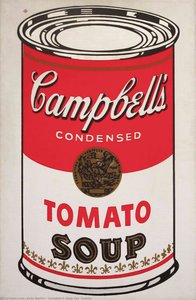
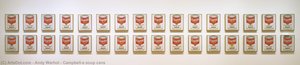
The light in Campbell's soup cans is not merely illumination; it is a language . Andy Warhol did not paint light—he composed it from the bright, artificial glow of the supermarket aisle and the repetitive pulse of mass media. This 1962 masterpiece uses the mechanical rhythm of silkscreen printing to elevate thirty-two mundane cans into a profound statement on consumer culture. The striking reds and whites create a visual cadence that challenges the boundaries between high art and everyday life, turning the ubiquitous into the monumental.
This work is essential to the Pop Art movement because it does not just reflect our reality; it reinvents it through the lens of industrial repetition. Now, open your eyes. That vibrant, commercial glow is waiting to spill into your home, turning your walls into portals of inspiration where the ordinary becomes extraordinary.
Drowning girl - Roy Lichtenstein
 Drowning girl - Roy Lichtenstein
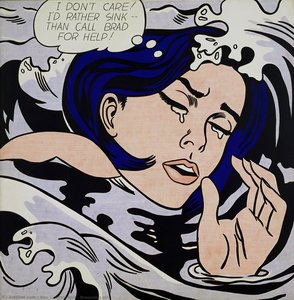
In Drowning Girl , Roy Lichtenstein does not merely depict light; he composes it as a language of high-contrast drama. It is not just illumination; it is a rhythmic pulse of Ben-Day dots and bold, primary hues that command the eye. This is why it remains a cornerstone of the Pop Art movement: it doesn't just reflect light; it invents it . As you observe this 1963 masterpiece, you feel the tension of comic-strip melodrama—the thick, expressive lines and the swirling, turbulent water mirroring the subject's internal despair. Lichtenstein brilliantly elevates a moment of pulp fiction into a profound exploration of modern emotion, using mechanical textures to create something deeply human. Now, open your eyes and imagine that vibrant, graphic energy spilling into your own space, turning a quiet wall into a portal of mid-century inspiration through a meticulously hand-painted oil reproduction.
Flag - Jasper Johns
 Flag - Jasper Johns
Imagine standing before a canvas that feels less like a painting and more like a sculptural relic, its surface heavy with the tactile depth of melted beeswax. When Jasper Johns unveiled Flag in the mid-1950s, he did not merely depict a national icon; he utilized the arduous, ancient technique of encaustic to transform a familiar symbol into a profound sensory experience. This technical mastery allowed Johns to bridge the raw, gestural energy of Abstract Expressionism with the cool, object-oriented focus that would come to define the Pop Art movement . By deconstructing the American flag through blurred lines and thick, textured layers, he challenged the world to reconsider the boundary between high art and everyday imagery. Such a commanding, intellectually stimulating masterpiece serves as an extraordinary anchor for a modern study or home office, fostering an environment of deep contemplation and sophisticated, creative rigor.
Girl with ball - Roy Lichtenstein
 Girl with ball - Roy Lichtenstein
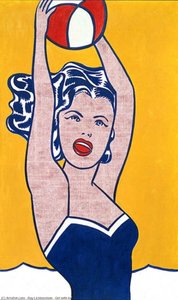
In 1961, Roy Lichtenstein redefined the boundaries between high art and mass media with Girl with ball . This masterpiece captures the electric energy of mid-century American pop culture, pulling inspiration from the ubiquitous language of advertising. As you gaze upon it, the eye is immediately drawn to the vibrant, sun-drenched yellow background and the striking, flat color fields that define the era.
Lichtenstein employs thick, confident black outlines to sculpt a figure of idealized beauty, her skin a soft pink set against the deep navy of her swimsuit. There is no attempt at realistic depth here; instead, the work celebrates a deliberate, graphic flatness and a sense of kinetic movement as the subject reaches for the volleyball. To possess such a piece is to do more than decorate; it is to invite the pulse of history into your home, transforming a simple room into a curated gallery of the soul where mass culture meets timeless genius.
Marilyn, leo castelli gallery, new york - Andy Warhol
 Marilyn, leo castelli gallery, new york - Andy Warhol
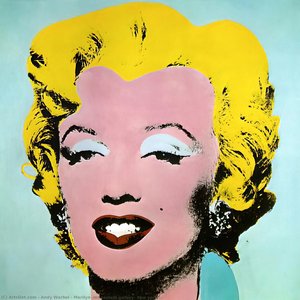
Imagine a world where the boundary between high art and mass media dissolves into a single, vibrant image. In 1964, Marilyn, leo castelli gallery, new york by Andy Warhol emerged as a definitive pillar of the Pop Art movement, capturing the electric pulse of an era obsessed with fame. Through the mechanical precision of silkscreen printing, Warhol strips away the human persona to reveal a graphic icon. The palette is strikingly bold: vivid yellow hair and deep red lips contrast against a soft, blue-gradient background, while stark black outlines create a sense of both immense glamour and haunting detachment. This masterpiece stands as a testament to the commodification of celebrity culture, transforming a tragic loss into a permanent cultural symbol. Even decades later, this work remains a powerful force, capable of transforming any contemporary space with its unmistakable energy and historical depth.
Still life no. 20 - Tom Wesselmann
 Still life no. 20 - Tom Wesselmann
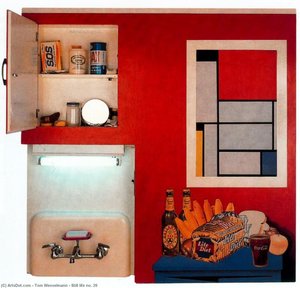
To acquire Still Life no. 20 by Tom Wesselmann is to invest in a profound legacy of mid-century taste and the enduring spirit of American consumerism. As a cornerstone of the Pop Art movement, this 1962 masterpiece captures the vibrant, often chaotic pulse of post-war domesticity. Wesselmann masterfully elevates mundane objects—from Coca-Cola bottles to everyday toiletries—into high art through a striking use of primary colors and sharp, graphic geometry. The composition’s bold red background and flattened perspective serve as a definitive rejection of Abstract Expressionism, establishing a new visual language that continues to influence the global art market. Its position among the most influential masterpieces is cemented by its ability to turn mass-produced imagery into a subject of serious aesthetic scrutiny.
For the modern connoisseur, integrating this work into a luxury interior offers unparalleled cultural authority; a high-quality, hand-painted reproduction carries this same commanding presence, infusing contemporary spaces with iconic, sophisticated energy.
Pool 2 figures - David Hockney
 Pool 2 figures - David Hockney
To encounter Pool 2 figures by David Hockney is to witness a masterclass in suspended emotion, a rare moment where the vibrant pulse of Pop Art meets profound psychological depth. As one of the definitive works of its era, it commands attention through its striking use of color and narrative ambiguity. The composition centers on a figure in a brilliant red jacket at the pool's edge, their gaze fixed upon a submerged presence beneath the cool, crystalline blues. This interplay of saturated hues—the lush greens of the landscape against the stark, geometric lines of the water—captures the movement's signature blend of high art and contemporary leisure.
Beyond its historical significance, the painting offers a sense of quiet prestige; its ability to evoke both serenity and a haunting solitude makes it an unparalleled centerpiece for a refined, modern collection, bringing a legacy of twentieth-century innovation into the heart of the contemporary home.
A bigger splash - David Hockney
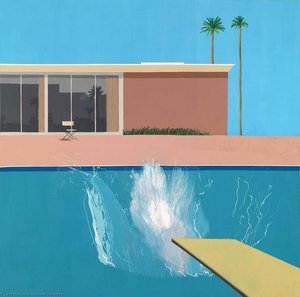 A bigger splash - David Hockney
The brilliant, sun-drenched cobalt blue of the sky and pool in David Hockney’s A Bigger Splash immediately evokes a sense of crystalline clarity and mid-century optimism. This vibrant shade sets a mood of serene, sun-soaked leisure, characteristic of the California dream. Hockney’s innovative use of a high-contrast palette—pairing the striking pink of modernist architecture with deep ultramarine and crisp whites—is precisely why this work is recognized among the Top 10 Masterpieces That Defined the 'Pop Art' Art Movement . The painting achieves a perfect tension between geometric stability and the sudden, organic energy of the water’s impact. For the discerning collector, integrating such a piece into a modern living space or dining room can transform the atmosphere; its cool turquoise tones and bright, flat planes of color serve as an exquisite tool for curating a light-drenched, sophisticated aesthetic that brings the effortless luxury of 1960s Los Angeles into the contemporary home.
Conclusion
As we conclude our exploration of these vibrant icons, we realize that Pop Art is far more than a colorful rebellion against tradition; it is a profound mirror held up to the heartbeat of modern life. These masterpieces are not merely historic treasures locked in the amber of the twentieth century, but living presences that continue to move hearts, shape the aesthetics of our contemporary interiors, and ignite the fires of new creativity. To stand before such works is to participate in a timeless conversation, where every saturated pigment and deliberate line serves as a bridge between the artist’s vision and our own enduring human experience. As the lights dim on this gallery tour, let us remember that art remains a vital, breathing connection across the ages, inviting us to find beauty in the everyday and permanence in the ephemeral. We invite you to further immerse yourself in this legacy by exploring our full collection .