A Symphony of Organic Grace: The Rebirth of Beauty in an Industrial Age
 The Elegance of Art Nouveau: Embracing Nature's Fluid Beauty and the Belle Époque Spirit
The Genesis of a New Aesthetic: A Rebellion Against Industrial Rigidity The Flowing Line & Flourishing Form: Exploring Art Nouveau's Aesthetic Legacy The Genesis of a New Aesthetic: Art Nouveau's Rejection of Tradition The late 19th century was a per...
To understand the soul of Art Nouveau, one must first listen to the quiet discontent that echoed through the late nineteenth century. It was a period of profound upheaval, where the relentless march of the industrial age began to cast long, soot-stained shadows over the European landscape. As factories rose and mass production threatened to strip the world of its unique character, a group of visionary artists felt a deep, spiritual yearning for authenticity. They looked upon the rigid, stifling structures of Victorian society and the repetitive academicism of the era's art with a sense of profound exhaustion.
This was not merely a desire for a new style, but a philosophical rebellion—a search for a visual language that could reconnect the human spirit with the rhythms of the living world. This movement, often referred to as New Art, sought to break free from the heavy chains of historical imitation. For decades, artists had been bound by Neoclassmic and Gothic Revival traditions, constantly looking backward to find inspiration in the ruins of the past. Art Nouveau, however, turned its gaze toward the present and the eternal cycles of nature, offering a sanctuary of beauty amidst the mechanical roar of progress.
Nature’s Sinuous Language: Exploring the Whiplash Line and Floral Motifs
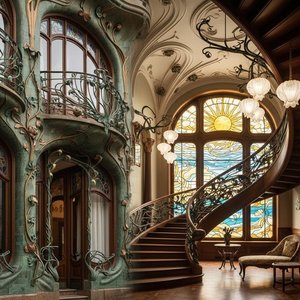 Art Nouveau: The Elegant Fusion of Nature and Design – A Journey Through Organic Sophistication
The Essence of Art Nouveau: A Symphony of Organic Lines and Natural Forms To step into the world of Art Nouveau is to enter a realm where the rigid boundaries between the man-made and the natural dissolve into a singular, flowing grace. Emerging at t...
To step into the world of Art Nouveau is to enter a realm where the rigid boundaries between the man-made and the natural dissolve into a singular, flowing grace. The movement's essence lies in its rejection of the straight line, which was viewed as sterile and mechanical. Instead, practitioners embraced the whiplash curve—a dynamic, energetic line that mimics the sudden, graceful movement of a stem caught in a breeze. This pursuit of organic unity sought to infuse everyday objects with the same spiritual depth found in high art.
Every stroke and silhouette whispered of the vitality found in vines, lilies, and dragonflies. The aesthetic was a symphony of organic lines, where asymmetry and fluid movement reigned supreme. Through this lens, a simple lamp or a chair was no longer just furniture; it became a sculptural extension of nature itself, breathing life into the domestic sphere through intricate, sinuous ornamentation. This fascination with the unruly aspects of the natural world allowed artists to create a sense of movement that felt both ancient and revolutionary, capturing the very breath of the living earth.
The Belle Époque Visionaries: Capturing Romance through Mucha and Kirchner
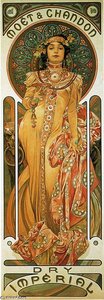
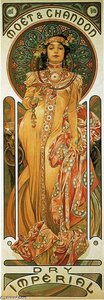 Moet ^ Chandon dry Imperial
Moët & Chandon Dry Imperial: A Belle Époque Vision The advertisement poster for Moët & Chandon’s “Dry Imperial” champagne is more than just a marketing piece; it's a meticulously crafted artifact of the Belle Époque, a testament to Alphonse Mucha’s m...
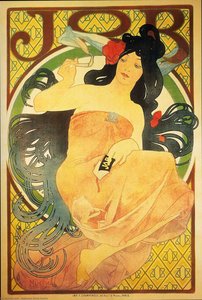
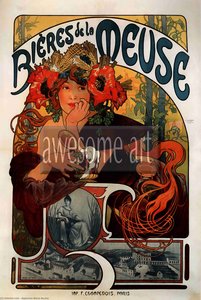
In the golden light of the Belle Époque, certain names emerged as icons of this romantic era. Perhaps none is more synonymous with Art Nouveau than Alphonse Mucha. His work, such as the exquisite advertisement poster for Moët & Chandon’s “Dry Imperial,” is much more than a marketing piece; it is a meticulously crafted artifact of refined luxury. In his hands, the woman becomes an idealized beauty, her dark hair adorned with delicate flowers, embodying grace and mystery. The deliberate curves of her attire echo the sinuous shapes of vines, creating a visual richness that captures the opulent spirit of Paris at the turn of the century.
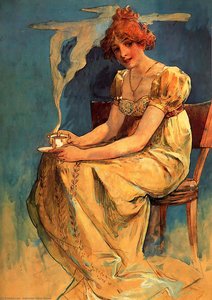
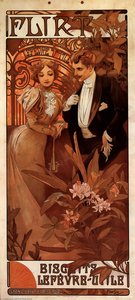
Alongside him, we find the poetic vision of Raphael Kirchner. Moving from his roots in Vienna to the flourishing creative scene of Paris, Kirchner brought a unique lithographic charm to the movement. His works, such as Modern Girls and Love Flowers, utilize pastel hues and floral motifs to evoke a sense of Belle Époque romance. These artists did not merely decorate; they captured a way of life—a world of romantic ideals and exquisite craftsmanship that continues to resonate with collectors and dreamers today.
Architectural Poetry: The Flowing Elegance of Brussels and Paris
 Art Nouveau in Brussels
The Art Nouveau movement of architecture and design first appeared in Brussels, Belgium, in the early 1890s, in the architecture and interior design of houses designed by Paul Hankar, Henry van de Velde, and especially Victor Horta, whose Hôtel Tasse...
The grandeur of Art Nouveau is perhaps most palpable in the stone and mortar of Europe’s historic urban centers. The movement first found its architectural voice in Brussels during the early 1890s. Architects like Victor Horta, through masterpieces such as the Hôtel Tassel, revolutionized design by using innovative materials like iron and glass to open interior spaces to maximum light. These structures were not mere buildings but living organisms, where curving lines and organic forms integrated seamlessly into the architecture.
In Paris, the movement reached its zenith at the 1900 International Exposition. The legendary designer Hector Guimard transformed the city's very identity with his iconic Art Nouveau metro stations. Characterized by a flamboyant use of vegetal designs and the signature whiplash line, these structures turned the urban landscape into an open-air gallery. From the ornate facades in Riga to the breathtaking glasswork found in Spain's Casa Lis, the movement transformed streetscapes into poetic expressions of light and form, proving that even the most functional structures could be vessels for profound beauty.
Bringing the Belle Époque Home: Preserving the Legacy of Art Nouveau
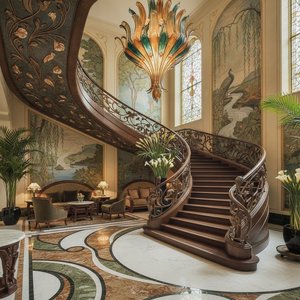 Art Nouveau Guide: Integrating Elegant Curves and Organic Design into Luxury Hotel Interiors
The Art Nouveau Aesthetic: Defining Organic Sophistication for Hospitality Design Art Nouveau: The Elegant Fusion of Nature and Design – A Journey Through Organic Sophistication The Essence of Art Nouveau: A Symphony of Organic Lines and Natural Form...
As we look back upon this era of unparalleled elegance, we find its legacy living on in the decorative arts that surround us. The movement's influence persists in the delicate glasswork, the intricate furniture, and the timeless allure of botanical motifs that continue to grace our most cherished spaces. To preserve Art Nouveau is to honor the belief that beauty should be pervasive, wrapping the human experience in a cocoon of elegance.
For the true lover of art, the charm of this era lies in its ability to bridge the gap between the classical past and the modern future. Whether through the study of a master's lithograph or the appreciation of a beautifully crafted piece of glassware, we can all find ways to invite that sense of organic sophistication into our lives. The beauty of Art Nouveau remains an eternal study in how light, color, and form can be harnessed to elevate the everyday into something truly ethereal.
- The Essence: A rebellion against industrial rigidity through organic grace.
- Key Motifs: The whiplash line, lilies, vines, and asymmetrical floral patterns.
- Master Artists: Alphonse Mucha, Raphael Kirchner, and Jules Chéret.
- Architectural Icons: Victor Horta's Brussels designs and Guimard's Paris Metro.