The Rebellion Against Idealism: The Emergence of a New Vision
 Realism (art movement)
Realism was an artistic movement that emerged in France in the 1840s. Realists rejected Romanticism, which had dominated French literature and art since the early 19th century. The artist Gustave Courbet, the original proponent of Realism, sought to ...
To understand the profound shift that occurred at the dawn of the twentieth century, one must first recall the gilded atmosphere that preceded it. For decades, the American artistic landscape was draped in the soft, romanticized veils of the Hudson River School and the refined, aristocratic elegance of society portraits. There was a certain comfort in those idealized landscapes—a sense of a nation looking backward toward a pristine, untouched wilderness or upward toward an untouchable European tradition. However, as the gears of industrialization began to turn with relentless momentum, this polished veneer started to feel increasingly disconnected from the lived experience of a rapidly changing people.
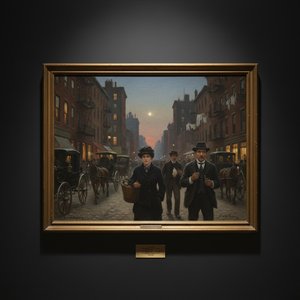
The emergence of American Realism was not merely a change in brushstroke, but a quiet, profound insurgency. It was a movement born from a desire to strip away the artifice and confront the world as it truly appeared. Much like the French Realists of the 1840s, led by the uncompromising Gustave Courbet, American artists began to reject the exoticism and exaggerated emotionalism of Romanticism. They sought a truth that was often unvarnished, sometimes even uncomfortable, finding beauty not in the mythological or the grand, but in the contemporary and the tangible. This was an era of seismic social shifts—unprecedented immigration, urban expansion, and class tensions—and the artists felt a burgeoning responsibility to bear witness to these transformations with unflinching honesty.
The Ashcan School: Capturing the Pulse of the Urban Streets
 Ashcan School
The Ashcan School, also called the Ash Can School, was an artistic movement in the United States during the late 19th-early 20th century that produced works portraying scenes of daily life in New York, often in the city's poorer neighborhoods. The mo...
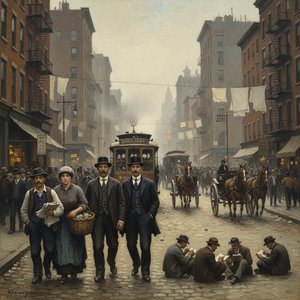
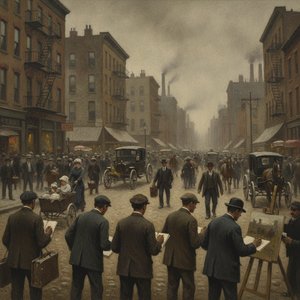
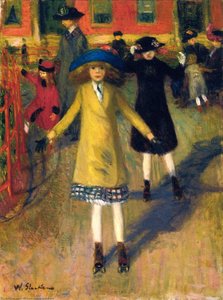
As the twentieth century unfolded, this spirit of rebellion found its most vibrant expression in the bustling, crowded tenements and sun-drenched sidewalks of New York City. A group of artists, later famously dubbed the Ashcan School, turned their gaze away from the manicured estates of the elite and toward the gritty, energetic heart of the metropolis. They were drawn to the very places others might have overlooked: the crowded street corners, the smoky taverns, and the lively immigrant neighborhoods where the true pulse of the city resided.
The name itself suggests a fascination with the discarded and the everyday—the remnants of urban life found in the gutters. These painters did not seek to sanitize the city; instead, they embraced its raw vitality. Their canvases were filled with the movement of crowds, the play of light on cobblestones, and the unpretentious drama of daily existence. By focusing on these "low" subjects, they achieved a remarkable democratization of art, proving that the mundane activities of ordinary people possessed a dignity and a narrative depth equal to any historical epic. Their work served as a visual record of an era defined by movement, much like the rhythmic, fast-paced energy of the new century itself.
Mastering the Everyday: The Intimate Portraits and Street Scenes of Glackens and Henri
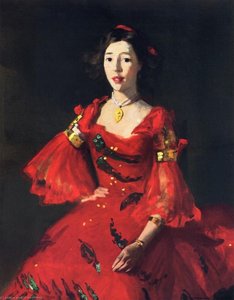 La Madrelenita
La Madrelenita: A Glimpse into Early 20th Century American Realism Robert Henri's "La Madrelenita," created in 1910, stands as a compelling example of American realism and a testament to Henri’s dedication to portraying everyday life with honesty and...
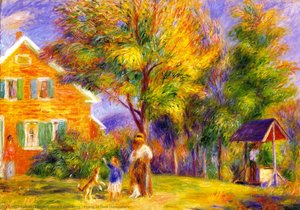
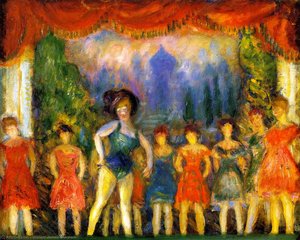
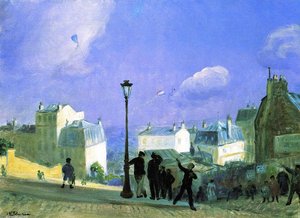
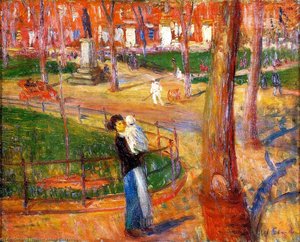
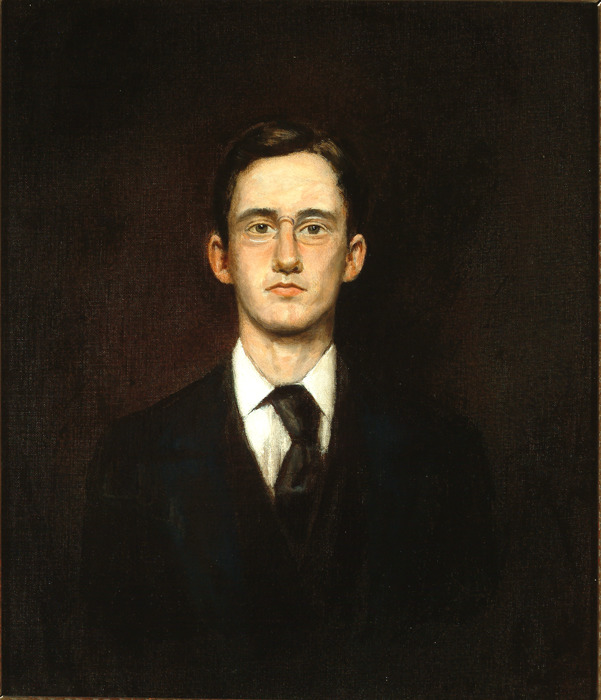
Within this movement, certain masters emerged whose ability to capture the human essence remains unparalleled. William James Glackens, a cornerstone of the Ashcan School, possessed a unique gift for blending the gritty reality of urban life with a luminous, almost Impressionistic sensibility. In works such as Italo-American Celebration, Washington Square, one does not merely see a parade; one feels the optimism and civic pride of a community. Glackens utilized a masterful wet-on-wet technique, allowing layers of paint to blend seamlessly, creating surfaces that seem to breathe with light and atmosphere. His ability to capture both the monumental scale of a city event and the intimate character of an individual—as seen in his evocative portrait of Ernest Lawson—demonstrates a profound technical and emotional range.
Alongside him, Robert Henri acted as the guiding spirit, a mentor whose dedication to honesty and vitality shaped a generation. Henri’s approach was deeply personal; he sought to find the soul within the subject. In his portrait La Madrelenita, we encounter a young woman whose gaze holds a complex duality of confidence and melancholy. Through bold brushstrokes and a vibrant palette, Henri does not just depict a face; he invites us into an intimate encounter with a living, breathing person. These artists did not merely replicate what the eye saw; they translated the textures, sounds, and feelings of the city onto canvas, ensuring that the fleeting moments of urban life were preserved with lasting significance.
Beyond the Surface: Social Commentary and the Democratization of Art
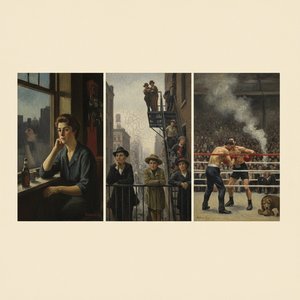 American Realism: Social Commentary & Artistic Representation in Early 20th-Century Painting
The Rise of Realism: Challenging Academic Conventions Wikipedia: American realism American realism was a movement in art, music and literature that depicted contemporary social realities and the lives and everyday activities of ordinary people. The m...
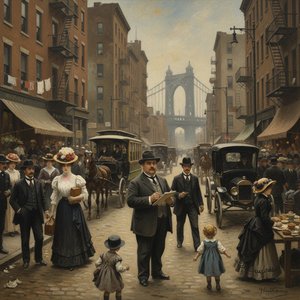
While the aesthetic beauty of these works is undeniable, the true depth of American Realism lies in its role as a form of social commentary. The movement was deeply intertwined with the socio-political realities of its time. By choosing to depict the working class, the immigrant, and the urban poor, artists like John Sloan and George Luks were making a profound statement about whose stories deserved to be told. Their art was an act of recognition, giving visibility to those who were often marginalized by the formal boundaries of traditional artistic beauty.
This era of painting reflected the exhaustion and the cultural exuberance of a nation in flux. The works functioned as a mirror to the struggles and triumphs of the common person, documenting the impact of industrialization and the shifting social hierarchies. There was a deliberate turning away from the refined tastes of the upper classes toward a more inclusive, democratic vision of American identity. In doing so, they challenged the conservative dictates of institutions like the National Academy of Design, paving the way for a more modern, urban-centric approach to art that would influence generations of creators to come.
The Enduring Legacy: How American Realism Redefined the National Identity
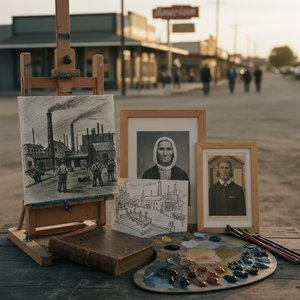 American Realism: Capturing the Raw Soul of a Nation Through the Lens of Art History
The Essence of American Realism: Beyond the Surface of Tradition To understand the heartbeat of a nation, one must look past the polished veneers of romanticized landscapes and into the unvarnished truth of its people. American Realism emerged not me...
The legacy of American Realism extends far beyond the era of its peak influence. It fundamentally altered the trajectory of American art by establishing a new vocabulary for authenticity. By finding profound meaning in the ordinary, these artists taught us that the soul of a nation is not found in its monuments or its myths, but in the everyday interactions of its people. They bridged the gap between the high art of the academy and the lived reality of the streets, creating a legacy that celebrates the beauty of the unvarnished truth.
Today, when we look upon these masterpieces, we see more than just historical artifacts; we see a timeless exploration of human connection and resilience. The movement’s ability to capture the ephemeral—the clinking of glass in a soda fountain, the soft murmur of a crowd, or the steady gaze of a stranger—continues to resonate with anyone who finds wonder in the world around them. American Realism remains a testament to the power of observation and the enduring strength of the human spirit, reminding us that even in the most common moments, there exists a profound and lasting beauty.
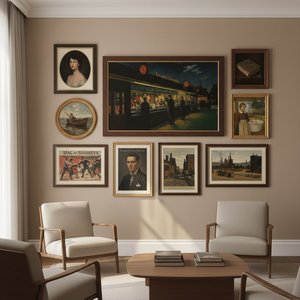
At ArtsDot.com, we share this lifelong passion for the masters who captured life's most authentic moments. Whether you are drawn to the vibrant urban energy of the Ashcan School or the light-drenched beauty of the Impressionists, our mission is to bring these extraordinary visions into your home. We specialize in hand-painted oil reproductions, where our master artists use traditional techniques to recreate the texture, depth, and soul of these historic works on 100% cotton canvas. From custom portraits that transform your personal memories into masterpieces to large-scale murals that redefine your space, we invite you to explore a world of curated excellence. Discover the artistry you have loved for a lifetime at ArtsDot.com.