Introduction
To step into the world of Édouard Manet is to walk through the bustling, sun-drenched streets of nineteenth-century Paris at the very moment the old world began to dissolve into the new. He was not merely a painter; he was a provocateur, a visual journalist of the Belle Époque, and the rebellious heartbeat of a movement that would forever alter the trajectory of Western art. While others sought refuge in the idealized myths of antiquity, Manet turned his gaze toward the café tables, the opera boxes, and the quiet, unvarnished corners of modern life, capturing the fleeting essence of a city in transition.
Manet’s genius lay in his ability to bridge the gap between the timeless techniques of the Old Masters—the dramatic chiaroscuro of Caravaggio and the profound presence of Velázquez—and the raw, unfiltered energy of contemporary existence. He understood that there was as much divinity to be found in a casual glance across a park bench as there was in a religious icon. Through his bold brushstrokes and daring compositions, he challenged the rigid hierarchies of the French Academy, often inviting scandal by presenting figures that looked back at the viewer with an unsettling, modern directness.
Today, these works remain profoundly meaningful because they mirror our own experience of modernity: the beauty found in the ephemeral, the tension between public persona and private reality, and the courage required to break from tradition. His canvases do not just depict scenes; they capture a mood—a certain flâneur spirit that wanders through the light and shadow of urban life. As we prepare to journey through this curated selection of his top 25 artworks , we invite you to look beyond the pigment and the canvas. We invite you to witness the birth of the modern eye, one masterful stroke at a time.
Olympia - Édouard Manet
 Olympia - Édouard Manet
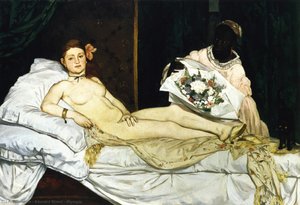
To stand before Olympia is to experience a sudden, breathless confrontation. There is an unmistakable tension in the air, a sense of being caught in a private, provocative moment that refuses to look away. Manet does not offer the soft, mythological escapism of the Old Masters; instead, he presents a stark, modern reality that vibrates with audacity.
As one of the top 25 artworks of Édouard Manet , this 1863 masterpiece earns its place through sheer revolutionary force. By replacing an idealized goddess with a contemporary woman—a courtesan whose direct, unapologetic gaze meets yours with unsettling honesty—Manet shattered the boundaries of the Paris Salon. The interplay of light across her skin, the symbolic presence of the black cat, and the vibrant bouquet delivered by her attendant all serve to dismantle academic pretension. It is a work that captures the very birth of modernism.
Integrating such a powerful piece into a contemporary collection allows a space to transcend mere decoration, inviting a dialogue on strength and authenticity. Whether through a hand-painted oil reproduction or a fine print, Olympia brings an intellectual depth and a commanding presence to any curated interior.
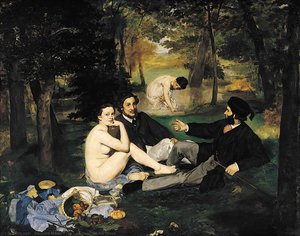
The Luncheon on the Grass - Édouard Manet
 The Luncheon on the Grass - Édouard Manet
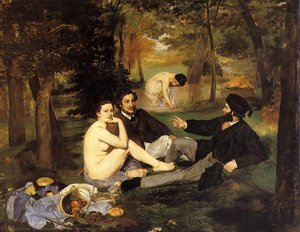
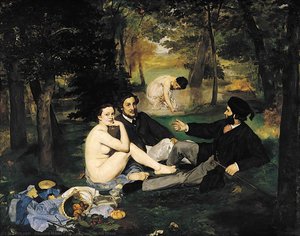
To step before The Luncheon on the Grass by Édouard Manet is to witness the precise moment the foundations of classical art began to fracture. In 1863, this work did not merely depict a woodland picnic; it staged a revolution. By stripping away the mythological pretenses of the Old Masters and replacing them with the unapologetic, sun-dappled reality of modern Paris, Manet forced the viewer into an uncomfortable, intimate confrontation.
The canvas vibrates with a radical energy, characterized by bold, flattened perspectives and a striking use of light that anticipates the Impressionist movement. One can almost feel the texture of the loose, expressive brushwork—the way the dappled shadows dance across the skin of the reclining figure and the heavy, dark contrasts of the forest foliage. It is a masterpiece of tension, where the direct gaze of the subjects breaks the fourth wall, challenging societal norms with every stroke. As one of the most significant entries in our collection of the top 25 artworks of Édouard Manet, this painting remains a profound testament to artistic courage, possessing a timeless vitality that continues to transform any space it inhabits.
A Bar at the Folies-Bergere - Édouard Manet
 A Bar at the Folies-Bergere - Édouard Manet
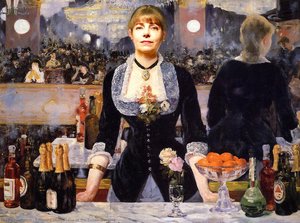
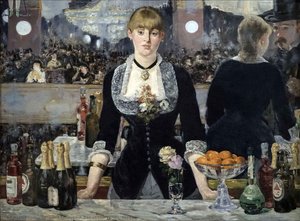
In A Bar at the Folies-Bergère , Édouard Manet achieves a breathtaking structural tension that secures its place among the top 25 artworks of Édouard Manet . The composition is anchored by the verticality of the barmaid, whose stoic presence provides a grounding axis against the dizzying, fragmented reflections in the mirror behind her. Manet masterfully balances the heavy, tactile forms of bottles and fruit on the marble counter with the ethereal, blurred movement of the Parisian crowd in the background. This interplay of solid shapes and atmospheric light creates a profound sense of equilibrium.
There is a striking parallel to be found between this late masterpiece and modern minimalist design ; the way Manet uses flattened perspective and deliberate focal points mirrors the clean, intentional aesthetics sought by contemporary interior designers. The painting does not merely depict a scene; it organizes chaos into a sophisticated visual rhythm. For the discerning collector, this work offers more than historical intrigue—it provides a timeless geometric harmony that effortlessly grounds a contemporary, high-end space with its soulful, avant-garde elegance.
The Railway - Édouard Manet
 The Railway - Édouard Manet
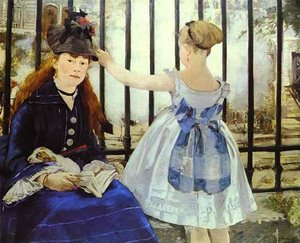
Imagine standing on a bustling Parisian platform, the air thick with the scent of coal smoke and the rhythmic pulse of industrial progress. In The Railway , Édouard Manet captures this fleeting, melancholic intersection of human intimacy and urban expansion. The scene unfolds behind a wrought-iron veil, where the pensive Victorine Meurent sits in quiet contemplation, her presence anchored by a sleeping puppy, while a young girl gazes toward the passing steam of the Gare Saint-Lazare.
This masterpiece earns its place among the top 25 artworks of Édouard Manet through its profound ability to bridge the gap between Realism and Impressionism. Through a palette of evocative blues, purples, and hazy light, Manet transforms a mundane moment into a dreamlike meditation on modernity. For the discerning collector, bringing such a piece into a home offers more than mere decoration; it introduces a sense of historical depth and atmospheric serenity, inviting a timeless reflection on the beauty found within the transient movements of modern life.
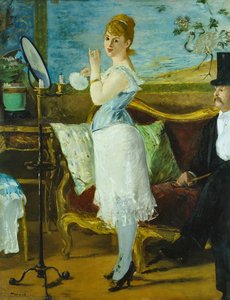
Nana - Édouard Manet
 Nana - Édouard Manet
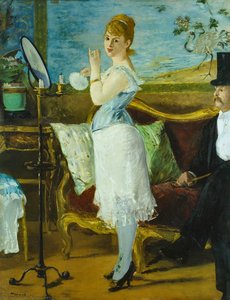
In Nana , Édouard Manet captures a profound moment of vanity and observation that continues to haunt the halls of modern art. As one of the top 25 artworks of Édouard Manet , this 1877 masterpiece serves as a psychological study of identity and the gaze. The scene, set within the intimate confines of a boudoir, presents a woman lost in her own reflection, while a man watches from the periphery, creating a tension between private introspection and public performance.
Manet’s brushwork here is nothing short of masterful, utilizing a vibrant yet muted palette where light spills from a distant window to illuminate the delicate textures of lace and silk. The interplay of soft, impressionistic strokes and deep, dramatic shadows evokes a sense of fleeting elegance. In today's era of curated aesthetics, Nana remains a powerful cultural touchstone; it speaks to our contemporary fascination with the duality of the self and the art of presentation, making it an essential piece for any sophisticated collection seeking to bridge the gap between historical realism and modern psychological depth.
Rue Mosnier with Flags, J. Paul Getty Museum, Ma - Édouard Manet
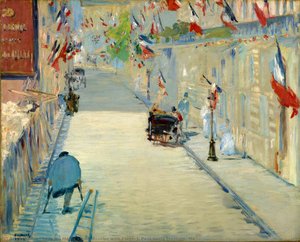 Rue Mosnier with Flags, J. Paul Getty Museum, Ma - Édouard Manet
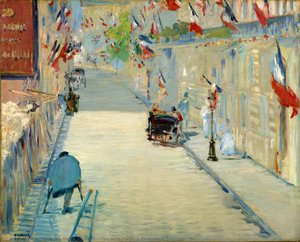
To gaze upon Rue Mosnier with Flags is to step directly into the rhythmic pulse of a celebrating Paris. Édouard Manet captures more than just a street scene; he preserves the ephemeral magic of a moment where national pride and urban vitality converge. The composition draws the eye down a receding perspective, where the soft, diffused light dances across festive banners and the movement of a bustling crowd, creating a sense of shared joy that feels remarkably intimate even a century later.
This masterpiece earns its place among the top 25 artworks of Édouard Manet through its masterful transition from Realism to Impressionism. The loose, expressive brushwork and vibrant interplay of cool blues and warm accents evoke a shimmering, dreamlike atmosphere that remains profoundly influential. At ArtsDot.com, we honor this legacy through our hand-painted oil reproductions . Our skilled artists meticulously recreate Manet’s signature texture and visible brushstrokes on fine cotton canvas, allowing you to invite the sophisticated energy of 19th-century Parisian life into your own curated space with authentic, museum-quality elegance.
Music in the Tuileries Garden - Édouard Manet
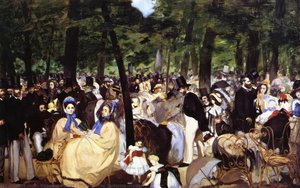 Music in the Tuileries Garden - Édouard Manet
To step into the canvas of Music in the Tuileries Garden by Édouard Manet is to be swept into the rhythmic pulse of a mid-19th-century Parisian afternoon. Before the era of modern distractions, the gardens served as the city's living room, and here, Manet captures that fleeting, sun-dappled magic with unparalleled vitality. This masterpiece earns its place among the top 25 artworks of Édouard Manet through its revolutionary departure from static tradition.
Manet eschews a singular focal point, instead guiding our eyes through a dense, lively tapestry of social interaction. We see the shimmer of silk, the structured elegance of top hats, and the soft, broken brushstrokes that suggest light filtering through leafy canopies. His palette—a sophisticated dance of earthy greens and deep browns punctuated by sudden, brilliant accents of red and white—creates a sense of movement and atmosphere. It is more than a landscape; it is an intimate portrait of a society in motion. Today, this work continues to transform interiors, offering a window into a world of grace, community, and the eternal beauty of a shared moment.
Spring (Study of Jeanne Demarsy) - Édouard Manet
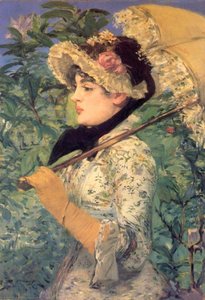 Spring (Study of Jeanne Demarsy) - Édouard Manet
In Spring (Study of Jeanne Demarsy) by Édouard Manet, a delicate infusion of soft pastel blues and luminous whites establishes an atmosphere of profound serenity and quiet prestige. This masterpiece, created in 1882, captures the artist at the height of his transition from Realism to Impressionism, utilizing a palette that feels as light and ephemeral as a spring breeze. The mastery of Manet’s color application—where dappled sunlight meets organic, earthy tones—is precisely why this work earns its place among the top 25 artworks of Édouard Manet .
For the discerning interior designer or collector, this painting offers unparalleled versatility in curation. The gentle, diffused lighting and the tranquil interplay of floral pinks and sun-drenched yellows can serve as the emotional anchor for a sophisticated dining room or a bright, airy living space. By integrating such a piece, one introduces a sense of wistful contemplation and timeless elegance, allowing the soft textures of the brushwork to harmonize with modern, light-filled architectural aesthetics.
Boating, Metropolitan Museum of Art, New York - Édouard Manet
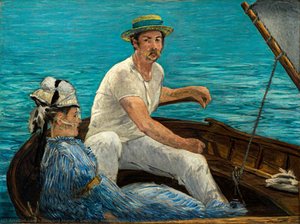 Boating, Metropolitan Museum of Art, New York - Édouard Manet
In Boating by Édouard Manet, a profound sense of serenity is anchored by the cool, luminous blues and verdant greens that mirror the tranquil waters of the Seine. This masterful palette does more than depict a summer afternoon; it captures the very essence of light and atmosphere, earning its prestigious place among the top 25 artworks of Édouard Manet . The way these aquatic tones interact with the warm, sun-drenched skin of the figures creates a rhythmic harmony that is both visually captivating and emotionally soothing.
For the discerning collector or interior designer, this masterpiece offers unparalleled inspiration for curating sophisticated modern spaces. The painting’s balanced composition and soft, natural lighting can serve as a cornerstone for a dining room or lounge, establishing an atmosphere of quiet luxury and leisure. By integrating these Impressionist hues into a room's color story, one can evoke the same sense of peaceful companionship and timeless elegance found within this iconic work at the Metropolitan Museum of Art.
Isabelle Lemonier, Woman with golden hairpin - Édouard Manet
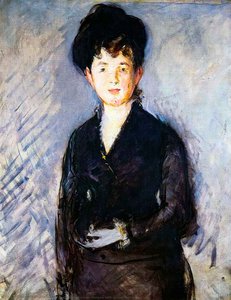 Isabelle Lemonier, Woman with golden hairpin - Édouard Manet
In Isabelle Lemonier, Woman with golden hairpin , Édouard Manet invites us into a sanctuary of quiet elegance and profound introspection. Painted in 1879, this impressionistic masterpiece transcends mere portraiture; it is an invitation to stillness. The subject emerges from a somber, muted palette, her presence defined by fluid, organic brushstrokes that capture the very essence of light and atmosphere. Manet’s masterful use of soft, diffused lighting illuminates her face and hands, creating a luminous connection between the viewer and this moment of serene contemplation.
The composition is a study in sophisticated restraint. While her dark, formal attire suggests a sense of tradition and social refinement, the subtle, melancholic expression in her eyes hints at a deeper, more private narrative. The delicate golden hairpin serves as a singular, brilliant focal point amidst the textured, layered oils. To possess a reproduction of this work is to do more than decorate a wall; it is to transform your space into a gallery of the soul , surrounding yourself with the enduring genius of a man who redefined modern art.
The Execution of the Emperor Maximilian of Mexico - Édouard Manet
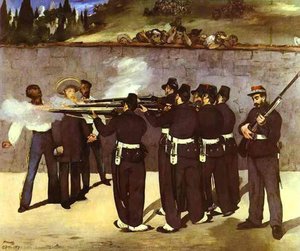 The Execution of the Emperor Maximilian of Mexico - Édouard Manet
In The Execution of the Emperor Maximilian of Mexico , Édouard Manet transcends mere historical documentation to confront the viewer with the raw, unsettling weight of political tragedy. This profound work stands as a cornerstone among the top 25 artworks of Édouard Manet because it captures the precise moment where imperial ambition meets its violent end. The composition is strikingly stark; Manet utilizes a flattened perspective and a somber, muted palette of browns, blues, and grays to strip away any romanticism, leaving only the grim reality of the firing squad.
The visual language—characterized by disciplined, geometric uniforms contrasted against a turbulent, dark sky—creates a tension that remains hauntingly relevant in today's era of global political upheaval. As you observe the heavy brushwork and the dramatic, top-down lighting that carves shadows into the soldiers' faces, you feel the inexorable march of history. For the discerning collector, this piece is more than a masterpiece of Realism; it is a powerful meditation on justice and sacrifice, making it an intellectually stimulating focal point for any curated collection.
Copy after Delacroix's "Bark of Dante" - Édouard Manet
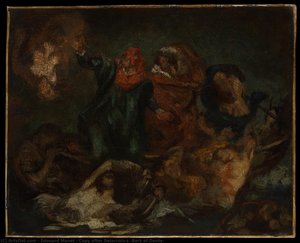 Copy after Delacroix's "Bark of Dante" - Édouard Manet
What story does the turbulent, shadow-drenched atmosphere of Copy after Delacroix's "Bark of Dante" by Édouard Manet tell? This 1859 work is far more than a mere replication; it is a profound dialogue between a young master and his predecessor. By revisiting Eugène Delacroix’s harrowing vision of the River Styx, Manet does not simply mimic the Romantic tradition—he breathes new, agitated life into it. Through thick, expressive impasto and a dramatic interplay of light and deep shadow, he captures the visceral anguish of Dante's lost souls with an almost modern intensity.
As one of the most compelling entries in our collection of the top 25 artworks of Édouard Manet, this piece serves as a bridge between Romanticism and the dawn of Impressionism. For the discerning collector or interior designer, such a painting offers more than decoration; it provides a sophisticated emotional anchor. Its dark, cinematic depth creates a curated escape, inviting a sense of historical gravity and intellectual mystery into a contemporary space, transforming a room into a sanctuary of profound storytelling.
Boy with a Sword - Édouard Manet
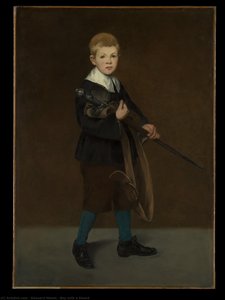 Boy with a Sword - Édouard Manet
What if I told you that Boy with a Sword by Édouard Manet was born from a moment of quiet rebellion—a stroke of defiance against the rigid academicism of his era? In this 1861 masterpiece, we witness the artist bridging the gap between the heavy shadows of the Old Masters and the luminous freedom of Impressionism. Featuring his stepson as the subject, Manet utilizes a restrained palette of muted ochres and deep browns to evoke a sense of dignified solemnity, yet his loose, anticipatory brushwork breathes a modern vitality into the seventeenth-century attire.
Its inclusion in our Top 25 is essential; it represents the precise moment Manet began to transform historical reverence into psychological depth. The boy’s averted gaze and the soft, diffused light create an atmosphere of introspection that transcends mere portraiture. At ArtsDot.com, we believe such profound emotion should not be confined to museum archives. Imagine this evocative study of light and shadow gracing your private study or a refined salon, turning a simple wall into a window onto the birth of modernity. With our hand-painted oil reproductions, you can invite this piece of art history to become a living, breathing statement in your personal sanctuary.
The "Kearsarge" at Boulogne - Édouard Manet
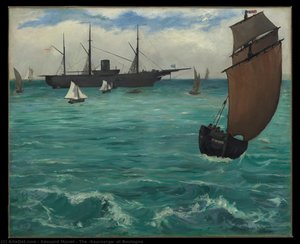 The "Kearsarge" at Boulogne - Édouard Manet
In The "Kearsarge" at Boulogne , Édouard Manet captures more than a mere maritime scene; he preserves the pulse of a world in transition. This masterpiece stands as a profound intersection of historical drama and the dawn of Impressionism, where the salt-sprayed air of the French coast meets the echoes of the American Civil War. As the victorious Union warship anchored in France, it became a symbol of global connectivity and the sudden intrusion of distant conflicts into the European consciousness.
Manet’s visual language is strikingly modern, utilizing loose, expressive brushstrokes and a cool palette of deep blues and sea-foam greens to evoke the restless energy of choppy waters. The painting eschews rigid academic precision for an atmospheric impression , where light is diffused through an overcast sky, creating a sense of ephemeral beauty. For the contemporary collector, this work resonates deeply with modern aesthetics that value movement, texture, and the raw power of nature. It remains a vital piece in the collection of top 25 artworks of Édouard Manet, offering a sophisticated dialogue between historical weight and the spontaneous, fleeting light of the sea.
Portrait of Victorine Meurent - Édouard Manet
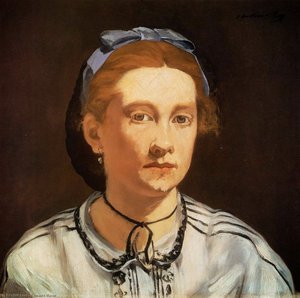 Portrait of Victorine Meurent - Édouard Manet
In the Portrait of Victorine Meurent , Édouard Manet captures a gaze that transcends time, inviting us into a moment of quiet, modern introspection. As part of our curated selection of the top 25 artworks of Édouard Manet, this 1862 masterpiece stands as a profound bridge between the grounded truths of Realism and the luminous innovations of Impressionism. The painting is far more than a mere likeness; it is a psychological study where the subject’s direct, challenging eyes confront the viewer, framed by vibrant red hair and the soft, directional light that defines Manet's revolutionary technique.
What secures its place in the pantheon of art history is its departure from academic polish, favoring visible, energetic brushstrokes and a striking use of tonal contrast. This raw, tactile vitality offers a timeless elegance that resonates deeply within contemporary aesthetics. At ArtsDot.com, we believe in democratizing such profound beauty. Through our meticulous, hand-painted oil reproductions, you can bring the transformative presence and sophisticated soul of Manet’s vision into your own home, office, or private gallery, preserving this piece of cultural heritage for generations to come.
Oysters - Édouard Manet
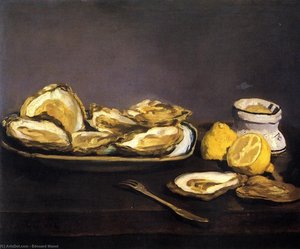 Oysters - Édouard Manet
Owning Oysters by Édouard Manet isn’t merely a purchase; it is an inheritance of the Parisian avant-garde. In this 1862 masterpiece, Manet invites us into a moment of quiet, sensory indulgence, stripping away the grandiosity of academic tradition to find divinity in the mundane. The composition is a masterclass in Realism, where the glistening, pearlescent surfaces of the shells meet the vibrant, acidic brightness of sliced lemons. Through a sophisticated play of light and shadow, Manet captures the tactile freshness of the seafood, making the viewer almost taste the brine and citrus.
This work stands as a vital entry in our collection of the top 25 artworks of Édouard Manet because it embodies his revolutionary spirit—the courage to find profound beauty in a simple plate of food. At ArtsDot, we believe this lineage of taste belongs in your home. Whether you are drawn to the subtle textures of his brushwork or the symbolic abundance of the scene, bringing a hand-painted reproduction of this classic into your space is a nod to the masters and a celebration of life's most exquisite, ordinary moments.
The Waitress (also known as The Beer Serving Girl) - Édouard Manet
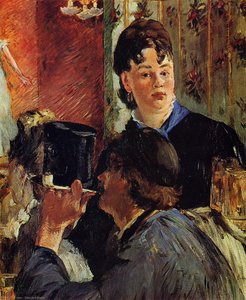 The Waitress (also known as The Beer Serving Girl) - Édouard Manet
There is a profound, quiet intimacy in witnessing a single, unscripted moment of service captured forever on canvas. In The Waitress (also known as The Beer Serving Girl ), Édouard Manet invites us into the rhythmic pulse of a late 19th-century Parisian establishment, where the clink of bottles and the soft rustle of black silk seem almost audible. This 1878 masterpiece earns its place among the top 25 artworks of Édouard Manet through its masterful ability to elevate the mundane into the monumental.
Manet utilizes a sophisticated blend of Realism and Impressionism, using light to sculpt the figures and atmosphere within the room. The composition—centered around a dining table with its dark bottles and seated patrons—possesses an emotional resonance that transcends time, celebrating the dignity of everyday life. At ArtsDot.com, we honor this legacy through our handmade oil reproductions . Our artists meticulously recreate every visible brushstroke and tonal depth found in the original at the Musée du Louvre, allowing you to bring the authentic texture and soulful atmosphere of Manet’s Paris into your own curated collection.
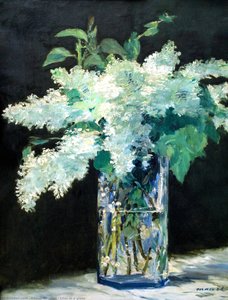
Lilac in a glass - Édouard Manet
 Lilac in a glass - Édouard Manet
In Lilac in a glass by Édouard Manet, we encounter a masterclass in structural harmony and ephemeral beauty. The composition is anchored by the vertical elegance of a cylindrical glass vase, which provides a stable, geometric foundation for the organic, overflowing abundance of the lilac bouquet. This careful balance between the rigid form of the vessel and the soft, rounded clusters of blossoms creates a sense of timeless perfection that has secured its place among the top 25 artworks of Édouard Manet .
Manet utilizes a sophisticated interplay of light and shadow; the dark, muted background pushes the luminous whites and pale lavenders forward, creating a profound sense of depth. There is a striking parallel here to modern minimalist design—the way the painting strips away unnecessary detail to focus on essential forms and a cool, serene palette allows it to ground a clean, contemporary aesthetic in any luxury interior. As you observe the subtle refractions within the glass, you feel the quiet tranquility of a fleeting spring moment captured forever through masterful, impressionistic brushwork.
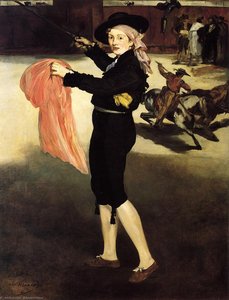
Mlle V...in the Costume of an Espada - Édouard Manet
 Mlle V...in the Costume of an Espada - Édouard Manet
In the quiet presence of Mlle V...in the Costume of an Espada , one feels transported to a theatrical moment frozen in time. Painted by Édouard Manet in 1862, this evocative work captures a striking intersection of Spanish flair and Parisian modernity. The subject stands poised on a stage, her figure draped in the dramatic attire of an espada , clutching a vibrant red cloth that provides a singular, pulse-like splash of color against the more muted, atmospheric background.
Manet masterfully orchestrates a scene of lively movement; behind the central figure, the silhouettes of horses and the bustle of a crowd suggest the kinetic energy of a grand performance. The interplay of light and shadow creates a sense of depth that draws the viewer into this historical spectacle. For the discerning collector or interior designer, introducing such a piece into a contemporary space offers more than mere decoration; it brings a narrative of elegance and cultural intrigue. Whether displayed as a large-scale oil reproduction or a delicate print, this masterpiece serves as a sophisticated focal point, inspiring a sense of timeless drama and refined reflection in any curated environment.
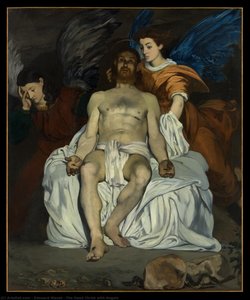
The Dead Christ with Angels - Édouard Manet
 The Dead Christ with Angels - Édouard Manet
To encounter The Dead Christ with Angels is to stand before one of the most profound provocations in the top 25 artworks of Édouard Manet. This 1864 masterpiece does not merely depict a biblical moment; it strips away the gilded illusions of religious iconography to reveal a raw, visceral meditation on mortality. For the discerning collector, this canvas offers an unparalleled study in emotional depth and technical rebellion.
Manet eschews the polished perfection of his contemporaries, instead employing a somber, muted palette of grays, whites, and deep shadows that command the room with a heavy, melancholic stillness. The stark realism of Christ’s cadaverous form, contrasted against the tender, contemplative presence of the surrounding angels, creates a tension that is both unsettling and deeply moving. In a modern, refined interior, such a piece serves as a powerful anchor—a testament to the beauty found in truth and the enduring legacy of Manet’s revolutionary spirit. It is not simply a painting, but an atmospheric experience of light, shadow, and human vulnerability.
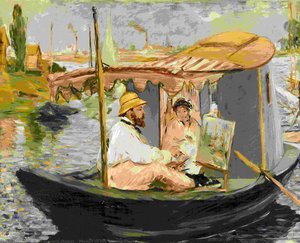
Monet in his Studio Boat - Édouard Manet
 Monet in his Studio Boat - Édouard Manet
To gaze upon Monet in his Studio Boat is to witness a profound artistic dialogue frozen in time. In this 1874 masterpiece, Édouard Manet does not merely paint light; he composes it like a delicate sonata, capturing the very essence of the Impressionist revolution. As you observe Claude Monet immersed in his craft amidst the tranquil waters of Gennevilliers, you can almost feel the gentle sway of the Seine and hear the rhythmic whisper of brush against canvas.
Manet’s technique here is a masterclass in sensory storytelling. He moves away from academic rigidity, utilizing bold, textured brushstrokes that dance across the surface to simulate sunlight shimmering on moving water. The palette—a luminous tapestry of intense blues, brilliant whites, and earthy tones—invents a world of atmosphere rather than mere documentation. For the discerning collector or interior designer, this painting offers more than decoration; it provides a portal of inspiration, bringing a sense of serene vitality and intellectual depth into any sophisticated space.
The Croquet Party (La partie de croquet) - Édouard Manet
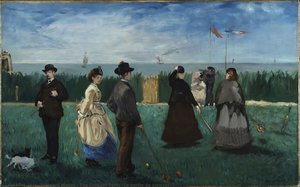 The Croquet Party (La partie de croquet) - Édouard Manet
There is a profound, quiet magic in The Croquet Party (1871), a work that captures the ephemeral essence of a summer afternoon suspended in time. Manet invites us into a sun-drenched moment of Parisian leisure, where the rustle of silk and the soft light of Boulogne-sur-Mer create an atmosphere of elegant intimacy. This masterpiece earns its place among the top 25 artworks of Édouard Manet due to its revolutionary ability to blend social observation with the burgeoning Impressionist technique; through loose, broken brushstrokes and a vibrant interplay of light and shadow, he transforms a simple garden game into a sophisticated study of modern life.
The painting’s enduring allure lies in its tactile vitality—the way the white highlights shimmer on clothing and the subtle tension between figures suggests untold stories. At ArtsDot, we honor this legacy through our hand-painted oil reproductions . Our master artists meticulously recreate Manet’s signature impasto and tonal depth on fine cotton canvas, ensuring that the emotional resonance and luminous textures of this historical treasure can be brought into your own curated collection with absolute authenticity.
Guerre Civile - Édouard Manet
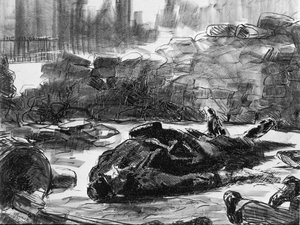 Guerre Civile - Édouard Manet
In Guerre Civile , Édouard Manet masterfully utilizes a stark, monochromatic geometry to navigate the chaos of post-war Paris. The composition is anchored by an asymmetrical arrangement of rugged, imposing rocks that create a heavy visual weight, contrasting sharply with the delicate, gestural lines of the fallen figures. This structural tension—a deliberate imbalance between the solid, dark masses and the ethereal, near-white voids—captures the very essence of societal instability. The use of intense hatching and cross-hatching provides a sculptural depth, transforming a simple lithograph into a profound meditation on vulnerability.
There is an enduring, almost architectural harmony found in this work's starkness; its reliance on tonal contrast rather than color mirrors the principles of modern minimalist design. Much like a contemporary monochrome photograph, the piece uses negative space to ground the viewer, making it a sophisticated choice for a clean, modern aesthetic. As one of the most evocative pieces in our collection of the top 25 artworks of Édouard Manet , Guerre Civile remains a hauntingly beautiful testament to resilience through its disciplined use of light and shadow.
Two roses on a tablecloth - Édouard Manet
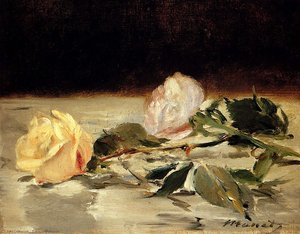 Two roses on a tablecloth - Édouard Manet
In Two roses on a tablecloth , Édouard Manet does not merely depict flowers; he composes a silent sonata of light and fragility. To gaze upon this 1883 masterpiece is to witness the artist’s ability to transform a simple linen surface into a stage for profound emotional resonance. One can almost feel the cool, velvety texture of the pristine white rose and the delicate blush of its budding companion through Manet's masterful, loose brushstrokes.
The light in this work is not just illumination—it is a language . Manet captures the ephemeral dance of shadows across the petals, creating a sense of immediacy that feels as though the moment might vanish if you blink. This piece stands among the top 25 artworks of Édouard Manet because it embodies the very soul of the Impressionist revolution: finding the extraordinary within the ordinary. As the soft light spills from the canvas, it invites you to bring this quiet, poetic intimacy into your own space, turning a mere wall into a portal of timeless inspiration and grace.
George Moore (1852–1933) at the Café - Édouard Manet
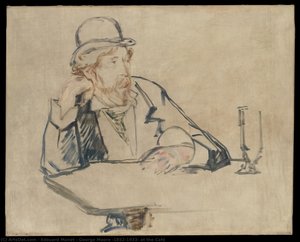 George Moore (1852–1933) at the Café - Édouard Manet
Imagine the soft flicker of candlelight against a dim Parisian evening, the distant murmur of intellectuals, and the quiet weight of profound thought. In George Moore (1852–1933) at the Café , Édouard Manet invites us into this intimate sanctuary of the late 19th century. This masterpiece captures more than just a likeness of the Irish writer; it encapsulates a fleeting moment of contemplative solitude amidst the vibrant energy of the Café de la Nouvelle-Athènes.
Manet utilizes a sophisticated palette of earthy ochres and muted greys, employing loose, impressionistic brushstrokes that prioritize atmosphere over rigid detail. The way Moore’s chin rests thoughtfully upon his hand evokes a sense of melancholy and intellectual depth that remains deeply moving today. As one of the top 25 artworks of Édouard Manet , this piece earns its place through its ability to transform a simple social setting into a timeless study of human introspection. Bringing such a work into a modern interior offers more than mere decoration; it introduces a sense of historical serenity and a sophisticated, quiet strength to your personal sanctuary.
Conclusion
To wander through the oeuvre of Édouard Manet is to walk the streets of a Paris that no longer exists, yet remains vibrantly alive through every bold brushstroke and provocative gaze. These twenty-five masterpieces are far more than mere relics of a bygone era or subjects for academic study; they are breathing, pulsing windows into the human condition. They capture the fleeting glance, the quiet tension of a café encounter, and the revolutionary spirit that dared to find beauty in the unvarnished truth of modern life. Even as decades pass, the emotional resonance of his work remains undiminished, possessing a unique ability to anchor a room with character and stir the soul with its profound intimacy.
At ArtsDot.com , we believe that such profound beauty should not be confined to the hushed halls of a museum, but should instead become a living presence within your own sanctuary. We strive to bridge the gap between historical reverence and contemporary living by ensuring that every masterpiece can be reborn as a meticulous, hand-painted reproduction. Our skilled artists, trained in the rigorous traditions of fine art academies, approach each canvas with a deep sense of responsibility, honoring the original's soul, its textured impasto, and those inimitable light-drenched moments that define Manet’s legacy. Whether you are seeking to anchor a grand architectural space or add a touch of Parisian elegance to a private study, we invite you to explore the full collection and bring the enduring spirit of Manet into your home.