The Architect of the Surrogate: The Visionary World of Allan McCollum
In the vast, often overwhelming landscape of contemporary art, few figures command attention through such quiet, subversive power as Allan McCollum. Born on August 4, 1944, in Los Angeles, McCollum’s artistic journey is not merely a chronicle of creating objects, but an epic exploration of how we assign value to the world around us. His work exists at the profound intersection of the unique and the mass-produced, challenging the very boundaries between the sacred aura of a masterpiece and the democratic anonymity of a commodity. To encounter a McCollum installation is to enter a space where the distinction between a singular moment of genius and a repetitive industrial gesture begins to dissolve, forcing the viewer to reconsider their own role as both a consumer and a witness to culture.
McCollum’s intellectual foundations were laid in the vibrant, multidisciplinary atmosphere of Yale University, where he earned his Bachelor of Fine Arts. This period of rigorous academic inquiry served as a crucible for his later conceptual breakthroughs. Before settling into the medium that would define his legacy, he experimented with the tactile languages of ceramics and printmaking. However, it was his eventual mastery of plaster—a material that is both fragile and deceptively permanent—that allowed him to execute his most daring psychological experiments. By utilizing plaster to create surrogates, McCollum found a way to mimic the presence of art without its traditional prestige, creating a bridge between the high-culture museum and the everyday lived experience.
The Alchemy of Repetition and the Shapes Project
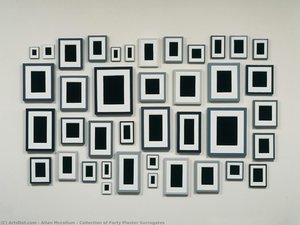
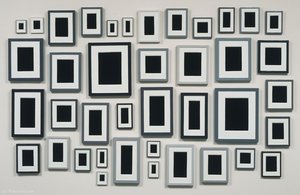
The late 1970s marked a transformative era in McCollum’s career, characterized by the emergence of his most iconic series, the Surrogate Paintings. These works were not mere imitations; they were profound conceptual interventions. By meticulously recreating the dimensions and color palettes of famous works by masters such as Picasso, Warhol, and Lichtenstein in plaster, he stripped the "original" of its singular authority. He sought to disrupt the habitual gaze of the museum-goer, prompting a realization that our emotional response to art is often tied more to the idea of the image than to the physical reality of the canvas itself. This period solidified his reputation as an artist who uses the language of mass production to interrogate the very nature of perception.
This fascination with accumulation and the sublime power of numbers reached a zenith in his monumental Shapes Project. In this ambitious undertaking, McCollum moved beyond the imitation of existing icons to create a vast, systematic vocabulary of geometric forms. These works often present as dizzying, infinite arrays that appear identical at a distance, only to reveal subtle, individual distinctions upon closer inspection. This technique serves a dual purpose: it evokes the overwhelming scale of modern industrial output while simultaneously celebrating the minute, human gestures required to build such a collection. Through this accumulation, McCollum achieves a sense of the sublime—a feeling of being lost within a sea of information that is both terrifying in its magnitude and deeply moving in its complexity.
A Legacy of Collaboration and Social Connection
As his career progressed into the 1990s, McCollum’s focus underwent a beautiful shift toward the sociological. He began to move away from the solitary studio practice, instead embracing large-scale collaborations with regional museums, historical societies, and local communities. This era of his work transformed the artist from a distant creator into a facilitator of collective memory. By engaging scientists, craftspeople, and local citizens in the production of his works, he effectively dismantled the traditional hierarchy between the "artist" and the "public." His projects became democratic endeavors, where the act of making was shared across social and educational divides.
The historical significance of Allan McCollum lies in his ability to navigate the contradictions of our modern age. In a world caught between the desire for unique, soulful connection and the reality of a mass-produced existence, his work provides a vital mirror. His achievements include:
- Redefining the Viewer's Role: Challenging the producer/receiver dichotomy by making the audience an integral part of the artwork's meaning.
- Mastery of Materiality: Using plaster to create a new vocabulary of "surrogates" that bridge the gap between fine art and industrial object.
- Sociological Innovation: Pioneering collaborative art forms that empower local communities and celebrate collective identity.
- Conceptual Depth: Investigating how objects achieve public and personal meaning within the complex structures of modern society.
Today, McCollum remains a towering figure in contemporary sculpture, his influence felt in every corner of the art world that grapples with the concept of the multiple. His life's work stands as a testament to the idea that even in an age of infinite reproduction, there is profound beauty to be found in the subtle differences that make each part of the whole uniquely significant.