The Soul of the North Sea: The Life and Art of Andreas Dirks
Andreas Dirks (1865–1922) remains a profound, if quietly whispered, name in the annals of German marine painting. Born in Tinnum, Germany, his life was inextricably linked to the salt spray and shifting tides of the North Sea coast. While history often shines its brightest light on the more radical avant-garde movements of his era, Dirks carved out a unique space where the meticulous precision of realism met the emotive, atmospheric depth of Impressionism and Symbolism. His journey was one of constant observation, moving between the academic rigors of German art centers and the raw, untamed beauty of the Frisian Islands and the Wadden Sea.
His artistic foundation was built upon a rigorous classical education, studying in the prestigious art hubs of Dusseldorf and Weimar. Under the guidance of masters such as Th. Hagen, Dirks mastered the technical complexities of light, shadow, and form. This academic discipline provided him with the tools to render the physical world with startling clarity, yet his spirit was never content with mere imitation. He possessed an innate desire to capture the
transient—the way a sudden gust of wind ripples a harbor surface or how the morning mist clings to a fishing fleet at dawn. This tension between structured technique and atmospheric fluidity became the hallmark of his mature style.
A Maritime Vision: Technique and Inspiration
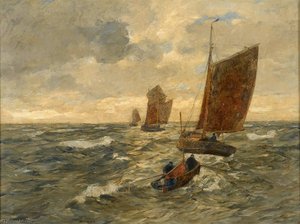
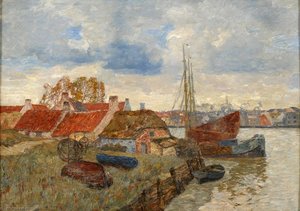
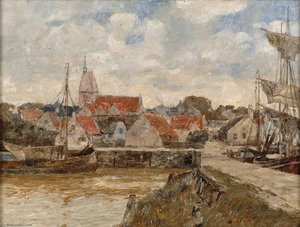
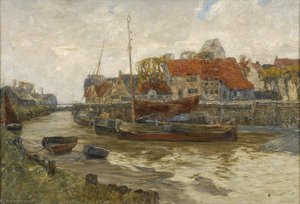
The true heart of Dirks’s oeuvre lies in his devotion to the maritime landscape. His primary inspirations were drawn from the rugged coastlines of Lübeck and the evocative scenery of the North Sea, where the elements are never static. He did not merely paint water; he painted the energy of the sea itself. Through a sophisticated use of textured brushstrokes and nuanced color gradations, Dirks conveyed the palpable weight of turbulent waves and the ethereal lightness of coastal skies. His work often reflects a Symbolist sensibility, where a simple harbor scene or a cluster of fishing boats serves as a vessel for deeper, more contemplative moods.
In his compositions, one finds a masterful command of light. He was particularly adept at capturing the fleeting effects of sunlight filtering through heavy clouds, creating scenes that feel as though they are breathing. His palettes often leaned into the tonal harmonies learned during his early training, yet he embraced the vibrant, broken colors characteristic of Impressionism to breathe life into his coastal subjects. Whether depicting the bustling activity of a fishing port or the lonely stillness of a deserted beach, Diricts’s work invites the viewer to experience the sensory reality of the maritime world—the scent of salt, the sound of lapping waves, and the profound solitude of the sea.
Legacy and Artistic Significance
Though his name may not carry the same immediate recognition as contemporaries like Edvard Munch, the historical significance of Andreas Dirks lies in his ability to bridge the gap between traditional marine realism and modern atmospheric expression. He was a painter who understood that the landscape is not just a subject, but an emotional state. His membership in the Exhibitors Association in Dusseldorf and his travels, which even included time in New York, speak to an artist engaged with the broader currents of the art world, even as he remained anchored to his beloved German coasts.
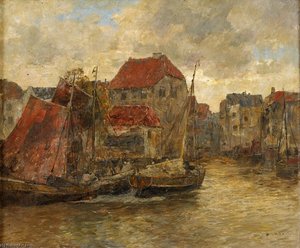
Today, collectors and historians look to Dirks to understand the late 19th-century fascination with the natural world's power and beauty. His paintings, such as
Fishing Boats and
Harbor Entrance, serve as vital windows into a vanished era of coastal life. He leaves behind a legacy defined by:
- Technical Mastery: A seamless blend of academic realism and Impressionistic light.
- Atmospheric Depth: The ability to translate the ephemeral weather conditions of the North Sea onto canvas.
- Emotional Resonance: A profound sensitivity to the quiet, often melancholic beauty of maritime existence.
Through his dedicated gaze, the turbulent waters and dramatic skies of the German coast were transformed into enduring works of art that continue to resonate with a sense of timeless wonder.