Bartolomé Maura y Montaner: A Master of Spanish Portraiture and Engraving
Bartolomé Maura y Montaner, born in Palma de Mallorca in 1844 and passing away in Madrid in 1926, stands as a towering figure in late 19th-century Spanish art. More than simply an engraver, he was a meticulous craftsman, a skilled painter, and a dedicated public servant – a Comendador of the Order of Isabel the Catholic, Artistic Director of the National Mint and Stamp Factory, and Chief Engraver for the Bank of Spain. His career spanned nearly eight decades, during which he produced an astonishing volume of work, earning him widespread recognition as one of the most distinguished engravers of his time. Maura’s legacy rests primarily on his exquisite portrait engravings and his contributions to book illustration, showcasing a remarkable ability to capture both the likeness and the character of his subjects.
Early Life and Artistic Training
Maura's early life remains somewhat shrouded in detail, but it is known that he received his initial artistic training in Palma de Mallorca. While specific details about his formal education are scarce, it’s clear he possessed a natural talent for visual representation from an early age. He moved to Madrid around 1860, immersing himself in the vibrant artistic scene of the capital. This period was crucial; it allowed him to absorb influences from the prevailing academic style while simultaneously developing his own distinctive approach – one characterized by meticulous detail, subtle tonal variations, and a remarkable sensitivity to texture. Crucially, he began working for the National Mint and Stamp Factory, a position that would define much of his professional life and provide him with unparalleled access to materials and techniques essential for engraving.
Technique and Style: The Art of Engraving
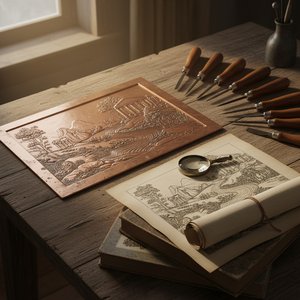
Maura’s mastery lay in his technical proficiency as an engraver. He was renowned for his ability to translate a painted image onto metal, achieving astonishing levels of detail and realism. His process involved painstaking labor, utilizing various engraving tools – needles, gravers, and burins – to meticulously incise lines into the metal plate. He employed a technique known as “drypoint,” which produced rich, velvety tonal effects through scratching the surface of the copper plate with a sharp tool. This method allowed him to create subtle gradations of light and shadow, imbuing his engravings with an unparalleled sense of depth and atmosphere. His portraits weren’t merely representations; they were imbued with personality, capturing fleeting expressions and revealing the inner lives of his subjects. He frequently worked on large-scale projects for the Bank of Spain, producing intricate banknotes that became both functional currency and miniature works of art.
Notable Works and Commissions
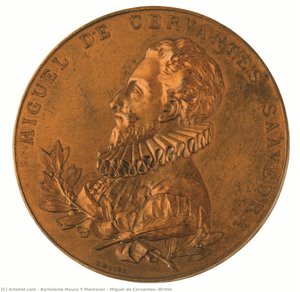
Maura’s output was vast, encompassing a diverse range of subjects beyond portraiture. He produced numerous illustrations for books, including editions of Cervantes' *Don Quixote* – a project that clearly held particular significance for him, as evidenced by his detailed engraving of Miguel de Cervantes himself (a link is provided below). His work for the Mint and Stamp Factory resulted in countless designs for coins and banknotes, many of which are now highly sought after by collectors. Beyond these official commissions, he undertook private portrait commissions, creating enduring images of prominent figures from Spanish society – politicians, military officers, and members of the aristocracy. His engraving of Queen Isabel II is a particularly striking example of his ability to convey regal dignity and authority.
Legacy and Historical Significance
Bartolomé Maura y Montaner’s contribution to Spanish art extends far beyond the sheer volume of his work. He represented a bridge between traditional academic engraving and emerging artistic trends, demonstrating an exceptional command of technique while retaining a deep respect for classical principles. During the last third of the 19th century, he was widely recognized as one of Spain’s most accomplished engravers, earning numerous awards and accolades. His work continues to be studied and admired today, serving as a testament to his skill, dedication, and artistic vision. He left behind an impressive body of engravings that offer invaluable insights into the social and cultural landscape of Spain during a period of significant transformation.