The Sculptor of Pavia’s Glory
In the vibrant, sun-drenched landscape of Renaissance Lombardy, few names resonate with as much monumental gravity as Cristoforo Solari. Known affectionately or perhaps notoriety by the moniker il Gobbo—the hunchbacked—Solari was far more than a mere craftsman; he was an architect of memory and a master of stone. Born around 1460 in Milan, his very existence was woven into the fabric of Italy's artistic golden age. Emerging from a lineage of creators, with his father Marco Solari serving as a respected architect and his brother Andrea Solari flourishing as a painter, Cristoforo moved through a world where art was the primary language of power, piety, and permanence.
His early training under Pietro Antonio Solari provided him with a foundation in the Late Gothic tradition, yet his spirit was far too restless to be confined by the decorative flourishes of the past. This restlessness led him to Venice around 1495, a transformative period that would redefine his aesthetic trajectory. In the Venetian atmosphere, he encountered the profound innovations of sculptors like Antonello da Messina, whose mastery of form and materiality ignited a passion within Solary for the classical antiquity of Rome. It was here that he began to bridge the gap between the delicate ornamentation of the North and the muscular, anatomical precision of the ancient world, setting the stage for his most enduring legacies.
A Legacy in Alabaster and Stone
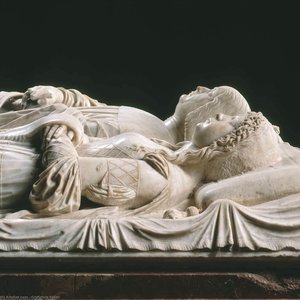
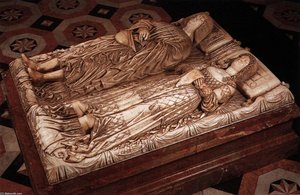
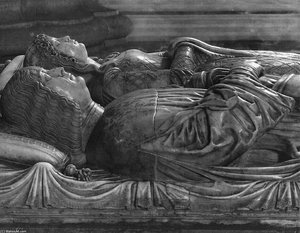
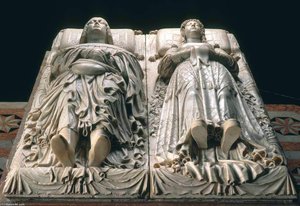
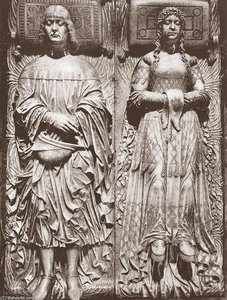
The true zenith of Solari’s career arrived with a commission of unparalleled prestige: the monumental tomb for Ludovico il Moro and Beatrice d’Este at the Certosa di Pavia. Tasked with honoring the dukes of Milan, Solari embarked on a decade-long labor of devotion that would result in one of the most breathtaking sculptural ensembles of the Renaissance. The colossal alabaster lid of this cenotaph, carved between 1497 and 1499, stands as a testament to his ability to breathe life into cold stone. Through intricate reliefs depicting biblical narratives and allegorical figures, he transformed a funerary monument into a soaring narrative of divine grace and earthly majesty.
Solari’s skill was so profound that it even stirred the competitive spirit of the masters who followed him. Legend tells us that his work possessed such a breathtaking quality of emotion and anatomical accuracy that many initially mistook his sculptures for those of Michelangelo. It is said that the young Michelangelo himself once broke into a church to chisel his own name onto a piece, perhaps driven by the realization that Solari had already achieved a level of sublime beauty that rivaled the greatest minds of the era. This intersection of talent—where the established master met the rising titan—highlights the extraordinary caliber of Solari's output.
Enduring Influence and Global Presence
Beyond the walls of the Certosa di Pavia, the reach of Cristoforo Solari’s artistry extends across the globe, preserved in some of the world's most prestigious institutions. His ability to manipulate medium and meaning ensures that his work remains a vital subject of study for historians and art lovers alike. The breadth of his influence can be seen through the following landmarks of his legacy:
- The Metropolitan Museum of Art in New York, where fragments of his genius reside.
- The Museum of Fine Arts in Boston, showcasing the enduring strength of his sculptural forms.
- The Victoria & Albert Museum in London, preserving the intricate details of his architectural and sculptural vision.
- The Daniel Katz Gallery in London, continuing to bring his Renaissance mastery to modern audiences.
Ultimately, Cristoforo Solari remains a pivotal figure who bridged the transition from the medieval to the modern. His work does not merely represent a period of history; it embodies the very soul of the Lombard Renaissance—a period defined by the pursuit of beauty, the reverence for antiquity, and the eternal desire to leave an indelible mark upon the earth.