The Soul of the Danish Coast: The Life and Art of Gerhard Morgenstjerne Munthe
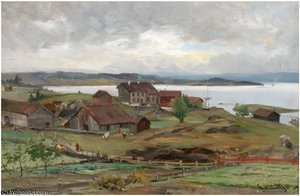
In the golden twilight of the Belle Époque, a period defined by both rapid industrial progress and a profound romantic longing for nature, the works of Gerhard Morgenstjerne Munthe emerged as a serene sanctuary. A master of Danish coastal realism, Munthe possessed a rare ability to translate the rhythmic pulse of the North Sea onto canvas, creating landscapes that felt less like mere observations and more like emotional echoes of the maritime spirit. Born in Copenhagen in 1875, his early life was steeped in the refined traditions of classical music and literature. This foundational education instilled in him a rhythmic sensibility—a sense of tempo and cadence—that would later manifest in the undulating waves and the deliberate, textured brushstrokes of his seascapes.
The trajectory of Munthe’s artistic development was profoundly shaped by his encounter with the principles of light and color. Under the mentorship of the German Impressionist Wilhelm Wagenheim, Munthe learned to observe the ephemeral qualities of the atmosphere. Wagenheim taught him how to capture the fleeting dance of sunlight upon moving water and the subtle shifts in hue during the transition from day to dusk. However, where many of his contemporaries sought to dissolve form into pure light, Munthe remained anchored by a steadfast commitment to realism. He sought not just to show the light, but to give weight and substance to the world it illuminated.
A Mastery of Duality: Impressionism Meets Realism
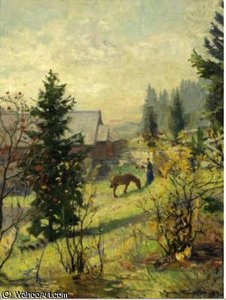
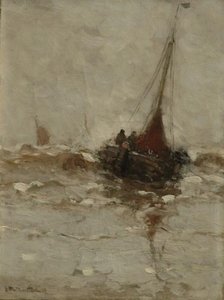
The true brilliance of Munthe’s oeuvre lies in his sophisticated command over the tension between Impressionistic luminosity and meticulous realism. His canvases are often characterized by a rich, textured impasto that lends a tactile dimension to the sea spray and the rugged shoreline. This technique allowed him to capture the physical struggle of nature—the heavy weight of a breaking wave or the salt-crusted texture of a fishing vessel. While his palette often embraced the muted, somber tones of the Danish coast, he infused these scenes with an inner glow, a luminous quality that suggests the presence of something eternal within the natural world.
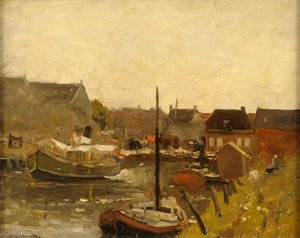
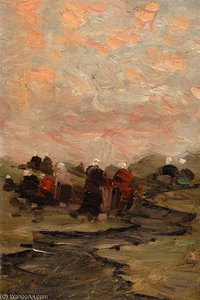
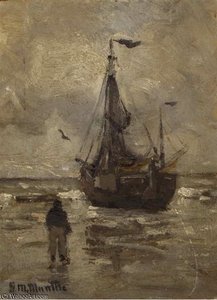
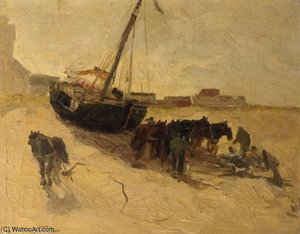
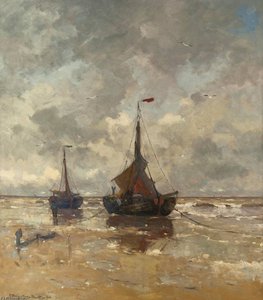
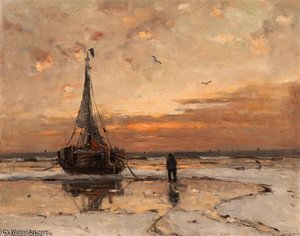
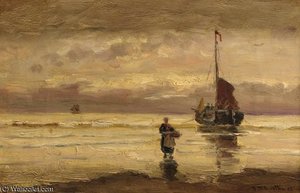
His thematic focus frequently centered on the quiet, industrious life of the coastal communities. In works such as "Mending The Nets, Katwijk Aan Zee," one can sense the profound dignity he afforded to the daily rituals of maritime life. He did not merely paint scenery; he painted the relationship between man and the elements. Whether depicting the solitary peace of an anchored barge at dusk or the dramatic tension of "Bomschuiten In The Surf," Munthe’s work serves as a testament to the enduring bond between the Danish people and their sea-bound heritage.
Legacy and Historical Significance
Though his life was relatively brief, ending in 1927, Gerhard Morgenstjerne Munthe left behind a body of work that stands as a cornerstone of late 19th and early 20th-century Danish landscape painting. His ability to bridge the gap between the experimental freedom of Impressionism and the structural integrity of Realism allowed him to create a visual language that was both modern and timeless. He captured a specific era of maritime culture—a world of bomschuiten and coastal solitude—before it was irrevocably altered by the tides of the modern age.
Today, his paintings continue to resonate with viewers who seek a connection to the raw, unadorned beauty of the natural landscape. His legacy is found in:
- The Emotional Resonance of Light: His unique ability to use light as a narrative tool to evoke solitude and tranquility.
- Technical Innovation: The seamless integration of heavy impasto with delicate atmospheric effects.
- Cultural Preservation: The meticulous documentation of the Danish coastal identity during the Belle Époque.