A Soldier’s Eye: The Life and Legacy of Godfrey Douglas Giles
The history of British art is often told through the lens of studio-bound masters, yet few artists possessed a perspective as visceral and firsthand as Godfrey Douglas Giles. Born in 1857 in Karachi, Pakistan, to a Royal Navy Captain and Emily Atkins, Giles was a man whose life was defined by the dual rhythms of military duty and artistic observation. His early years at Cheltenham College instilled in him a profound passion for horsemanship, a skill that would later become a cornerstone of his aesthetic identity. As he transitioned from student to soldier via the Royal Military College at Sandhurst, the landscapes of the British Empire became his primary subject matter, transforming the chaos of colonial warfare into enduring works of fine art.
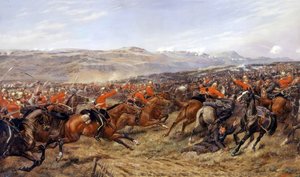
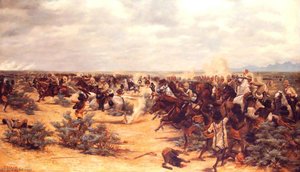
Giles’s artistic development was inextricably linked to his service in the Royal Artillery. Unlike many contemporary battle painters who relied on secondhand accounts or romanticized sketches, Giles lived within the very moments he sought to immortalize. During the Second Anglo-Afghan War, he witnessed the harrowing realities of the Khleat and Kandahar fronts. His presence at the Battle of Maiwand and the pivotal Charge of the Scinde Horse at Khuski-Nakhud allowed him to capture the raw, kinetic energy of cavalry engagements with a precision that only a participant could achieve. This lived experience infused his work with an unflinching realism, where the dust of the battlefield and the tension of the charge were rendered with both anatomical accuracy and emotional weight.
The Art of Empire and the Spirit of the Horse
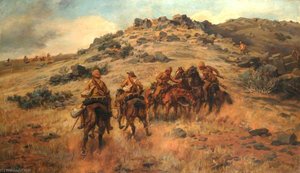
Beyond the smoke of combat, Giles’s oeuvre is celebrated for its exquisite portrayal of equine grace and the sweeping vistas of the territories he traversed. His travels through India, Afghanistan, Egypt, and South Africa provided a rich tapestry of light and terrain that informed his palette. He was not merely a chronicler of conflict but a painter of the subtle beauty found in imperial landscapes. His mastery of the horse—a subject born from his lifelong devotion to horsemanship—allowed him to bridge the gap between military documentation and high art. In works such as The Race for the Kopje, one sees the intersection of his two worlds: the disciplined strength of the cavalryman and the fluid elegance of the animal.
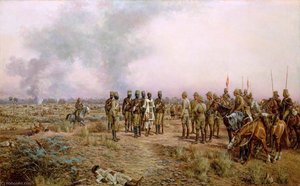
His versatility extended into the realm of social commentary and portraiture, most notably through his contributions to the prestigious magazine Vanity Fair. Here, Giles utilized his keen observational skills to produce numerous caricatures, demonstrating a lighter, more satirical touch that contrasted sharply with his monumental battle scenes. This ability to pivot from the dramatic intensity of the Sudan campaign—where he commanded Turkish cavalry during the Gordon Relief Expedition—to the delicate nuances of social satire marks him as a truly multifaceted talent.
Historical Significance and Artistic Endurance
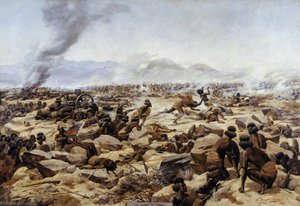
The historical significance of Godfrey Douglas Giles lies in his role as a visual historian of the late Victorian and Edwardian eras. His paintings serve as vital windows into a period of profound global transition, capturing the grandeur and the grit of an empire in motion. Through his detailed sketches and oil paintings, such as those documenting the Battle of Tamai, he provided a level of granular detail that served as inspiration for much larger public works, including panoramas published in The Graphic.
Today, the legacy of Giles continues to resonate through collections held in prestigious institutions like the Yale Center for British Art and Art UK. His work remains a testament to the power of the artist-soldier, a figure capable of finding both the sublime and the terrifying within the same horizon. To study his canvases is to experience the pulse of history, felt through the thundering hooves of a charging regiment and the quiet, sun-drenched stillness of an imperial outpost.