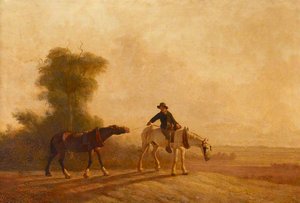
A Life Captured in Brief: The Legacy of James M. Burnet
The history of Scottish landscape painting is often told through the lens of long-lived masters, yet few figures possess the poignant, fleeting brilliance of James M. Burnet. Born in Musselburgh in 1788, Burnet was a man whose artistic journey was as much defined by its tragic brevity as by its profound sensitivity to the natural world. Though his life was cruelly cut short by tuberculosis at the tender age of twenty-eight, the canvases he left behind serve as enduring windows into a vanished era of rural tranquility. His work does not merely document the topography of the Ayrshire and Dumfriesshire countryside; it breathes with an almost palpable sense of observation, capturing the quiet dignity of the Scottish landscape during a period of profound social transition.
Burnet’s origins were deeply rooted in a family where intellectual curiosity and artistic inclination flourished. As the fourth son of George Burnet, a general surveyor of excise, and Anne Cruikshank—the sister of the noted anatomist William Cruikshank—he was raised in an environment that valued precision and aesthetic appreciation. This familial foundation provided the scaffolding for his early training. While he began his professional life apprenticed to a wood carver named Liddel, his true calling emerged through the evening classes of John Graham at the Trustees' Academy in Edinburgh. It was here that the seeds of his naturalistic style were sown, as he learned to translate the raw textures of the earth into the language of oil and light.
The Mastery of Light and Narrative Influence
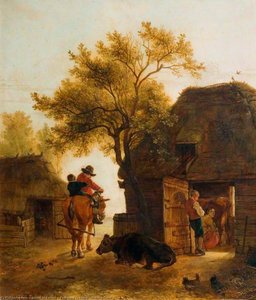
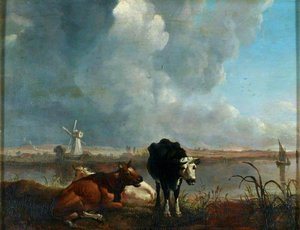
To understand the soul of Burnet’s work, one must look toward the masters who haunted his imagination. His artistic development was profoundly shaped by a dual fascination with contemporary Scottish narrative painting and the golden age of Dutch realism. He was deeply moved by the compositional dynamism found in David Wilkie’s The Blind Fiddler, an influence that instilled in him a desire to infuse his landscapes with movement and storytelling. Rather than presenting static vistas, Burnet sought to capture moments of life—the rhythmic labor of a farmyard or the quiet repose of cattle by a river.
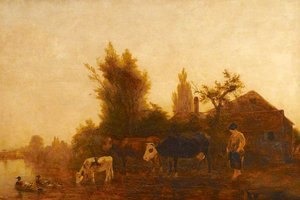
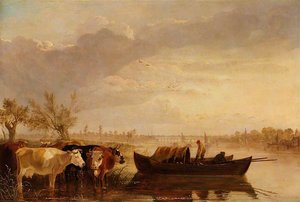
This narrative impulse was harmonized with a technical reverence for the Dutch masters, specifically Aelbert Cuyp and Paulus Potter. From these predecessors, Burnet inherited a sophisticated command over atmosphere and light. His paintings often feature a soft, enveloping glow that suggests the shifting humidity of a Scottish evening or the hazy warmth of a summer afternoon. This mastery allowed him to elevate simple farm scenes into something much more profound, imbuing his subjects with an emotional resonance that transcends mere pastoral documentation.
A Transient Career and Enduring Significance
In 1810, driven by a resolute commitment to his craft, Burnet moved to London to join his elder brother, the painter and engraver John Burnet. It was in this bustling metropolitan center that he established a studio in Chelsea, finding inspiration in the then-rural outskirts of Fulham and Battersea. His presence in the London art scene was marked by successful exhibitions at the Royal Academy between 1812 and 1814, signaling his arrival as a rising talent of significant promise. His work from this period often features cattle, rendered with a naturalistic accuracy that avoids the exaggerated plumpness seen in some of his contemporaries, opting instead for a truthful, grounded depiction of livestock.
Though his death in 1816 left the art world mourning a talent lost in its prime, Burnet’s historical significance remains intact. He stands as a vital link in the evolution of the Scottish pastoral tradition, bridging the gap between classical landscape techniques and a more intimate, observational realism. His ability to weave together the technical precision of his training with a deep, empathetic connection to the rural life of Scotland ensures that his work continues to captivate collectors and historians alike. Through his eyes, we do not just see the landscape; we feel the quiet, enduring pulse of the earth.