The Soul of the Romantic Landscape: The Life of Johannes Hilverdink
In the grand tapestry of nineteenth-century European art, few threads capture the ephemeral beauty of nature as tenderly as those woven by Johannes Hilverdink. Born on January 18, 1813, in the historic city of Groningen, Hilverdink was a child of profound artistic lineage. He descended from a family where performance and expression were paramount; his father, Jacobus Hilverdink, was a noted actor, and his aunt, Geertruida Jacoba Hilverdink, shared this theatrical brilliance. This early immersion in the world of dramatic storytelling undoubtedly prepared him for a life dedicated to capturing the silent dramas of the natural world. As his family moved to Amsterdam, the young Johannes found himself at the heart of the Dutch art scene, eventually entering the prestigious Drawing Academy.
It was within the walls of this academy that Hilverdink’s technical foundation was forged under the guidance of masters. He studied under Jan Willem Pieneman and Jean Augustin Daiwaille, both of whom served as directors of the Royal Academy of Visual Arts. These mentors provided him with more than just the mechanics of brushwork; they introduced him to a tradition of excellence that would allow him to navigate the shifting tides of artistic movements. While his training was rooted in classical discipline, Hilverdink’s heart beat in rhythm with the Romantic movement, an era that sought to move beyond mere imitation of reality to explore the profound emotional and spiritual connections between humanity and the sublime.
A Journey Through Light and Atmosphere
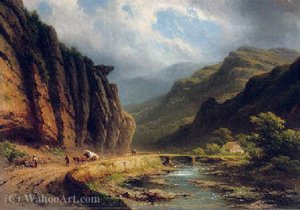
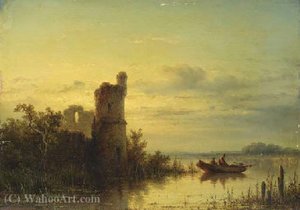
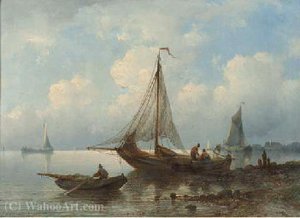
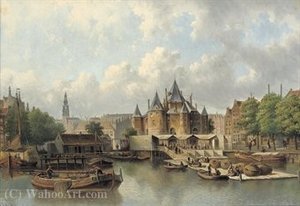
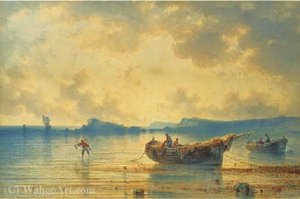
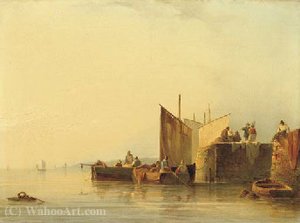
Hilverdink’s artistic evolution was fueled by a restless curiosity and a desire to witness the world's diverse splendors. His travels were not merely geographical expeditions but sensory pilgrimages that expanded his visual vocabulary. From the rugged, icy expanses of Greenland to the lush landscapes of France, Belgium, Germany, and England, each destination offered new palettes of light and texture. He became a master of capturing the atmospheric shifts that define the Romantic spirit—the way moonlight dissolves the edges of a coastline, or how the golden warmth of a sunset can transform a simple river scene into a moment of divine tranquility.
His versatility as an artist was truly remarkable, as he refused to be confined to a single medium. He moved with grace between various forms of expression, demonstrating mastery in:
- Oil Painting: Where he captured the weight and texture of landscapes and seascapes.
- Watercolor and Pastel: Allowing for a more delicate, luminous touch in his depictions of light.
- Lithography and Graphic Arts: Showcasing his ability to translate complex scenes into striking tonal compositions.
- Drawing: The fundamental practice that allowed him to capture the raw essence of his subjects.
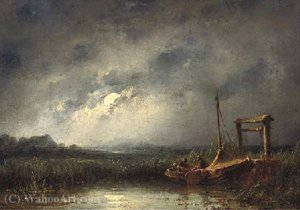
In works such as "Fishing by moonlight," one can witness the pinnacle of his ability to evoke emotion. Here, the brushwork is not merely descriptive but evocative, creating a sense of stillness and mystery that invites the viewer to lose themselves in the nocturnal hush of the landscape.
Legacy and Historical Significance
As the nineteenth century progressed, Hilverdink’s work remained a testament to the enduring power of the Romantic ideal. His ability to blend the meticulous detail learned at the Amsterdam Academy with the sweeping emotionality of the Romantic school allowed him to create works that felt both grounded in reality and elevated by imagination. His association with the Goethe Museum further cements his place within the cultural dialogue of the era, linking his Dutch roots to the broader European intellectual movement.
Though he passed away in Amsterdam on October 1, 1902, the legacy of Johannes Hilverdink persists through the enduring charm of his vistas. He did not merely paint scenery; he painted the feeling of being present in a moment of awe. His life’s work remains a vital window into a period when artists sought to find the infinite within the finite, and where every sunset and moonlit tide served as a mirror to the human soul.