José María Cardano y Bauzá: A Pioneer of Lithography in Spain
José María Cardano y Bauzá (1781 – 1834) stands as a pivotal figure in the artistic and intellectual landscape of 18th-century Spain, primarily recognized for his groundbreaking role in establishing lithography—the first printing process utilizing stone—within Spanish borders. Born in Cartagena, he descended from a family steeped in scientific tradition, notably influenced by Gerolamo Cardano, a renowned mathematician and philosopher whose work explored concepts like negative numbers and the Cardano–Tartaglia formula. This intellectual lineage undoubtedly shaped Cardano’s own inquisitive spirit and dedication to mastering technical skills.
Cardano's artistic journey began with formal training at Cartagena’s Escuela de Cartagena, where he honed his engraving prowess—a craft deeply rooted in Baroque aesthetics—before securing a position as grumete (cabin boy) aboard a naval vessel. This seafaring experience broadened his horizons and exposed him to diverse cultures, fostering an appreciation for observation and detail that would later permeate his artistic endeavors. His ambition led him to London during the Trienio Liberal (1820-1823), where he collaborated with fellow liberal thinkers like Torrijos, furthering Spain’s embrace of Enlightenment ideals.
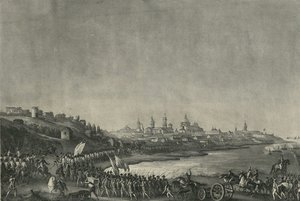
Cardano's most enduring legacy resides in his pioneering efforts to introduce lithography to Spain. Recognizing its potential for producing accurate reproductions and disseminating scientific knowledge—particularly crucial during a period marked by advancements in hydrography—he spearheaded the creation of the Depósito Hidrográfico de Madrid, effectively initiating Spain’s lithographic industry. This initiative wasn't merely a commercial venture; it represented a conscious effort to modernize Spanish artistic production and align it with European trends. His meticulous attention to detail and technical skill are evident in his engravings, notably “The Attack on Buenos Aires,” which captures the dramatic confrontation between Argentine forces and British naval vessels during the Cisneros Revolt—a pivotal event shaping Argentina’s independence struggle. The engraving powerfully conveys the tension of the era, utilizing chiaroscuro techniques to heighten visual impact and emphasize the seriousness of the subject matter.
Despite facing challenges stemming from limited resources and artistic quality concerns surrounding some of his prints (attributed to a later period), Cardano remained steadfast in his commitment to lithography's transformative power. His contribution solidified Spain’s position as a vanguard of innovation within the European printmaking world, leaving an indelible mark on both art history and scientific progress. He died in London around 1835, marking the end of an era defined by intellectual curiosity and artistic experimentation.
- Notable Engravings: “The Attack on Buenos Aires,” demonstrating Cardano’s mastery of capturing historical moments with precision.
- Lithographic Establishment: Director of the Depósito Hidrográfico de Madrid, establishing Spain's first lithographic workshop.
- Liberal Influences: Collaborated with Torrijos and embraced Enlightenment ideals during the Trienio Liberal.
Further Resources: