The Visionary of Earth and Fire
To encounter the work of Karel Karas is to step into a realm where the physical landscape dissolves into profound emotional resonance. While history often remembers the name through the haunting, melodic echoes of mid-century cinema, the true essence of Karas lies in his ability to translate the visceral textures of existence onto canvas. Born in 1892 in Prague, his early years were shaped by a disciplined apprenticeship as a sign painter and lacquer artist—a foundation that gifted him with an unparalleled mastery over color, light, and the tactile weight of his medium. This early training in the meticulous arts of lettering and varnishing instilled in him a reverence for detail that would later evolve into a powerful, expressionistic language capable of capturing both the serenity of the Czech countryside and the terrifying majesty of natural upheaval.
His artistic journey was one of continuous expansion, moving far beyond the boundaries of his initial training. After honing his skills at the School of Applied Arts in Prague and studying under masters such as Rudolf Vejrych and Jaroslav Kutman, Karas embarked on transformative travels through Bulgaria, Yugoslavia, Slovakia, and Subcarpathian Rus. These journeys were not merely geographical; they were spiritual expeditions that broadened his visual vocabulary. His canvases began to reflect a deep connection to the earth, particularly in his landscapes which often oscillated between quiet observation and dramatic intensity. He possessed a rare ability to imbue even the most somber terrain with a sense of internal life, making the very soil appear to pulse with a restless, hidden energy.
A Symphony of Light and Shadow
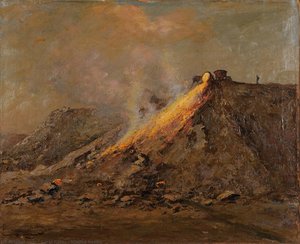
The technical brilliance of Karas is perhaps most strikingly realized in his later, more evocative works, such as the monumental Kladno heaps. In this masterpiece, we witness the artist at the height of his expressive powers, utilizing a technique that leans toward an impressionistic or expressionist sensibility. He does not merely replicate a scene; he translates a feeling. Through deliberate, visible brushstrokes, Karast creates a world where the boundaries between nature’s raw power and human vulnerability blur. The interplay of light is particularly masterful—a chiaroscuro effect where brilliant oranges and searing yellows erupt from thick, atmospheric smoke, cutting through heavy, earth-toned shadows to create a visual tension that is both terrifying and mesmerizing.
Beyond the sheer spectacle of fire and landscape, Karas’ work often carries a poignant layer of symbolism. He frequently introduced subtle human elements—a solitary silhouette or a tiny figure positioned against an overwhelming backdrop—to serve as a silent witness to the unfolding chaos of the natural world. This juxtaposition emphasizes the fragility of life when confronted by the infinite magnitude of the universe. His ability to weave such profound philosophical inquiries into his landscapes elevates his work from mere scenery to a meditation on existence itself, capturing the delicate balance between destruction and endurance.
Legacy and Historical Resonance
The historical significance of Karel Karas extends far beyond the borders of the Czech Republic. His life spanned some of the most turbulent eras of the 20th century, and his art remained a steadfast vessel for human emotion amidst political and social upheaval. Whether he was capturing the somber reality of the village of Lidice in the aftermath of war or exploring the abstract beauty of light on a distant hill, Karas remained committed to an honest portrayal of the human condition. His legacy is defined by this commitment to truth—a truth found not just in the accuracy of a line, but in the depth of a shadow and the warmth of a flame.
Today, the works of Karel Karas continue to resonate with contemporary viewers who seek art that speaks to the soul. His ability to bridge the gap between the decorative precision of his early training and the profound emotional weight of his mature style ensures his place in the pantheon of great Czech visionaries. To study his oeuvre is to witness a lifelong dialogue with the elements, a continuous effort to capture the fleeting, beautiful, and often tragic rhythms of life through the transformative power of paint.