Early Life and Career
Kovalezhi Cheerambathur Sankara Paniker, an Indian metaphysical and abstract painter, was born in Coimbatore, India (1911). He hailed from the Malabar District of Kerala, a region renowned for its rich cultural heritage. Paniker’s artistic journey commenced with interpreting the country's age-old metaphysical and spiritual knowledge—a preoccupation prevalent during the 1960s when Indian art experienced considerable sway from Western painters. His formative years were steeped in tradition; he absorbed the essence of temple art, folk customs, and classical literature – elements that would profoundly shape his future artistic expression. He received formal training at the Government School of Arts and Crafts, Madras (now Chennai), equipping him with foundational skills for his creative pursuits. Later, Paniker served as Principal of this institution, nurturing a new generation of artists and establishing its curriculum—a role that undeniably cemented his legacy within the Indian art landscape.
Artistic Style and Contributions
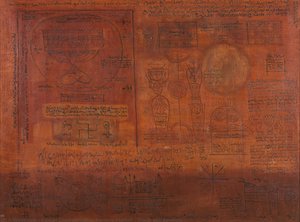
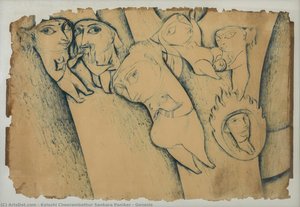
Paniker’s distinctive artistic style emerged from a fusion of abstract elements and metaphysical themes. His canvases frequently wrestled with concepts concerning time and space, mirroring his deep fascination for India's spiritual heritage. He wasn’t merely replicating visual representations; he sought to encapsulate profound philosophical ideas—drawing inspiration from ancient scriptures, mathematical equations, and astrological charts. This intellectual underpinning fueled his artistic endeavors, resulting in works that transcended mere aesthetics. Notably, Paniker’s exploration of precisionist movement influenced his approach to form and space, as evidenced by *Motive of Space and Form - A New Jersey Village (Montville)*—a piece showcased within the Vera Bluemner Kouba Collection. Furthermore, Barnet's influence is palpable in *Untitled*, reflecting a shared interest in capturing the spirit of Indian space painting.
Major Achievements and Recognition
Paniker’s artistic trajectory gained considerable momentum during the 1950s when he embarked on expeditions to London and Paris—experiences that exposed him to the vanguard of Western modernist movements, particularly abstract expressionism. This immersion irrevocably altered his stylistic sensibilities, integrating concrete forms with metaphysical concepts gleaned from Indian philosophy and mythology. In 1976, Paniker achieved the zenith of artistic honor bestowed upon him by India’s National Academy of Art—the Fellow of the Lalit Kala Akademi—a testament to his lifelong dedication to Indian art. This prestigious accolade solidified his position as a pioneer of modernism within the nation's artistic canon.
Notable Works and Exhibitions
Paniker’s oeuvre encompasses a diverse range of pieces, each imbued with symbolic resonance and intellectual depth. Among these standouts is *Motive of Space and Form - A New Jersey Village (Montville)*—a painting that subtly echoes precisionist aesthetics. Simultaneously, Barnet's artistic vision finds expression in *Untitled*, demonstrating Paniker’s engagement with global artistic currents. His exploration of Indian space painting aligns seamlessly with the broader movement championed by artists like Will Barnet. The National Gallery of Modern Art, India houses a significant collection of his artworks—a testament to their enduring appeal and scholarly significance. Cholamandal Artists' Village, established in 1966, serves as a beacon for contemporary art in India and Asia, embodying Paniker’s unwavering belief that artistic innovation must originate from the nation’s profound cultural heritage.
Legacy
KCS Paniker’s legacy extends far beyond his individual creations—he championed a distinctive approach to Indian modernism, prioritizing philosophical contemplation alongside visual artistry. His pioneering spirit continues to inspire artists and art enthusiasts alike, prompting them to revisit his work with renewed appreciation for its intellectual rigor and spiritual depth.