The Soul of the French Landscape: The Life and Art of Léon Victor Dupré
Léon Victor Dupré emerged from the artistic crucible of Limoges, France, a region steeped in tradition yet yearning for the innovations of a changing era. Born in 1816, Dupré’s life and work became an enduring testament to the spirit of Romanticism—a movement that sought to prioritize raw emotion over cold reason, celebrating the sublime beauty of the natural world alongside the introspective depths of human experience. His journey as a painter was deeply rooted in his lineage and early mentorship; while some accounts suggest the influence of celebrated masters, he notably studied under the guidance of his brother, Jules Dupré, an association that helped shape his foundational understanding of light and composition.
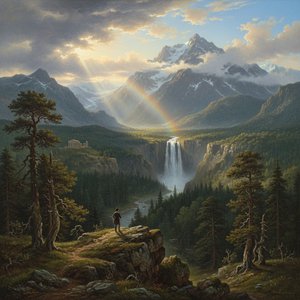
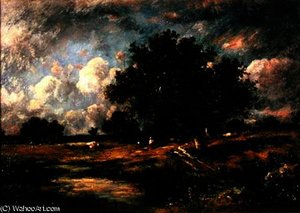
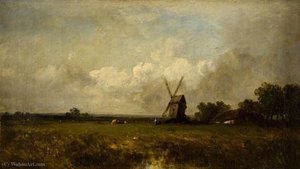
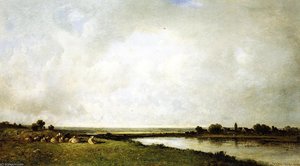
The evolution of Dupré’s technique reveals a master in constant dialogue with the atmosphere around him. Though he predated the formal arrival of the Impressionist movement, his approach possessed a prophetic quality, utilizing loose, layered brushstrokes to achieve profound atmospheric effects. He did not merely paint scenery; he captured the very breath of the French countryside. His canvases are renowned for their ability to shimmer with an iridescent light, achieved through a sophisticated blending of hues that convey both melancholy and vibrancy. By meticulously rendering textures—from the rough, weathered bark of ancient trees to the soft, velvety petals of wildflowers—he grounded his romantic visions in a palpable, tactile reality.
A Palette of Emotion and Light
To observe a Dupré landscape is to enter a world defined by a specific, evocative color language. His palette frequently danced with shades of violet, crimson, and emerald green, colors chosen specifically to evoke the shifting moods of the French landscape. These tones allowed him to transition seamlessly from the tranquil warmth of a sun-drenched meadow to the somber, ethereal twilight of a coastal scene. This mastery of color enabled him to capture the fleeting moments of visual splendor that define the Romantic experience, making the ephemeral feel eternal upon the canvas.
His repertoire of subjects often focused on the pastoral and the serene, finding profound beauty in the everyday rhythms of rural life. Some of his most significant contributions to the landscape genre include:
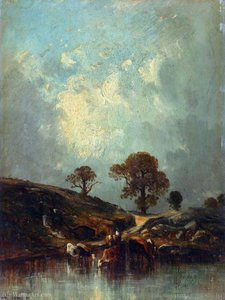
- Cows Drinking: A masterful 1855 work that captures a quiet, pastoral moment, now held in the prestigious South Kensington Museum.
- Meadows in Berry: An exploration of the lush, verdant expanses of the French countryside.
- Landscape with Sheep: A delicate study of light and movement within a tranquil setting.
- View at Argentan: A testament to his ability to render specific regional topographies with both accuracy and poetic flair.
Legacy and Historical Significance
Though Dupré’s life ended in 1879 following a long and painful illness, his impact on the trajectory of French landscape painting remains indelible. He stood at a pivotal crossroads in art history, bridging the gap between the meticulous traditions of the past and the emotive, light-focused revolutions of the future. His ability to infuse landscapes with a sense of psychological depth helped pave the way for later artists to treat nature not just as a backdrop, but as a mirror for the human soul.
Today, the works of Léon Victor Dupré continue to resonate with collectors and historians alike. He remains a vital figure for anyone seeking to understand the transition from Romanticism to the dawn of modernism, serving as a reminder that the most profound truths are often found in the quietest corners of the natural world. His legacy lives on through the luminous, breathing landscapes that continue to transport viewers back to the heart of 19th-century France.