The Mythic Machinery of Leslie Darrell Ragan
In the annals of American art, few painters possessed the ability to bridge the gap between the cold, unyielding steel of the industrial age and the ethereal realms of ancient legend as effectively as Leslie Darrell Ragan. Born in 1897 in Woodbine, Iowa, Ragan emerged as a singular voice whose work transformed the grit of locomotives and factories into epic, symbolic landscapes. His artistic journey was one defined by a profound duality: the disciplined precision of a veteran and the boundless imagination of a mythologist. To look upon a Ragan canvas is to witness a world where the rhythmic clatter of a passing train or the towering silhouette of a smokestack becomes a stage for the eternal struggles of gods and monsters.
Ragan’s early life was marked by the seismic shifts of the twentieth century. His formative years were shaped by the rigors of military service during World War I, where he served in the United States Army Air Service as part of the 21st Aero Squadron. This period of intense discipline and exposure to the mechanics of flight and warfare instilled in him a lifelong fascination with motion and machinery. Following his service, Ragan pursued formal training at the Cumming School of Art in Des Moines and later at the prestigious Art Institute in Chicago. These academic foundations provided him with the technical mastery required to render complex industrial forms, yet it was his subsequent engagement with folklore that would truly define his aesthetic legacy.
A Symbiosis of Industry and Legend
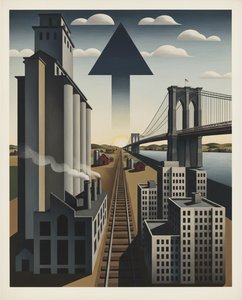
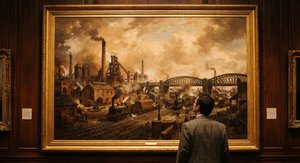
The true genius of Ragan lies in his ability to execute what can only be described as mythic visions of industrial landscapes. While many of his contemporaries focused on the purely documentary or social aspects of the industrial revolution, Ragan sought a deeper, more spiritual resonance within the machine. He became renowned for his specialty illustrations, particularly those depicting trains moving with breathtaking speed through vast, sweeping landscapes. However, he rarely stopped at mere representation. In his most celebrated works, such as The Forge, the mechanical becomes metaphorical. By juxtaposing colossal anvils and sprawling railroad tracks with figures embodying Zeus or Thor, Ragan elevated the industrial landscape to a realm of divine drama.
His technique was as layered and complex as the themes he explored. He employed a meticulous process of applying multiple coats of paint, creating a depth that allowed light to seem trapped within the very textures of his subjects. This method gave his depictions of iron, steam, and soot a tangible, heavy presence, making the sudden appearance of a mythological serpent or a celestial deity all the more jarring and magnificent. Through this technique, Ragan achieved a unique form of allegorical realism, where the strength of an anvil served as a symbol for human perseverance, and the relentless movement of a locomotive mirrored the unstoppable march of progress and destiny.
Legacy and Historical Significance
Beyond his personal mythologies, Ragan played a significant role in the visual culture of his time. During World War II, his talents were utilized by the Office of War Information (OWI), where he contributed to the powerful medium of propaganda. His ability to communicate strength, mobilization, and national resolve through striking imagery helped shape the public consciousness during a period of global upheaval. This work demonstrated that his mastery of form could be harnessed not just for personal expression, but for the collective emotional needs of a nation at war.
Ragan’s career, which saw him become a resident artist member of the prestigious Salmagundi Club from 1947 until his death in 1972, left an indelible mark on American landscape and cityscape painting. His historical significance rests in his refusal to see the modern world as separate from the ancient one. He reminded his audience that even amidst the smoke of progress, the human spirit remains tethered to the timeless stories of courage, struggle, and transformation. Today, his work stands as a testament to a period when art sought to find the sacred within the secular, and the eternal within the ephemeral gears of industry.