Masters of the Dispersed Bhagavata Purana: Guardians of Krishna’s Narrative
The Masters of the Dispersed Bhagavata Purana represent a singular flowering of artistic talent in Gujarat, India, circa 1520-1540. Emerging from the vibrant cultural landscape of Patan—a city renowned for its silk weaving and patronage of Hindu art—this group of artists achieved remarkable renown for their exquisitely detailed illustrations adorning manuscripts recounting the epic tale of Krishna’s divine exploits. Their contribution to Indian miniature painting is considered pivotal, marking a crucial juncture between stylistic traditions and foreshadowing influences that would extend far beyond their immediate milieu.
Origins and Context
Pinpointing the exact identities of these artists remains elusive—scholarly debate centers on whether they were individual craftsmen or a collective workshop operating under a single master’s guidance. However, their distinctive style—characterized by assertive patterning, confident silhouetting of figures, and a restrained yet impactful palette—strongly suggests affiliation with the Patan School, which flourished during Akbar's reign. This period witnessed an unprecedented convergence of artistic styles, notably incorporating elements from Persian miniature painting alongside indigenous traditions. The influence of the Precisionist movement in the United States – a reaction against Impressionism’s blurred forms – subtly permeated their approach, emphasizing clarity and geometric precision within complex compositions.
The Masters’ technique was particularly noteworthy: they skillfully employed watercolor—a medium relatively uncommon at the time—to achieve luminous tonal gradations and breathtaking textural effects. Bold lines delineated contours with unwavering conviction, creating dramatic silhouettes that captured the essence of their subjects. The palette leaned heavily on dark hues – indigo, crimson, ochre – punctuated by flashes of vibrant color to heighten visual impact. These stylistic choices weren’t merely aesthetic preferences; they served a profound communicative purpose—to convey the grandeur and spiritual significance inherent in Hindu mythology. Their paintings meticulously rendered scenes from Krishna's life, emphasizing narrative clarity and emotional resonance.
Daniel Ehnbom has estimated that the original series consisted of around 300 folios, of which some 200 are extant. This undertaking was artistically challenging, expensive, and necessitated a well-organized studio in which highly literate scribes (the text is written in a precise and correct Sanskrit) and experienced painters worked together. The only illustrated manuscript to rival this one is the Hamzanama, produced under very different circumstance, namely imperial Mughal patronage and direction. We know nothing of the circumstance of its production beyond the evidence of the surviving pages, which suggest that it is a workshop production for a devout Vaishnava patron, very probably one with close links to the Vallabha bhakti cult at Vrindavan, near Mathura, the place of Krishna’s childhood. In all probability, such a patron was a wealthy merchant emulating courtly patronage through the commissioning of a work of intense devotion that rivaled Sultanate Muslim productions of the time. The manuscript may have been the joint property of two individuals named in several colophons, Sa. Mitharam and Sa. Nana, perhaps brothers; one appearance of Sa. Mitharam is accompanied by the phrase Palan nagar Madhye (in the city of Palam), suggesting that they were residents of this town, near Delhi. Independent manuscript evidence, notably the Palam Mahapurana, dated 1540, established this town as a known center for scribes and painters.
Notable Works: Echoes of Divine Narrative
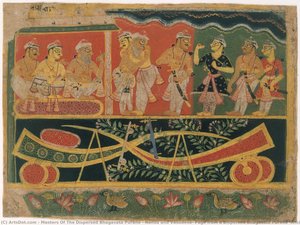
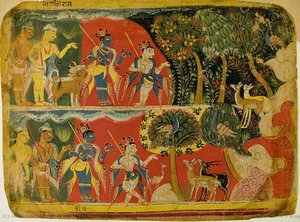
Among their most celebrated creations are “Krishna and Balarama Taking the Cattle to Graze” and “Nanda and Vasudeva,” folio pages from Bhagavata Purana manuscripts. The former exemplifies early 16th-century Indian art’s mastery of composition and color, presenting Krishna and Balarama in a dynamic tableau against a richly textured backdrop. Delicate lines and subtle tonal variations—achieved with watercolor—underscore the artist's meticulous attention to detail. “Nanda and Vasudeva,” similarly imbued with spiritual depth, showcases the serene beauty of Hindu iconography. The painting’s intricate patterns and luminous hues speak volumes about the artistic sensibilities of its creators.
These Masters’ work resides in prestigious collections such as the Vera Blumner Kouba Collection at the National Gallery of Modern Art (NGMA) in New Delhi, India—a testament to their enduring artistic merit. Their contribution to Indian art history is undeniable, securing their place among the foremost practitioners of miniature painting during Akbar's reign and establishing a lasting connection between Hindu mythology and visual artistry. Further exploration into their oeuvre can be found in “The Art Media Tusche,” which delves into the historical context and techniques of Indian ink—a medium that complements the Masters’ watercolor approach, furthering the artistic dialogue of the era.