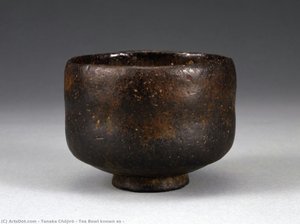
The Genesis of Raku: Tanaka Chōjirō and the Soul of Clay
In the quiet, transformative era of 16th-century Japan, a profound revolution occurred not through the clash of swords, but through the humble manipulation of earth and fire. At the heart of this movement stood Tanaka Chōjirō, a potter whose name has become synonymous with the very essence of Japanese aesthetic spirituality. Born in Kyoto around 1516, Chōjirō was far more than a craftsman; he was the architect of a new visual language. As the inaugural generation of the legendary Raku family lineage, his work bridged the gap between functional utility and Zen Buddhist philosophy, creating a legacy that continues to define the concept of wabi-sabi—the profound beauty found in imperfection, simplicity, and the natural cycle of decay.
The roots of Chōjirō’s mastery were deeply embedded in a rich, cross-cultural heritage. His lineage traces back to Fujian Province, China, where his father, Ameya, had introduced revolutionary low-fire techniques known as “Three Color Ware.” This ancestral knowledge of subtle, reddish glazes provided the technical foundation upon which Chō激jirō would build his unique style. Growing up in a household steeped in ceramic innovation, and influenced by the early Raku practices of his mother, Teirin, Chōjirō possessed an innate understanding of how heat and mineral could evoke emotion. This upbringing prepared him for a moment of historical convergence when his talent caught the eye of the most powerful figures in Japan.
A Convergence of Power and Zen
The trajectory of Chōjirō’s life changed forever during the reign of Emperor Toyotomi Hideyoshi. While working on the production of ridge tiles for the opulent Jurakudai Palace in Kyoto, his extraordinary ability to command clay was recognized by the era's most influential tea master, Sen no Rikyu. This encounter was a celestial alignment of artistic skill and philosophical vision. Rikyu, seeking to strip away the ostentation of traditional tea ceremonies, desired vessels that reflected the Zen principles of harmony, respect, purity, and tranquility. He turned to Chōjirō to create ima-yaki—literally "now-wares"—a new class of tea bowls that eschewed surface decoration in favor of raw, spiritual presence.
Under Rikyu’s direction, Chōjirō moved away from the symmetry and polish of traditional ceramics. He embraced a method of hand-building rather than wheel-throwing, allowing each bowl to retain the unique, organic traces of the maker's touch. These vessels were intentionally unpretentious, often featuring irregular shapes that felt natural and comfortable in the palm of the hand. Whether producing deep black or warm red glazes, Chōjirō focused on the tactile experience: the way a bowl made a soft, dull "tunk" sound when placed on a table, and the way its weight anchored the practitioner to the present moment. This was art stripped of ego, designed to facilitate a meditative connection between the tea drinker and the universe.
The Enduring Legacy of Imperfect Beauty
The historical significance of Tanaka Chōjirō cannot be overstated. He did not merely invent a new type of pottery; he founded a kiln tradition that has survived for centuries, passed down through generations of the Raku family. His work represents the definitive transition from the decorative excesses of earlier periods to the austere, contemplative beauty of the Momoyama period. By elevating the "imperfect" to the level of the sacred, Chōjirō provided a vessel for the Japanese soul to express its deepest values of humility and resilience.
Today, the impact of his artistry is felt in every corner of the ceramic world. His contributions can be summarized through several enduring pillars of influence:
- The Birth of Raku-ware: Establishing the technical and aesthetic foundations of one of Japan's most globally recognized ceramic styles.
- Embodiment of Wabi-Sabi: Transforming a philosophical concept into a tangible, tactile medium through the use of irregular forms and muted glazes.
- The Integration of Zen: Creating functional objects that serve as essential tools for spiritual practice and mindfulness within the tea ceremony.
- A Lineage of Mastery: Founding a family tradition of potters that has maintained the integrity of his original vision for over four hundred years.
In the quiet shadows of a tea room, where a single black bowl sits in silent dignity, the spirit of Tanaka Chōjirō remains vibrantly alive. He taught the world that true beauty does not require gold or intricate patterns, but rather the courage to embrace the raw, the simple, and the profoundly human.