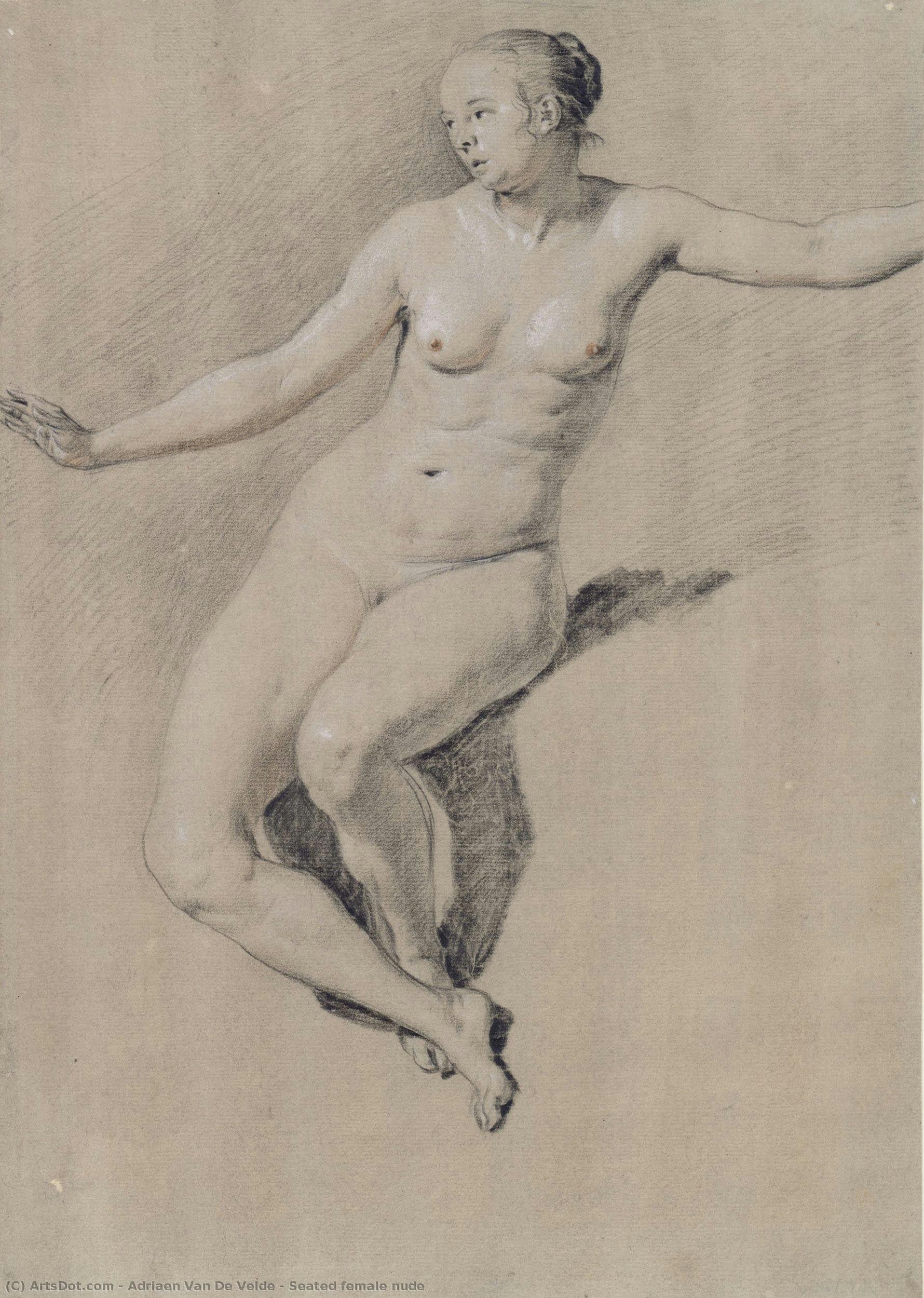
The Intimacy of the Sketch: A Study in Light and Form
In the quiet corners of the Dutch Golden Age, away from the grand maritime vistas and sweeping landscapes that defined the era, lies a more intimate form of artistic exploration. Adriaen van de Velde’s Seated Female Nude serves as a profound window into this private creative process. This delicate work, executed in three hues of chalk on grey paper, is far more than a mere preliminary sketch; it is a masterclass in the observation of light and the grace of the human silhouette. While originally conceived as a preparatory figure study for a larger painted composition, the drawing possesses a self-contained beauty that commands attention. The way the reflected light dances across the skin and the subtle shadows cast by the legs suggest a moment frozen in time, capturing the model in a state of relaxed, natural repose.
The technical prowess displayed in this piece is nothing short of mesmerizing. Through the meticulous use of hatching and cross-hatching, Van de Velde breathes life into the two-dimensional surface, creating a sense of volume and anatomical weight that feels almost tactile. The artist’s ability to manipulate graphite and chalk allows for a spectrum of tones, from the softest highlights on the shoulder to the deep, velvety shadows beneath the limbs. This rhythmic application of lines does not merely define the edges of the body but builds a textured landscape of musculature and curve, inviting the viewer to trace the contours of the figure with their eyes. It is this rigorous attention to detail that makes the piece an essential study for anyone captivated by the intersection of realism and classical elegance.
Historical Resonance and Artistic Legacy
To understand this drawing, one must look into the vibrant studio culture of seventeenth-century Holland. Adriaen van de Velde was a master of the tranquil landscape, yet his repertoire of figure studies reveals a deeper, more experimental side of his genius. During this period, figure studies were vital tools in an artist's arsenal, used to refine anatomical accuracy before committing brushstrokes to canvas. There is a poignant historical layer to this work as well; while male family members and colleagues often served as models for such studies, female models in the Dutch Republic frequently occupied complex social positions. In this drawing, however, the social context fades into the background, leaving only the pure, academic pursuit of beauty and form.
For the discerning collector or interior designer, this artwork offers a sophisticated touch of classical refinement. Its monochromatic palette of greys and subtle browns allows it to integrate seamlessly into a variety of high-end decor styles, from contemporary minimalist galleries to traditional, richly textured studies. The piece evokes an atmosphere of intellectual curiosity and timelessness, making it an ideal focal point for a space dedicated to contemplation. Owning a reproduction of such a significant study is not merely about possessing a beautiful image; it is about bringing the disciplined, observant spirit of the Dutch masters into the modern home, celebrating a legacy of anatomical truth and artistic devotion.