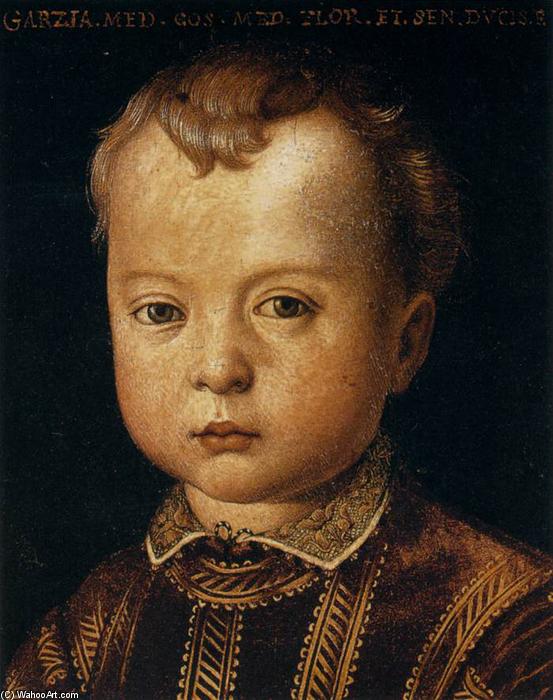
A Moment Suspended in Time: The Enigma of Garzia de' Medici
To gaze upon Agnolo Bronzino’s “Garzia de' Medici” is to encounter an exquisite moment suspended in the amber glow of the Italian Renaissance. Painted around 1555, this portrait transcends a mere likeness of a young boy; it is a carefully constructed meditation on status, expectation, and the delicate passage of time. The subject, a child of only five years, possesses an almost porcelain quality to his skin, which contrasts sharply with the deep, velvety expanse of the background. This dramatic void serves to elevate the figure, drawing the viewer into a silent dialogue across the centuries. There is a profound sense of dignified stillness in his gaze—a contemplative depth that belies his tender years and invites us to wonder about the weight of the Medici legacy resting upon such young shoulders.
The painting serves as a quintessential masterpiece of the Mannerist aesthetic. Unlike the balanced, optimistic naturalism of the High Renaissance seen in works by Raphael, Bronzino’s approach embraces a refined restraint and an unsettling, polished perfection. He rejects overt emotional outbursts in favor of a cool, intellectualized beauty. In this portrait, we see the hallmark of Mannerism: the deliberate use of elongated elegance and a smooth, almost enamel-like surface that prioritizes an idealized vision over raw naturalism. For the collector or interior designer, this piece offers a sophisticated focal point, bringing a sense of historical gravity and aristocratic grace to any curated space.
Technical Virtuosity and the Art of Detail
The enduring allure of Bronzino’s work lies in his unparalleled technical mastery. He employed a painstaking process of layering thin, translucent glazes over a precise disegno, or underdrawing, to achieve an astonishing textural depth. One cannot help but be captivated by the meticulous rendering of the boy's attire; the delicate lace of the ruffled collar and the intricate patterning of his garments are executed with such precision that they appear almost sculptural. Every strand of blonde hair is meticulously placed, demonstrating a commitment to anatomical accuracy that borders on the miraculous.
This mastery extends to Bronzino’s handling of light and shadow, known as chiaroscuro. The subtle variations in tone create a powerful illusion of volume, making the young Medici appear to emerge from the darkness into the light. The palette, though predominantly composed of muted shades of ivory, brown, and deep shadows, possesses a hidden luminosity that shifts as the viewer moves. This interplay of light not only defines the physical form but also contributes to the painting's emotional atmosphere—a blend of solemnity and quiet majesty. For those seeking a high-quality reproduction, capturing these subtle tonal transitions is essential to preserving the soul of Bronzino’s original vision.
A Legacy of Florentine Elegance
Beyond its aesthetic brilliance, the portrait is steeped in the rich historical context of the Florentine Court. As the official court painter to Cosimo I de' Medici, Bronzino was tasked with capturing the rigid etiquette and frozen grandeur of one of Europe's most powerful dynasties. This portrait of Garzia is not merely a family memento but a political instrument, projecting an image of stability, continuity, and noble composure. The boy’s serious expression reflects the disciplined upbringing expected of Medici royalty, where even childhood was framed by the responsibilities of lineage.
Integrating such a piece into a modern interior provides more than just decoration; it introduces a narrative of resilience and timelessness. Whether placed in a formal study or as a conversation piece in a contemporary gallery, the "Garzia de' Medici" evokes a sense of refined nostalgia. It is an invitation to appreciate the beauty of restraint and the power of a single, steady gaze to command a room. For the discerning art lover, owning a reproduction of this caliber means possessing a fragment of the Renaissance spirit—a piece that celebrates the intersection of human vulnerability and eternal nobility.