A Moment Frozen in Time: The Drama of Dürer’s Masterpiece
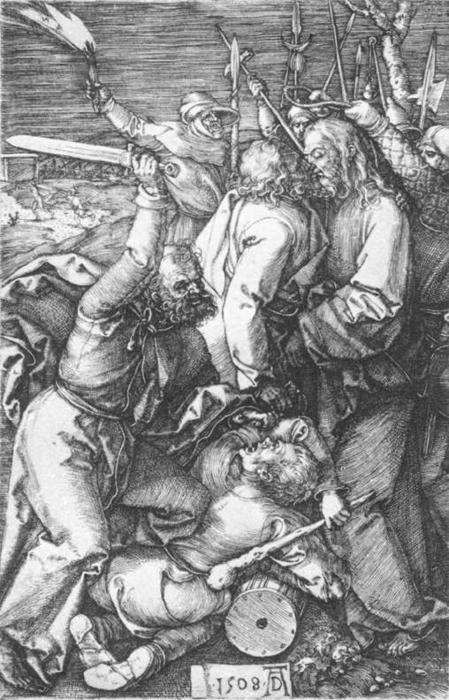
In the quiet intensity of Albrecht Dürer’s 1508 engraving, Betrayal of Christ (No. 3), we find ourselves thrust into a pivotal moment of human history and spiritual tragedy. This is not merely a depiction of a biblical event; it is a masterclass in capturing the palpable tension that exists between loyalty and treachery. As the viewer approaches this intricate work, they are immediately enveloped by a scene of controlled chaos. Within a confined, shadowed space, the air seems thick with the impending weight of destiny. Dür ander skillfully orchestrates a dense population of figures—soldiers, onlookers, and the central protagonists—to create an atmosphere where every shadow feels heavy with meaning and every movement suggests an irreversible turning point.
The composition centers on the agonizing intimacy of the betrayal itself: the embrace between Jesus Christ and Judas Iscariot. It is a profound study in psychological contrast. While the physical act is one of closeness, the emotional distance is vast. Through the strategic use of overlapping forms and a carefully constructed perspective, Dürer guides our eyes through the swirling crowd, ensuring that we do not just witness the arrest, but feel the claustrophobia and urgency of the moment. For the collector or designer, this piece offers a profound focal point, bringing a sense of historical gravity and intellectual depth to any curated space.
The Symphony of Line: Technical Brilliance in Printmaking
To behold this engraving is to witness the pinnacle of Northern Renaissance technical innovation. Dürer’s mastery of the printmaking medium is revealed through his unparalleled application of hatching and cross-hatching. These are not merely marks on a plate; they are the very breath of the artwork. Through a meticulous symphony of fine lines, the artist achieves an astonishing level of realism that defies the limitations of black and white ink. He renders the heavy folds of Christ's robes and the rugged textures of Judas’ cloak with such precision that one can almost sense the weight and weave of the fabric.
The brilliance lies in how Dürer uses line density to manipulate light and shadow. In areas where the lines are tightly packed and intersecting, deep, velvety shadows emerge, creating a sense of profound depth and mystery. Conversely, sparser, more delicate strokes allow light to flicker across the scene, suggesting the presence of torches that illuminate the faces of the soldiers and the grim determination of the captors. This interplay of light and dark—the chiaroscuro effect achieved through pure line work—gives the composition a sculptural quality, making the figures appear to emerge from the paper into our own reality.
Symbolism and the Legacy of the German Renaissance
Beyond its technical splendor, the artwork serves as a profound vessel for religious and symbolic narrative. Every element within the frame is imbued with significance. The Judas kiss, a symbol of ultimate treachery, stands in stark opposition to the stoic resignation visible in the countenance of Christ. The presence of armed soldiers represents the encroaching power of earthly authority, while the flickering torches serve as metaphors for both the illumination of truth and the impending darkness of death. This layer of symbolism invites deep contemplation, making the piece an enduring subject for academic study and personal reflection.
As a cornerstone of the German Renaissance, this work reflects the meticulous craftsmanship of Nuremberg’s artistic tradition. Dürer’s ability to blend intense emotionality with mathematical precision set a new standard for European art. For those seeking to adorn their homes or galleries with a high-quality reproduction, Betrayal of Christ (No. 3) offers more than just decoration; it provides an invitation to engage with the very soul of art history. It is a piece that commands attention, sparking conversation and providing a timeless sense of elegance and intellectual rigor to any sophisticated interior.