A Renaissance Vision of Devotion and Nature
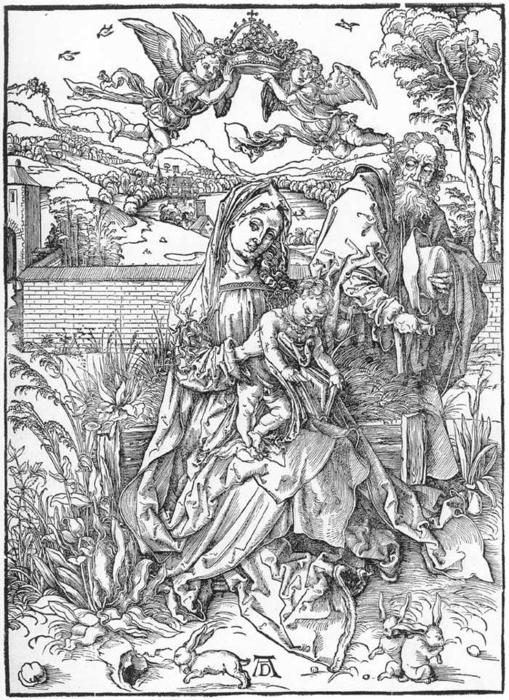
In the quiet, meticulously carved lines of Albrecht Dürer’s “The Holy Family with Three Hares,” we encounter more than just a religious scene; we step into a profound meditation on the interconnectedness of the divine and the earthly. Created around 1497-98, this masterpiece from the Northern Renaissance captures a moment of serene intimacy within an enclosed garden, a setting that evokes the primordial innocence of Eden. As the eye wanders through the composition, it meets the tender gaze of the Virgin Mary cradling the Christ Child, while Joseph stands as a silent, protective sentinel. The artwork does not merely depict a family; it invites the viewer into a sanctuary of peace, where the boundaries between the sacred and the natural world seem to dissolve into a single, harmonious breath.
The emotional resonance of this piece lies in its ability to balance monumental theological themes with delicate, earthly delights. Dürer, a master of the woodcut medium, utilizes the stark contrast of black ink on paper to breathe life into every texture—from the soft, downy fur of the animals to the heavy, rhythmic folds of the figures' garments. There is a palpable sense of warmth within the monochrome palette, achieved through an extraordinary command of hatching and cross-hatching. For the collector or designer, this work offers a sophisticated interplay of light and shadow, making it a centerpiece that commands attention through its quiet intensity rather than through loud color.
The Language of Symbolism and Technical Mastery
Beyond its surface beauty, the artwork is a complex tapestry of hidden meanings, designed to be decoded by the observant viewer. Most striking are the three hares scattered throughout the lower portion of the print. In the iconographic language of the Renaissance, these creatures were far more than mere woodland inhabitants; they served as potent symbols of fertility, abundance, and even the regenerative power of Christ. Their playful presence adds a layer of vitality to the scene, suggesting that the grace of the Holy Family flows outward into all living things. Even smaller details, such as the coral necklace around the infant Jesus, whisper of both protection against hardship and the foreshadowing of his eventual sacrifice.
Technically, this work represents the pinnacle of Dürer’s early achievements in printmaking. The precision of his lines is nothing short of breathtaking, showcasing a level of detail that was unprecedented for the woodcut medium of his era. Each stroke is deliberate, creating a sense of three-dimensional volume and depth within a relatively flattened perspective. This mastery of line allows the artist to create a rich variety of textures—the rough bark of trees, the smooth skin of the Madonna, and the intricate architectural elements of the background. For those seeking to adorn a space with art that embodies intellectual depth and technical perfection, this reproduction serves as a timeless testament to the enduring genius of the German Renaissance.