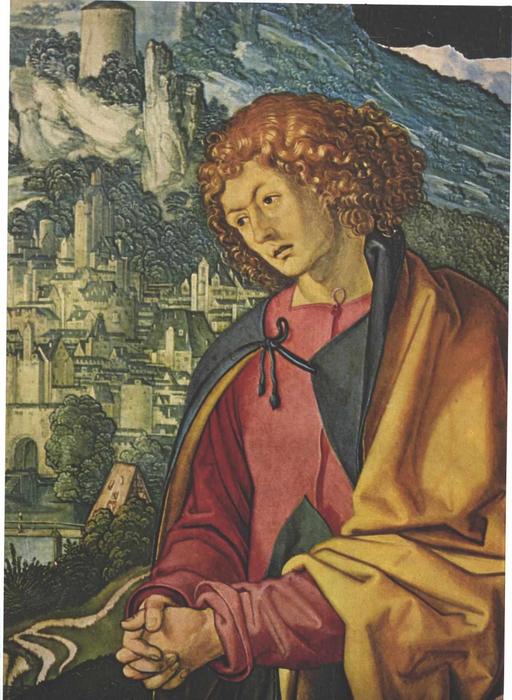
Experience Albrecht Dürer’s iconic ‘John,’ a dramatic Renaissance painting featuring a robed figure with long hair contemplating a book amidst a majestic mountainous landscape and castle backdrop, capturing the artist's masterful detail and profound spiritual mood. Discover this timeless artwork to own a piece of history.
A Portrait of Contemplation: Albrecht Dürer's "John"
Albrecht Dürer’s “John” is not merely a depiction of a man; it’s an immersion into the profound introspection characteristic of the Northern Renaissance. Painted around 1506, this arresting image captures a moment of intense contemplation, rendered with the meticulous detail and symbolic depth that defined Dürer's artistic legacy. The subject, identified as John – likely referencing John the Baptist, though the precise identification remains open to interpretation – is presented in a dramatic landscape setting, immediately establishing an epic scale and suggesting a spiritual journey. The painting’s power lies not just in its technical brilliance but also in its ability to evoke a deep sense of human vulnerability and the search for meaning within a complex world.
Technical Mastery and Dürer's Innovation
- Oil on Panel: Dürer’s masterful use of oil paint on a wooden panel allowed for unprecedented levels of detail, color blending, and tonal variation. This technique was revolutionary at the time, moving away from the more limited methods of tempera painting prevalent in earlier Renaissance art.
- Linear Perspective & Detail: The meticulously rendered mountainous landscape employs a sophisticated understanding of linear perspective, drawing the viewer’s eye into the depth of the scene. Dürer's obsessive attention to detail – from the folds of the robe to the individual strands of hair – is characteristic of his approach and reflects his desire to capture reality with unparalleled accuracy.
- Cross-Hatching & Burnishing: Dürer’s signature technique of cross-hatching, combined with subtle burnishing (polishing the paint surface to create a luminous effect), creates a rich texture and depth that adds to the painting's dramatic impact.
Symbolism Within the Scene
The symbolism within “John” is layered and open to interpretation, reflecting Dürer’s engagement with humanist thought and religious allegory. The figure’s downward gaze suggests prayer or deep contemplation, a common theme in Northern European art during this period. The mountainous landscape itself can be seen as representing the challenges of faith and the arduous climb towards spiritual enlightenment. The presence of other figures in the background, likely members of a gathering or court, adds to the narrative complexity, perhaps symbolizing the influence of society on an individual’s beliefs. The distant castle, a recurring motif in Dürer's work, may represent worldly power and ambition – a stark contrast to the figure’s inward focus.
Historical Context & Dürer’s Vision
Painted during a pivotal moment in European history—the early 16th century—"John" embodies the spirit of the German Renaissance. Dürer, deeply influenced by Italian Renaissance artists like Botticelli and Perugino, sought to synthesize classical ideals with Northern European traditions. His work reflects a growing interest in humanism, emphasizing individual potential and intellectual inquiry. Dürer’s exploration of religious themes, combined with his technical innovations, cemented his place as one of the most important artists of the era, shaping the course of art history for generations to come.