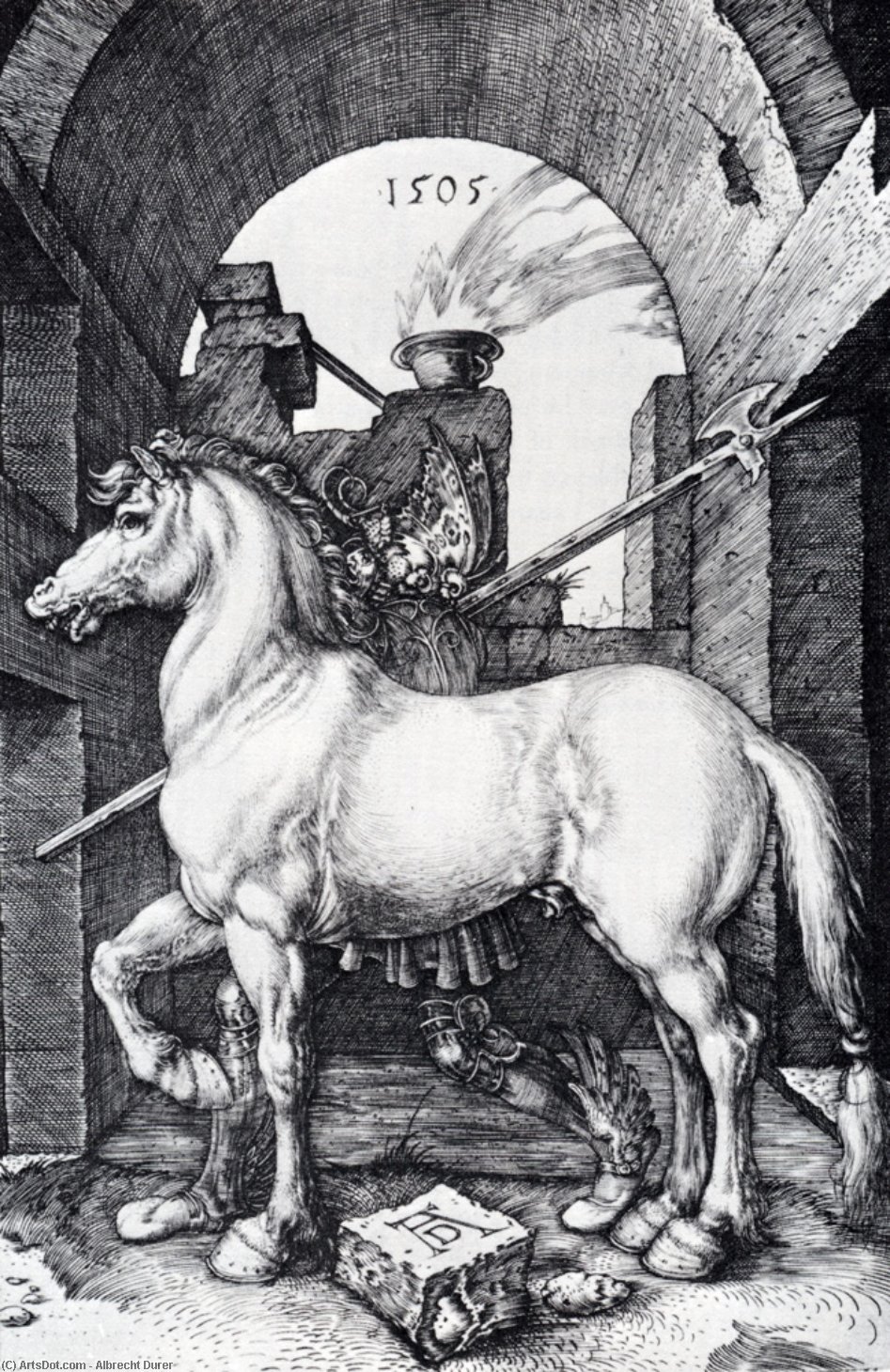
Albrecht Dürer’s meticulously detailed engraving, ‘The Small Horse,’ captures a stunning Renaissance scene of two horses and figures within an imposing architectural setting, showcasing the artist's masterful linework and perspective from 1505.
A Masterpiece of Precision: Albrecht Dürer's "The Small Horse"
Albrecht Dürer’s “The Small Horse,” created in 1505, stands as a monumental achievement within the Northern Renaissance printmaking tradition. This engraving, meticulously rendered with an almost obsessive attention to detail, offers a profound glimpse into the artistic sensibilities of one of history's most influential figures. More than just a depiction of two horses and their riders, it’s a carefully constructed tableau brimming with symbolic weight and technical mastery – a testament to Dürer’s relentless pursuit of perfection.
Technical Brilliance: The Art of the Burin
- Medium & Technique: Executed as an engraving on copper, “The Small Horse” showcases Dürer's unparalleled skill with the burin. This precise tool allowed him to carve incredibly fine lines into the metal plate, creating a surface that, when inked and pressed onto paper, produced astonishingly detailed imagery.
- Line Work: The engraving’s power resides in its meticulously crafted lines. Close-spaced hatching builds up tonal values with remarkable subtlety, while broader strokes define the horses' muscular forms and the architectural backdrop. Dürer’s mastery of *hatching* and *cross-hatching* elevates the image beyond a simple representation; it achieves a palpable sense of volume and texture.
- Perspective & Depth: Linear perspective is flawlessly applied, drawing the viewer’s eye into the scene and creating an illusion of depth that was revolutionary for its time. The layering of architectural elements – arches, columns, and a book – further enhances this spatial effect.
Symbolism and Context: A Portrait of Power and Knowledge
Dürer’s “The Small Horse” is believed to have been commissioned by Emperor Maximilian I, reflecting the Renaissance fascination with classical themes and the power of equestrian portraiture. The two horses represent nobility and military might, while the rider embodies authority and control. The inclusion of a book in the lower right corner adds another layer of meaning – perhaps symbolizing knowledge, learning, or even the emperor’s scholarly pursuits. The bird in the upper left corner could be interpreted as a symbol of freedom or divine inspiration.
Emotional Impact & Artistic Style
The engraving's stark grayscale palette amplifies its emotional impact, focusing attention on the intricate details and Dürer’s masterful manipulation of light and shadow. The composition is remarkably balanced, drawing the eye to the central figures while simultaneously creating a sense of enclosure within the architectural setting. Dürer’s style exemplifies the Northern Renaissance printmaking tradition – characterized by its meticulous detail, precise linework, and realistic depiction of forms. It's a work that invites contemplation, revealing layers of meaning with each careful observation.