A Vision of Regal Splendor and Divine Grace
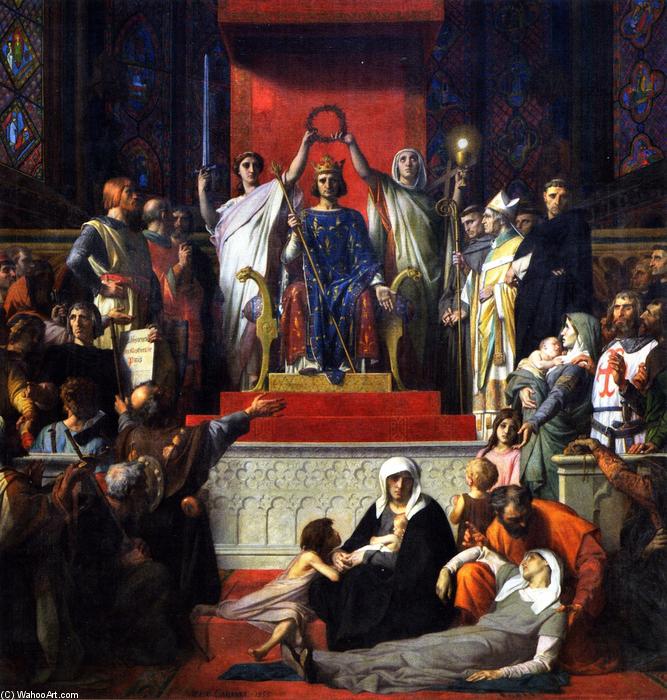
In the grand tapestry of nineteenth-century French art, few works capture the intersection of temporal power and spiritual devotion as profoundly as Alexandre Cabanel’s 1853 masterpiece, The Glorification of St. Louis. This monumental oil on canvas is far more than a mere historical record; it is an immersive experience that transports the viewer into the heart of a sacred coronation. As the eye wanders through the composition, one is immediately struck by the palpable sense of ceremony surrounding the coronation of Louis IX. Cabanel meticulously orchestrates a scene of immense gravity, where the weight of the crown is matched only by the spiritual significance of the moment. The painting serves as a breathtaking window into an era where the legitimacy of the throne was inextricably linked to divine will, presenting a spectacle that is both intensely human and ethereally holy.
The technical brilliance of Cabanel lies in his unwavering commitment to the principles of Academic Realism. A student of the prestigious École des Beaux-Arts, Cabanel employed a sophisticated technique of layering glazes to achieve surfaces that appear almost velvety to the touch. This method allows light to penetrate the upper layers of paint, creating a luminous depth that breathes life into the figures. The artist’s mastery of modeling is particularly evident in the way he renders the heavy, ornate drapery and the subtle musculature of the assembled dignitaries. Every fold of fabric and every glint of gold seems to vibrate with an inner light, lending the entire scene an otherworldly, dreamlike quality that elevates the historical event into the realm of legend.
Symbolism and the Echoes of Empire
Beyond its surface beauty, The Glorification of St. Louis is a complex web of symbolic language designed to inspire awe and reinforce traditional values. At the center of this dramatic tableau sits Louis IX upon his throne, a figure of commanding presence adorned with the fleurs-de-lis—the unmistakable emblem of French royalty. As he receives the crown from Archbishop Bertrand Dubois de Fézensac, the painting captures the precise moment where earthly authority is sanctified by religious ritual. The surrounding crowd, composed of various strata of society, acts as a chorus of witnesses, their varied postures of kneeling and reverence underscoring the themes of piety and social order that were so central to the Second Empire’s artistic mandate.
For the discerning collector or interior designer, this artwork offers an unparalleled opportunity to introduce a sense of historical weight and classical elegance into a space. The painting does not merely decorate a wall; it anchors a room with its narrative depth and tonal richness. Whether placed in a formal library, a grand salon, or a sophisticated contemporary study, a high-quality reproduction of this work brings with it the prestige of the French Salon tradition. It invites contemplation on the nature of legacy, the beauty of meticulous craftsmanship, and the enduring power of the heroic ideal, making it a timeless centerpiece for any curated collection.