Introduction to Alexej von Jawlensky and ‘Garden Path in Carantec’
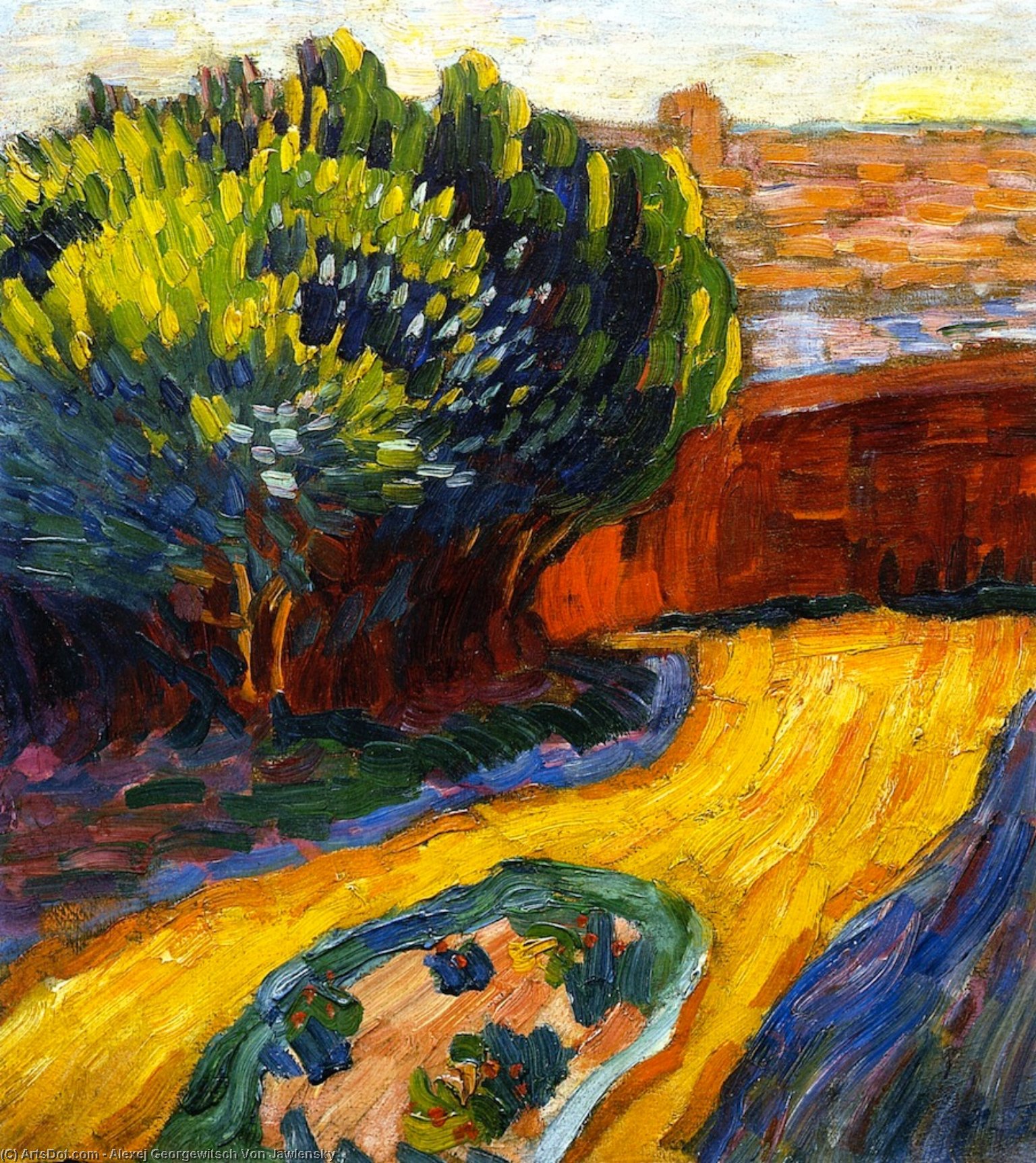
Alexej Georgewitsch von Jawlensky (1864 – 1941) stands as a profoundly significant, yet often overlooked, figure within the burgeoning landscape of early Expressionism. Born in Torzhok, Russia, his life was a testament to relentless artistic pursuit, fueled by an intensely personal vision and a rejection of academic convention. Jawlensky’s work wasn't merely about depicting reality; it was about excavating and conveying raw emotion – a characteristic that resonates powerfully within ‘Garden Path in Carantec,’ painted in 1905. This small canvas (53 x 50 cm) offers an intimate glimpse into the artist’s world, a world characterized by a fervent desire to capture not just what he saw, but how he *felt* about it. The painting's quiet beauty belies a deep current of psychological intensity, reflecting Jawlensky’s lifelong struggle with anxiety and his profound connection to the spiritual.
A Study in Color and Texture – The Style of Von Jawlensky
‘Garden Path in Carantec’ exemplifies Jawlensky's distinctive approach. He deliberately eschewed smooth blending and meticulous detail, favoring instead bold, gestural brushstrokes that built up layers of thick paint. This impasto technique isn’t simply a matter of texture; it’s integral to the painting’s expressive power. The vibrant yellows – dominant in the road and perhaps hinting at a feverish intensity – are juxtaposed with earthy browns and greens, creating a dynamic tension. The figures themselves are rendered with simplified forms, almost mask-like in their expression, further emphasizing the emotional weight of the scene. This deliberate distortion of form aligns perfectly with the tenets of Expressionism, prioritizing subjective experience over objective representation. Notice how the paint itself seems to vibrate with energy – a direct result of Jawlensky’s passionate application.
Contextualizing ‘Garden Path in Carantec’: The Brücke Movement
To fully appreciate ‘Garden Path in Carantec,’ it's crucial to understand its place within the broader artistic movement of Die Brücke (The Bridge). Founded in Dresden in 1905, Die Brücke was a group of artists – including Ernst Ludwig Kirchner and Erich Heckel – who sought to break free from the constraints of academic art. They were drawn to urban decay, social alienation, and the raw emotions of modern life. Jawlensky was a key member, and ‘Garden Path in Carantec’ reflects this shared aesthetic: a focus on stark contrasts, simplified forms, and an exploration of psychological states. The painting's creation coincided with the Brücke group’s formative years, demonstrating the influence of their collective experimentation with color and subject matter.
Symbolism and Emotional Resonance
The seemingly simple scene – a garden path, trees, and two figures – is laden with symbolic potential. The path itself can be interpreted as a journey, both literal and metaphorical. The figures, positioned at the edges of the composition, suggest isolation or perhaps a yearning for connection. Jawlensky’s use of color further amplifies this emotional resonance; the yellow road could represent hope or delusion, while the shadowed areas evoke feelings of unease and introspection. Ultimately, ‘Garden Path in Carantec’ is not merely a depiction of a landscape; it's a powerful meditation on human experience – a testament to Jawlensky’s ability to translate profound emotion onto canvas.
Bringing ‘Garden Path in Carantec’ into Your Space
ArtsDot.com offers meticulously crafted, hand-painted reproductions of Alexej von Jawlensky's 'Garden Path in Carantec'. Each reproduction is created using the same techniques and materials as the original painting, ensuring an authentic representation of this remarkable artwork. Whether you are a seasoned art collector or seeking to add a touch of emotional depth to your interior design, our reproductions provide a beautiful and enduring way to experience the power of Jawlensky’s vision. Consider how the vibrant colors and textured surface will interact with your existing décor – a bold statement piece for a modern space, or a subtle reflection of introspective beauty in a more traditional setting.