Alexej von Jawlensky: Mourning – A Study in Raw Emotion
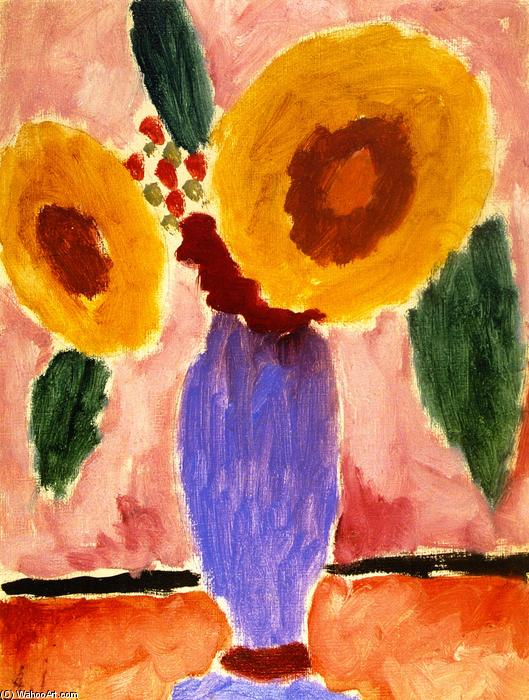
This arresting image, painted by Alexej von Jawlensky in 1917, is far more than a still life; it’s a visceral exploration of grief and the fragility of beauty. The composition immediately commands attention with its bold contrasts – the vibrant blue of the vase juxtaposed against the stark red of the table – a deliberate choice that amplifies the painting's emotional intensity. Jawlensky, a key figure in early 20th-century Expressionism, was driven by a desire to bypass representational accuracy and tap directly into the raw emotions simmering beneath the surface of experience. His work, often characterized by simplified forms and intensely saturated colors, reflects a profound engagement with the spiritual and psychological dimensions of human existence.
The subject matter itself – a simple vase overflowing with yellow flowers – is deliberately imbued with symbolic weight. Flowers have long been associated with mourning rituals across cultures, representing remembrance and the ephemeral nature of life. The specific choice of yellow, a color often linked to sorrow and decay in Western art history, further underscores this theme. Jawlensky’s masterful use of impasto—thickly applied paint—adds a tactile quality to the work, inviting the viewer to almost feel the texture of the vase and the weight of the emotion it embodies. The slightly distorted forms of the flowers, rendered with loose, expressive brushstrokes, contribute to a sense of unease and instability, mirroring the turbulent emotional state at the heart of the painting.
Technique & Style: The Essence of Expressionism
Jawlensky’s technique is instantly recognizable as a cornerstone of Expressionist painting. He rejected academic precision in favor of a highly personal style characterized by bold color choices, simplified forms, and an emphasis on conveying subjective experience rather than objective reality. His brushwork is deliberately rough and energetic, creating a sense of movement and urgency within the composition. The lack of blending and meticulous detail forces the viewer to confront the raw emotion directly, without mediation. This approach was heavily influenced by his time spent studying with Marianne Werefkin in Munich, where he absorbed her emphasis on color as a primary expressive tool.
The painting’s flatness – a deliberate stylistic choice – further enhances its emotional impact. Jawlensky stripped away any illusion of depth or perspective, forcing the viewer to engage with the image on a purely visual and emotional level. This technique aligns perfectly with the Expressionist movement's rejection of traditional representational conventions in favor of a more direct and immediate form of artistic expression.
Historical Context & Symbolism
Created during a period of immense social and political upheaval – the years leading up to World War I – “Mourning” reflects the anxieties and uncertainties of the era. Jawlensky’s work, like that of many Expressionist artists, can be interpreted as a response to the perceived loss of traditional values and the growing sense of alienation in modern society. The painting's symbolism extends beyond simple mourning; it speaks to broader themes of mortality, memory, and the human condition. The isolated vase, devoid of context or narrative, becomes a potent symbol of individual experience within a chaotic world.
Furthermore, the painting’s creation coincided with Jawlensky’s exploration of iconographic imagery, drawing inspiration from Byzantine religious icons – a tradition he deeply admired and sought to emulate. This influence is evident in the simplified forms and intense colors, reflecting a desire to tap into a deeper spiritual truth.
Emotional Impact & Artistic Value
"Mourning" remains a profoundly moving work of art, capable of eliciting a powerful emotional response from viewers. Jawlensky’s ability to translate complex feelings – grief, loss, and perhaps even a sense of existential dread – into a visually compelling image is testament to his artistic genius. This reproduction captures the essence of Jawlensky's style with exceptional fidelity, offering an opportunity to experience this iconic artwork firsthand. It’s a piece that invites contemplation, prompting viewers to confront their own emotions and consider the enduring themes of life and death.