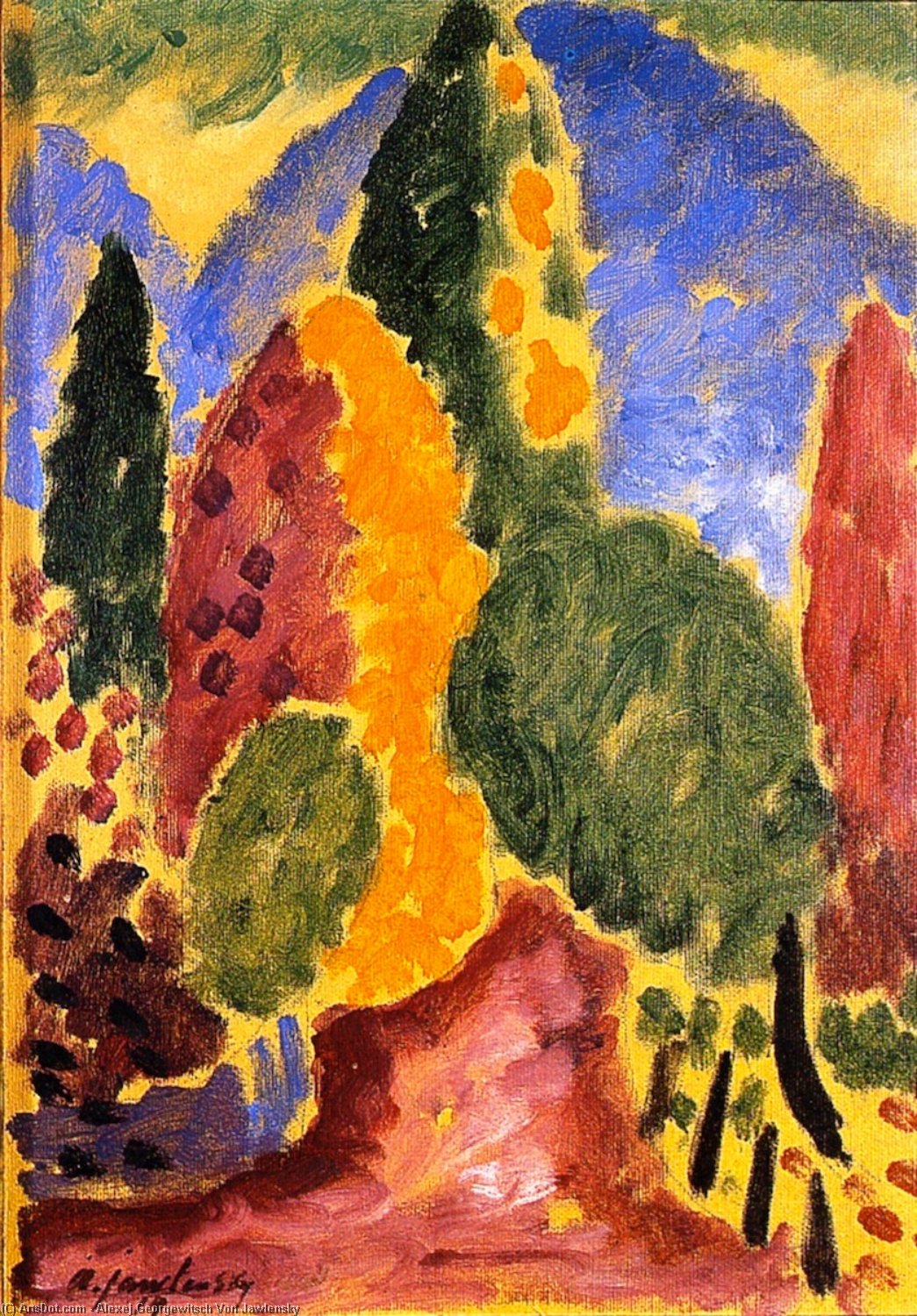
Alexej von Jawlensky: Variation IV – A Study in Emotional Color
Alexej von Jawlensky’s “Variation IV” is not merely a landscape; it's a raw, visceral outpouring of emotion rendered with the deliberate intensity characteristic of his Expressionist style. Painted in 1914, this work exemplifies his rejection of academic realism in favor of a deeply personal and subjective interpretation of nature. The composition – dominated by bold brushstrokes and a vibrant palette of blues, greens, and ochres – immediately draws the viewer into a world where form and color are inextricably linked, serving not to represent reality but to evoke feeling.
)
Impasto and Gesture: The Language of Emotion
Jawlensky’s technique is immediately apparent in the thick, almost sculptural impasto applied to the canvas. This heavy layering of paint isn't simply a stylistic choice; it’s a deliberate attempt to capture movement and energy – the rustle of leaves, the flow of water, the very breath of nature. The loose, gestural brushstrokes contribute to this sense of dynamism, creating a surface that is tactile and alive. Notice how the artist doesn’t meticulously blend colors but rather allows them to retain their individual character, contributing to the overall intensity and vibrancy of the scene.
Symbolism Within the Landscape
While seemingly depicting a simple landscape – trees against a sky – “Variation IV” is rich in symbolic meaning. Jawlensky was deeply interested in spirituality and the power of symbols, often drawing on Christian iconography. The simplified forms of the trees can be interpreted as representing resilience and strength, while the expansive blue sky suggests an infinite realm of possibility. The overall effect is one of profound contemplation, inviting the viewer to connect with the primal forces of nature.
Context: Expressionism and Jawlensky’s Vision
Created during a period of immense social and political upheaval, “Variation IV” reflects the broader trends within early 20th-century art. As a key member of Der Blaue Reiter (The Blue Rider) group – alongside artists like Kandinsky and Marc – Jawlensky was at the forefront of the Expressionist movement. This movement sought to express subjective emotions and experiences rather than objective reality, often employing distorted forms and jarring colors to achieve this effect. Jawlensky’s work stands as a testament to his unwavering commitment to artistic truth—a truth found not in imitation but in the honest expression of feeling.