Untitled (AQQC4N)

Alfredo Roque Gameiro’s 1920 watercolor captures a bustling European street scene. Discover this nostalgic piece – rich colors, organic lines & detailed realism.


Alfredo Roque Gameiro (1864 - 1935)

Alfredo Roque Gameiro (1864-1935) was a renowned Portuguese painter & graphic artist specializing in vibrant watercolors. Known for idyllic landscapes, 'Lisboa Velha', and book illustrations, he shaped Portuguese watercolor art. Explore his legacy!

A Glimpse into a Bygone Era: Alfredo Roque Gameiro’s Urban Scene

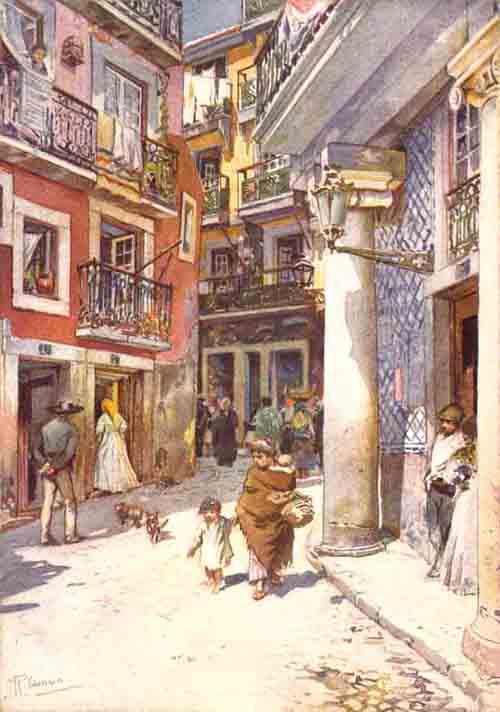
  • Subject & Composition: This captivating watercolor by Alfredo Roque Gameiro transports us to a bustling European street, likely within Portugal itself. The scene is alive with activity – figures stroll along the thoroughfare, suggesting a vibrant daily life unfolding before our eyes. Gameiro masterfully employs converging lines and densely packed forms to create a sense of depth and energetic movement, drawing the viewer into the heart of the urban landscape. The composition isn’t focused on grand monuments but rather the everyday interactions and architectural details that define a city's character.
  • Style & Technique: Painted in 1920, this work exemplifies Gameiro’s skill as a watercolorist. His technique leans towards realism, yet possesses a romantic sensibility – a delicate balance between precise observation and artistic interpretation. The visible brushstrokes and wet-on-wet blending create soft transitions of color and a slightly grainy texture, lending the piece a charmingly nostalgic quality. The predominantly organic lines echo the irregular shapes of buildings and people, contributing to the scene’s naturalistic feel. Gameiro's expertise in lithography, honed during his studies in Leipzig, likely informed his precise handling of line and form even within this watercolor medium.

Alfredo Roque Gameiro: A Portuguese Master of Watercolor

  • Artist’s Background: Alfredo Roque Gameiro (1864-1935) was a pivotal figure in Portuguese art, renowned for his watercolors and graphic work. His early training at the Faculty of Fine Arts in Lisbon, followed by specialized study in lithography in Leipzig, equipped him with a versatile skillset. He wasn’t merely a painter; he was also an educator – teaching at the Escola Industrial do Príncipe Real – and a prolific illustrator, contributing to publications like a deluxe edition of *The Lusiads*. This diverse career reflects his central role within Portugal's artistic community.
  • Historical Context: The year 1920 was a period of transition in Europe following the First World War. While not explicitly depicting wartime themes, Gameiro’s work offers a quiet counterpoint – a focus on everyday life and enduring urban spaces. His scenes provide a valuable glimpse into the social fabric of Portugal during this era, capturing a sense of continuity amidst broader societal shifts.

Emotional Resonance & Decorative Appeal

  • Atmosphere & Mood: The warm color palette and diffused lighting evoke a feeling of sunlight and liveliness. While the scene is crowded, it doesn’t feel chaotic; rather, there's a sense of harmonious activity. This creates an inviting atmosphere that draws the viewer in, fostering a connection to the depicted moment.
  • Interior Design Considerations: A reproduction of this artwork would be a beautiful addition to various interior styles – from traditional and eclectic spaces to more contemporary settings seeking a touch of vintage charm. The warm tones complement neutral palettes, while the detailed composition provides visual interest without overwhelming a room. Its relatively intimate scale makes it suitable for smaller spaces like studies or bedrooms, as well as larger living areas.