Alphonse Maria Mucha: The Poet of Flowing Lines – An Exploration of “Moet & Chandon White Star”
The Czech artist Alphonse Maria Mucha stands as an undisputed icon of Art Nouveau, a movement that sought to elevate decorative arts into realms of intellectual and emotional expression. More than just aesthetically pleasing, Mucha’s canvases strive to capture the spirit of their time – a reaction against industrialization and Victorian formalism, fueled by burgeoning interest in mythology, folklore, and psychoanalysis.
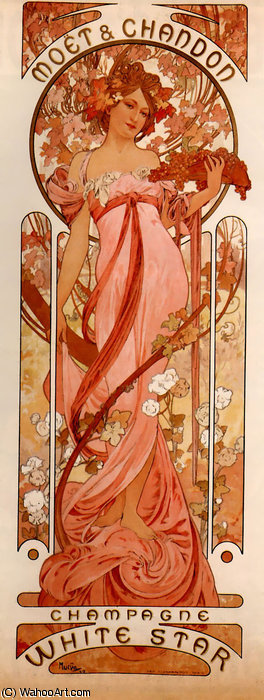
"Moet & Chandon White Star," commissioned for the prestigious Salon des Cent in Paris in 1903, exemplifies Mucha’s signature style with breathtaking precision. It's a portrait not merely of a woman, but of an idealized feminine archetype – a figure draped in shimmering fabric that embodies grace, serenity, and an almost ethereal beauty.
Style and Technique: The Art Nouveau Manifesto
Mucha’s technique is characterized by meticulous linework, achieved through the painstaking application of dry brushstrokes. These lines aren't simply decorative; they are imbued with movement and rhythm, mirroring the undulating curves that dominate the composition. He employs a palette dominated by pastel hues – creamy whites, pale yellows, blush pinks – creating an atmosphere of luminous softness.
"Moet & Chandon White Star" showcases Mucha’s masterful use of color blending and layering to achieve depth and luminosity. The artist skillfully manipulates tonal variations to sculpt the woman's form, emphasizing her delicate contours and conveying a palpable sense of stillness. Unlike Impressionists who sought to capture fleeting moments of light, Mucha aimed for permanence – to distill beauty into an image that transcends time.
Historical Context: A Reaction Against Tradition
The Salon des Cent arrived at the cusp of the 20th century, marking a decisive break from artistic conventions established in previous eras. Artists like Mucha rejected academic realism and embraced symbolism as a means of communicating complex ideas and emotions. The salon’s organizers deliberately curated an exhibition that challenged prevailing tastes, showcasing works that prioritized imagination over observation.
Mucha's inspiration drew heavily from Celtic mythology and the decorative arts traditions of Bohemia – his homeland. He meticulously researched ancient symbols and motifs, integrating them into his paintings with erudition and artistic sensitivity. “Moet & Chandon White Star” reflects this intellectual engagement, embodying Mucha’s belief that art should nourish the soul as well as delight the eye.
Symbolism: The Language of Dreams
The woman depicted in "Moet & Chandon White Star" is not simply a beautiful face; she represents an idealized feminine ideal – purity, innocence, and spiritual contemplation. The flowers held by the figure symbolize fertility and rebirth, echoing themes prevalent in Celtic folklore.
Furthermore, Mucha’s use of flowing drapery serves as a visual metaphor for transformation and fluidity. Just as water adapts to its surroundings, the woman's dress embodies an acceptance of change and an embrace of beauty in all its forms. The overall composition invites contemplation – prompting viewers to consider questions of identity, desire, and the relationship between art and life.
Emotional Impact: A Moment Frozen in Time
"Moet & Chandon White Star" transcends mere visual representation; it evokes a profound emotional response. Its serene beauty inspires feelings of tranquility and wonder, transporting viewers to a realm of imaginative grace.
More than just an exquisite artwork, Mucha’s masterpiece stands as testament to the transformative power of Art Nouveau – a movement that dared to redefine artistic boundaries and elevate decorative arts into vehicles for intellectual and emotional exploration. It remains a captivating emblem of beauty, symbolism, and enduring inspiration.