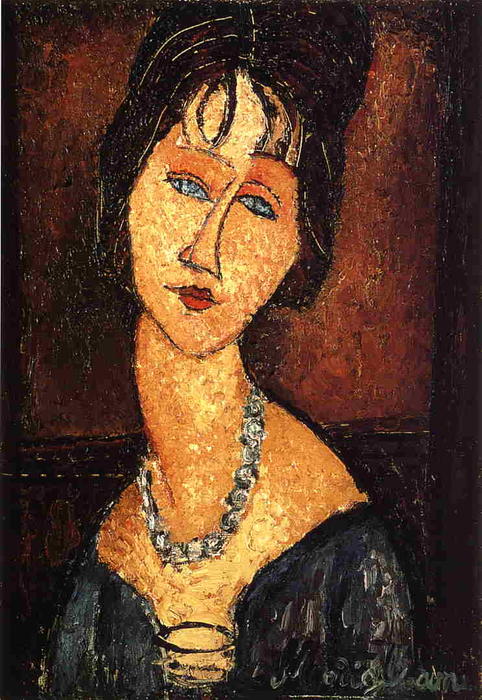
A Portrait of Melancholy: Amedeo Modigliani’s “Jeanne Hebuterne with Necklace”
Amedeo Modigliani's "Jeanne Hebuterne with Necklace," painted in 1917, isn’t merely a portrait; it’s a distilled essence of longing and quiet contemplation. This oil on canvas, measuring a modest 55 x 38 cm, encapsulates the artist’s signature style – elongated forms, subtly distorted features, and an intensely psychological depth that continues to resonate with viewers over a century later. The painting immediately draws you in with its muted palette of ochres, browns, and deep blues, creating a sense of intimacy as if peering into a private moment. It's a work born from a complex relationship – Modigliani’s muse, Jeanne Hebuterne, herself an artist, became the subject of countless portraits, each offering a glimpse into his world of passionate intensity and underlying sadness.
The Expressionist Soul: Distortion as Emotion
“Jeanne Hebuterne with Necklace” firmly resides within the realm of Expressionism, though Modigliani’s approach is uniquely his own. Rather than employing overt distortion to shock or provoke, he utilizes subtle shifts in proportion – particularly in the elongated neck and face – to convey a profound sense of inner turmoil. This isn't a celebration of beauty in the conventional sense; instead, it’s an exploration of vulnerability and the weight of unspoken emotions. The downward cast of Jeanne Hebuterne’s eyes speaks volumes, suggesting a thoughtful introspection or perhaps a quiet sorrow. The artist masterfully uses line to define form, creating a visual rhythm that mirrors the emotional currents flowing beneath the surface.
A Symphony of Color and Form
Technically, Modigliani's brushwork is remarkably controlled despite the expressive intent. He employs short, broken strokes, layering color to build depth and texture. The use of contrasting tones – particularly in the shadows that define her face – adds a dramatic quality to the composition. Notice how he utilizes a limited but carefully chosen palette; it’s not about vibrant hues, but rather the subtle interplay of light and shadow, creating an atmosphere of subdued intensity. The inclusion of the necklace itself is significant—a small, elegant detail that provides a counterpoint to the overall mood, hinting at a fleeting moment of grace within a larger narrative of melancholy.
Historical Context: Love, Loss, and the Parisian Avant-Garde
Painted in 1917, during a period of immense social and political upheaval – the shadow of World War I loomed large – “Jeanne Hebuterne with Necklace” reflects the anxieties and uncertainties of the era. Modigliani’s life itself was marked by tragedy; he battled illness throughout his adult years and tragically died in 1920, leaving behind a legacy of hauntingly beautiful works. His relationship with Jeanne Hebuterne was both passionate and fraught with difficulty, adding another layer of complexity to this portrait. The painting can be understood within the context of the Parisian avant-garde scene – a hub of artistic experimentation and bohemianism where Modigliani found his creative voice.
Owning a Fragment of History: Reproductions for the Soul
ArtsDot offers meticulously crafted, hand-painted reproductions of “Jeanne Hebuterne with Necklace,” allowing you to bring this evocative masterpiece into your home or office. These aren’t simply prints; they are faithful recreations that capture the spirit and emotional depth of Modigliani's original work. Consider how this piece would complement a space – its muted tones and contemplative mood lending an air of sophistication and quiet reflection. Explore other works by Modigliani on ArtsDot.com, including “Reclining nude” and “Nu couche de dos,” to delve deeper into the artist’s extraordinary vision. Each reproduction is a tangible connection to a pivotal moment in art history, inviting you to contemplate the enduring power of beauty, sorrow, and the human condition.