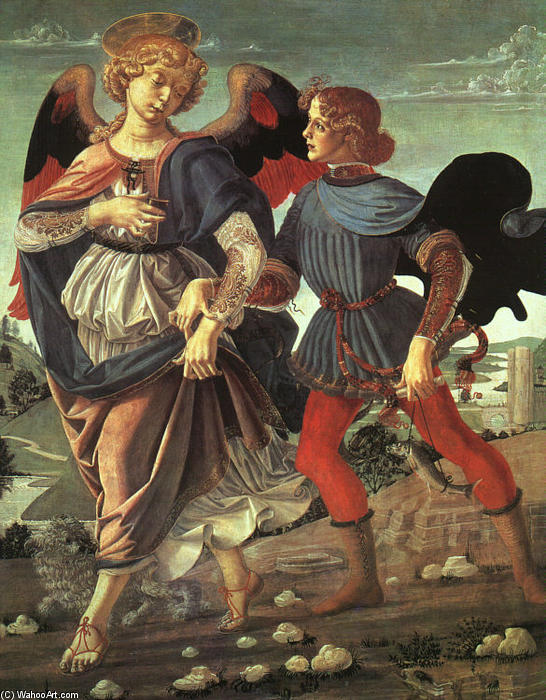
A Renaissance Dialogue Between Faith and Light
In the heart of the Florentine Renaissance, where the pursuit of humanism met the profound depths of spiritual devotion, Andrea del Verrocchio crafted a masterpiece that transcends the boundaries of mere paint on wood. “Tobias and the Angel” is not simply a depiction of a biblical journey; it is a carefully orchestrated tableau designed to communicate eternal truths through the interplay of light and shadow. Completed between 1470 and 1475, this work serves as a cornerstone of Florentine art, inviting the viewer into a sacred space where the earthly and the divine converge in a moment of serene solemnity.
The narrative captured on this poplar panel is one of profound resilience and divine providence. It portrays Tobias, an Ethiopian prince, navigating a perilous path under the watchful guidance of the Archangel Raphael. As they journey to rescue Tobias's father from the affliction of leprosy, the painting breathes life into the ancient tales of the Book of Tobit. There is a palpable sense of movement and purpose in the composition; the figures are rendered with a remarkable realism that reflects the humanist ideals of the era, presenting characters who possess both dignity and human vulnerability.
Mastery of Technique and Luminous Detail
To behold this artwork is to witness the meticulous craftsmanship of Verrocchio’s legendary workshop. Utilizing the traditional medium of egg tempera, the artist achieved a level of luminosity and durability that allows the colors to vibrate with life even centuries later. This technique was essential for capturing the subtle gradations of tone required to render Raphael’s radiant halo and the earnest, searching gaze of Tobias. Every brushstroke serves a purpose, contributing to an atmosphere of clarity and brilliance.
The technical prowess extends to the delicate rendering of textures that captivate the eye of any connoisseur. One cannot help but admire the meticulous feathering of Raphael’s wings, a testament to Verrocchio's dedication to anatomical accuracy and naturalism. This attention to detail creates a tactile experience for the viewer, where the softness of fabric and the strength of divine presence are equally palpable. It is this level of precision that makes a high-quality reproduction of this piece such a profound addition to any curated collection or sophisticated interior.
Symbolic Depth and Emotional Resonance
Beyond its visual splendor, “Tobias and the Angel” is rich with layers of symbolic meaning that reward deep contemplation. The Archangel’s outstretched wing acts as a powerful emblem of divine protection and guidance, mirroring his role as a celestial messenger. Furthermore, the presence of the fish—a central element in the narrative—serves as a potent symbol of resurrection and spiritual salvation. These elements weave together to create an overarching theme of renewal and the triumph of faith over adversity.
For the art lover or the interior designer, this painting offers more than just aesthetic beauty; it provides an emotional anchor. The interaction between the human and the angelic evokes a sense of peace, hope, and the enduring strength of the spirit. Whether placed in a quiet study to inspire reflection or as a focal point in a grand hall to command attention, this work brings with it the timeless elegance of the Italian Renaissance, making it an incomparable choice for those seeking to surround themselves with art that speaks to the soul.