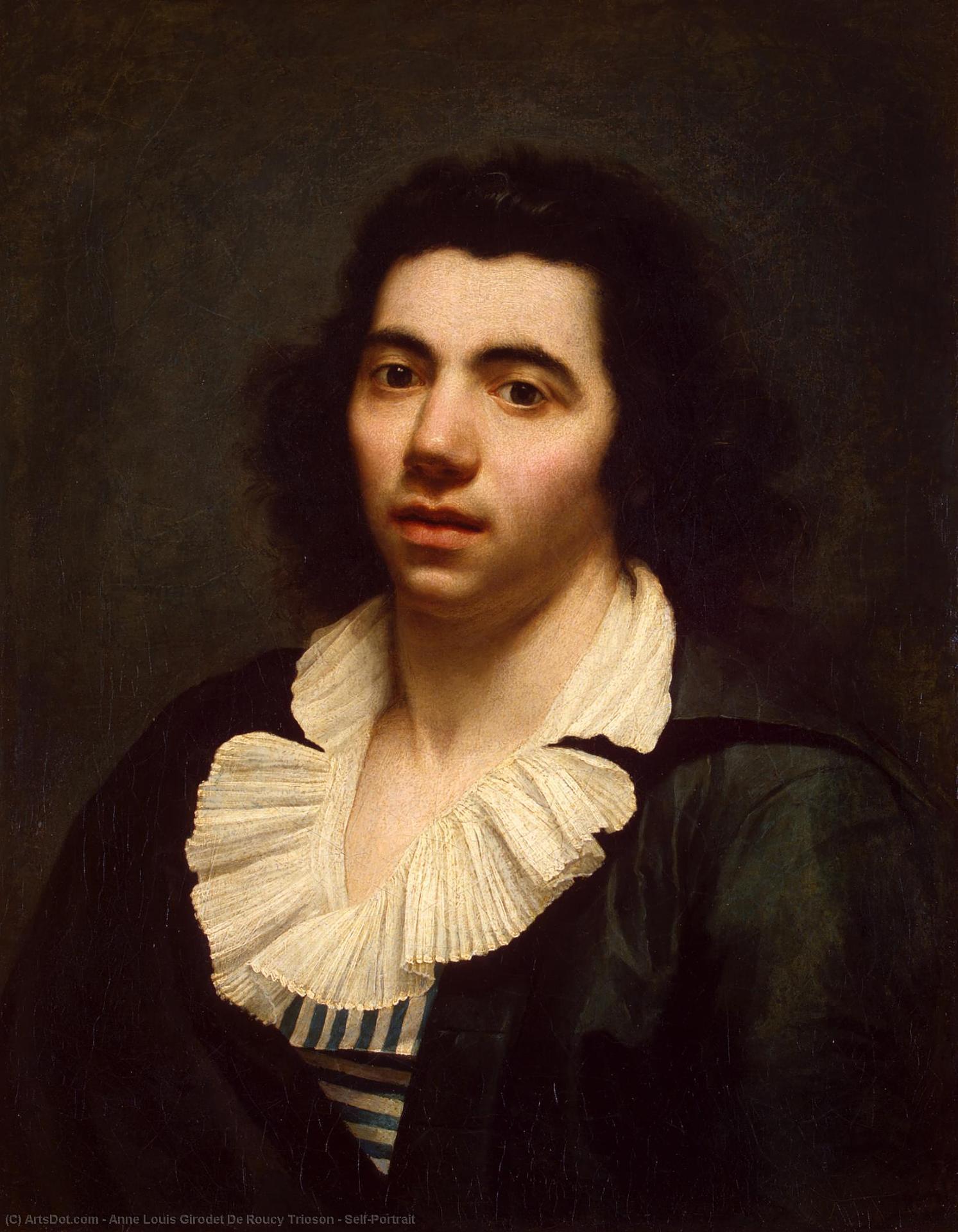
A Glimpse into the Soul: The Introspective World of Anne-Louis Girodet
In the quiet, shadowed depths of Anne-Louis Girodet’s Self-Portrait, we encounter more than just a likeness; we witness the dawn of a new era in French painting. Created around 1800, this evocative work serves as a profound bridge between the rigid, disciplined structures of Neoclassicism and the turbulent, emotional currents of Romanticism. As a protégé of the legendary Jacques-Louis David, Girodet was trained in the mastery of form and anatomical precision, yet in this self-portrait, he begins to break free from his master's shadow. The painting captures a young man poised in a three-quarter pose, his presence emerging from a dark, atmospheric void that suggests a mind turned inward, contemplating the complexities of identity and the fleeting nature of existence.
The technical brilliance of the piece lies in its masterful use of chiaroscroll. Light does not merely illuminate the subject; it sculpts him. Originating from the left, a dramatic light source carves out the contours of his face, casting deep, velvety shadows that lend a sense of three-dimensional volume and psychological weight. This interplay of light and dark—the classic tenebrism—creates a palpable tension, highlighting the intricate textures of his voluminous, slightly chaotic hair and the delicate, ruffled folds of his collar. The palette is a sophisticated arrangement of somber browns, deep blacks, and creamy highlights, a choice that imbues the portrait with a refined, timeless elegance suitable for the most discerning collections.
Symbolism and the Romantic Spirit
Beyond its technical execution, the Self-Portrait is rich with symbolic resonance. The subject’s gaze, though partially obscured by shadow, hints at a profound sense of melancholy and introspection. In an age where portraiture often served as a tool for displaying social status or political power, Girodet uses his own image to explore the internal landscape of the artist. The organic shapes of the flowing hair and draped fabric contrast with the structured precision of his features, mirroring the artist's own struggle to balance academic rigor with burgeoning emotional expression. It is a visual representation of a soul caught between two worlds: the ordered clarity of the Enlightenment and the passionate, unpredictable spirit of the Romantic movement.
For the art lover or the interior designer, this painting offers an unparalleled sense of dignified seriousness. Its ability to command attention through subtle tonal variations rather than overt spectacle makes it a versatile masterpiece for sophisticated environments. Whether placed in a library filled with classical literature or as a focal point in a contemporary gallery space, the work brings an air of intellectual depth and historical gravity. To possess a reproduction of this caliber is to invite a piece of art history into one's home—a piece that does not merely decorate a wall but narrates a story of transformation, resilience, and the eternal human quest for self-discovery.