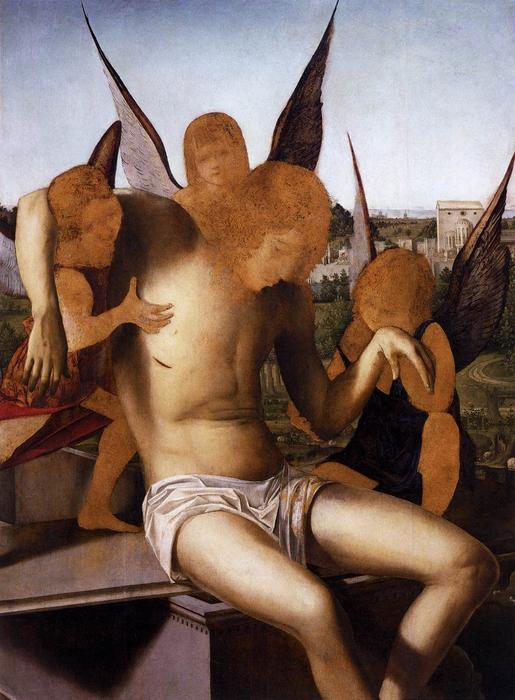
Experience the poignant beauty of Antonello da Messina's 'Pietà,' a Renaissance masterpiece depicting Jesus and Mary. Explore its rich details, symbolism, and artistic influence.
The Pietà: A Renaissance Echo of Grief and Grace
Antonello da Messina’s 1475 “Pietà” is not merely a depiction of sorrow; it's a profound meditation on loss, faith, and the enduring power of maternal love. Born in Messina, Sicily, during a period of intense artistic exchange between Italy and Northern Europe, Antonello skillfully blended the meticulous realism championed by his Flemish predecessors with the burgeoning humanist ideals shaping Renaissance art. This masterful synthesis results in an image that transcends its subject matter, resonating with viewers across centuries.
A Composition Steeped in Symbolism
The painting immediately draws the eye to the central figure of Mary cradling the lifeless body of Jesus. Her posture is one of exquisite sorrow, yet her face retains a serene dignity—a testament to her unwavering faith and acceptance of God’s will. The two angels flanking the scene are not simply attendants but active participants in this poignant drama, their gestures conveying both comfort and solemnity. Notice how they gently support Christ's body, mirroring Mary’s own embrace. Beyond these central figures, the architectural backdrop—a simplified yet evocative representation of a Venetian cityscape—adds depth and context to the narrative. The inclusion of buildings and trees subtly suggests the earthly realm from which Jesus has been taken, further emphasizing the tragedy of his sacrifice.
- The Triangle Composition: Antonello employs a classic triangular composition, anchoring the scene with Mary at its apex and Christ’s body forming the base. This arrangement creates a sense of stability amidst the overwhelming emotion.
- Color Palette: The painting's rich color scheme—deep reds for the drapery, blues and greens for the background—evokes both sorrow and spiritual depth. The use of chiaroscuro (light and shadow) dramatically highlights Mary’s face and Christ’s body, drawing attention to their emotional states.
- Symbolic Details: The inclusion of a small, almost hidden, figure in the background – often interpreted as an angel collecting blood from Christ's wounds – adds another layer of symbolic complexity, referencing the biblical account of the Passion.
Technique and Innovation: A Masterful Blend
Antonello’s technical prowess is immediately apparent in the painting’s remarkable detail and realism. He demonstrates a mastery of oil paint, utilizing layering techniques to achieve subtle gradations of color and texture. The drapery—particularly Mary's voluminous robes—is rendered with astonishing precision, capturing the folds and creases with breathtaking accuracy. Crucially, Antonello was among the first Italian artists to fully embrace the use of oil paints, a technique that allowed for greater luminosity, richer colors, and more nuanced blending than traditional tempera or fresco methods. This innovation significantly influenced subsequent generations of Italian painters.
A Legacy of Emotion and Influence
The “Pietà” stands as a pivotal work in the transition from Early to High Renaissance art, demonstrating Antonello’s ability to synthesize diverse artistic influences. It shares stylistic affinities with both Flemish masters like Jan van Eyck and Italian humanists like Piero della Francesca, creating a uniquely compelling visual experience. Its profound emotional impact has resonated throughout history, inspiring countless artists and viewers alike. Reproductions of this iconic image continue to captivate audiences today, offering a glimpse into the heart of Renaissance spirituality and artistic genius. The painting’s enduring appeal lies in its ability to evoke empathy and contemplation—a timeless reminder of loss, love, and faith.