A Soul Etched in Shadow: Unveiling “Abstracção (Maria)” by António Teixeira Carneiro Júnior
António Teixeira Carneiro Júnior’s “Abstracção (Maria),” a captivating portrait rendered in oil on canvas, stands as a poignant testament to the artist's profound engagement with the human psyche and the evocative power of symbolism. Painted circa 1900-1910 during his formative years in Paris and Porto, this work transcends mere representation, offering instead a glimpse into a world steeped in melancholy, introspection, and a yearning for spiritual connection – hallmarks of the Portuguese Expressionist movement he helped pioneer.
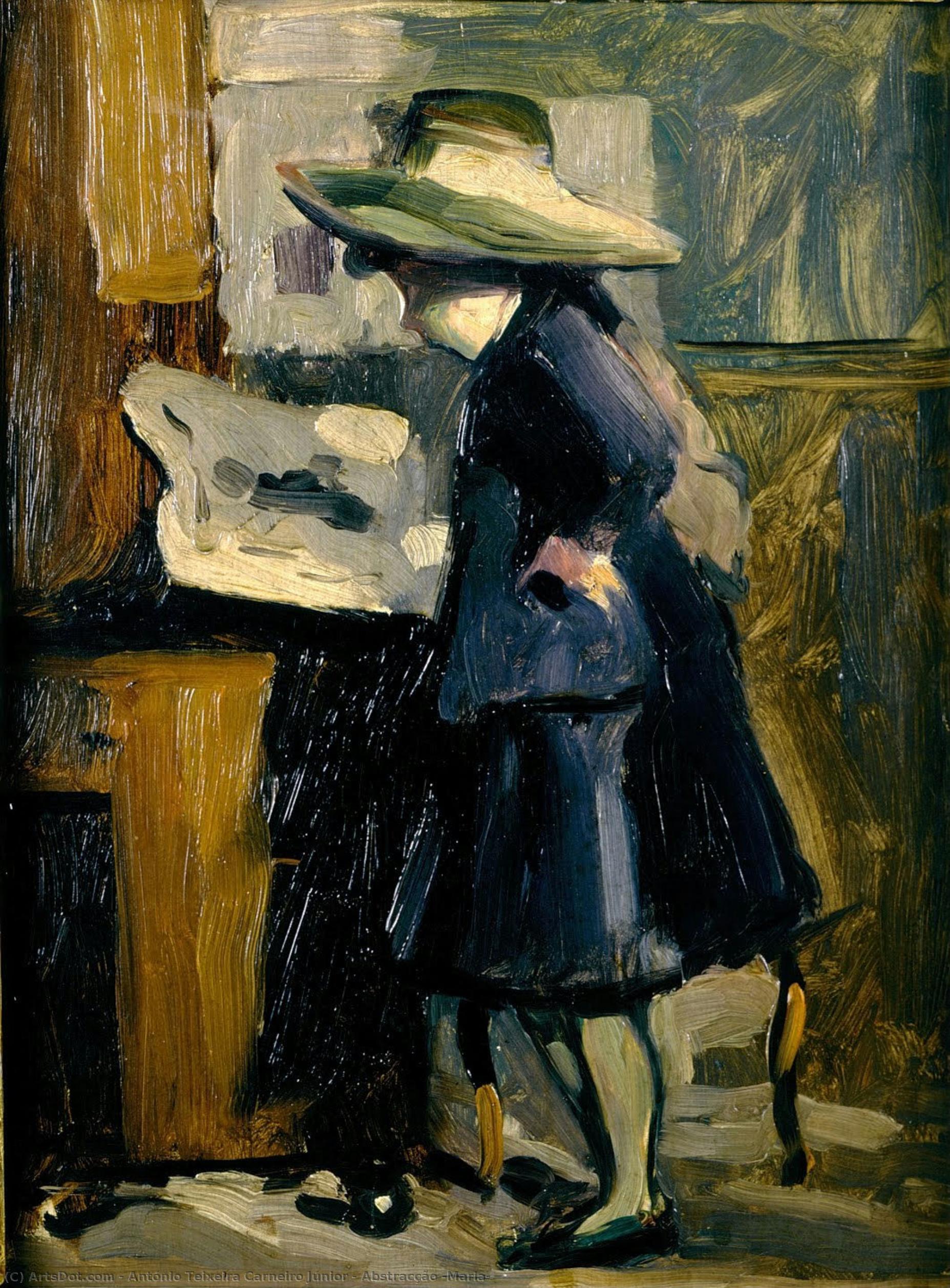
The scene unfolds within a modestly furnished interior, dominated by a dark wooden desk. A woman, identified simply as “Maria,” occupies the central space, her posture suggesting both contemplation and a quiet reserve. Dressed in a simple hat that partially obscures her face, she is positioned before a book or sheet of paper, her hands resting lightly on her hips – a gesture simultaneously assertive and vulnerable. The room itself is rendered with a muted palette of browns, greys, and deep blues, creating an atmosphere of subdued light and shadow, mirroring the emotional weight of the subject’s gaze.
The Artist's Crucible: A Life Forged in Loss
Understanding “Abstracção (Maria)” requires acknowledging the deeply personal context of António Teixeira Carneiro Júnior’s life. Born into hardship – abandoned by his father and orphaned at a young age – he spent much of his childhood within the confines of the Santa Casa da Misericórdia orphanage in Porto. This early experience, marked by isolation and loss, profoundly shaped his artistic vision, imbuing his work with an undercurrent of sadness and a sensitivity to human suffering. The orphanage’s chapel, where he initially learned to copy religious illustrations, provided him with his first exposure to art and instilled within him a reverence for the spiritual realm – a theme that would repeatedly surface in his oeuvre.
His time in Paris proved pivotal, exposing him to the burgeoning Symbolist movement and its emphasis on subjective experience and emotional resonance. Influenced by artists like Gustave Moreau and Edvard Munch, Carneiro began to explore techniques of distortion and exaggeration, employing color and form not merely to depict reality but to convey inner states of being. “Abstracção (Maria)” exemplifies this shift, moving beyond a straightforward portrait towards a more psychologically charged representation.
Symbolism in the Details: A Language of Emotion
Numerous elements within the painting contribute to its layered symbolism. The woman’s hat, partially concealing her face, suggests a desire for privacy or perhaps a reluctance to reveal her true self. The book or sheet of paper before her could represent knowledge, contemplation, or even a burden of responsibility. The muted color palette and the play of light and shadow evoke feelings of loneliness, introspection, and a sense of yearning. Notably, the composition itself—the woman centered within a confined space—underscores themes of isolation and confinement.
The artist’s use of brushwork is particularly noteworthy. Loose, expressive strokes create a sense of movement and dynamism, while subtle gradations of color suggest depth and texture. The shadows are not merely dark; they possess an almost palpable weight, contributing to the painting's overall atmosphere of melancholy.
A Legacy of Emotional Depth
“Abstracção (Maria)” is more than just a portrait; it’s a profound meditation on human emotion and the complexities of the inner life. It represents a crucial moment in António Teixeira Carneiro Júnior’s artistic development, marking his transition from a technically proficient draughtsman to a deeply expressive artist capable of capturing the nuances of human experience. Reproductions of this work offer a powerful opportunity to engage with the emotional depth and symbolic richness of one of Portugal's most important Expressionist painters – a reminder that art can be both a mirror reflecting our own vulnerabilities and a window into the souls of others.