A Symphony of Nature's Ephemera
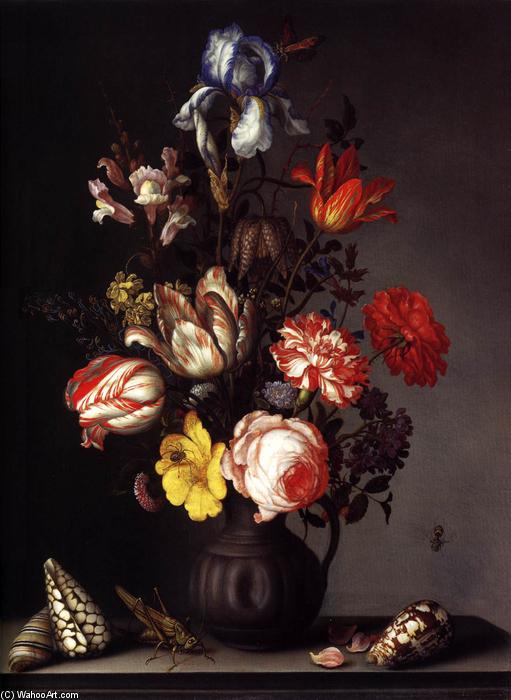
To gaze upon this still life is to step directly into the meticulously ordered, yet wildly abundant, world of the Dutch Golden Age. Balthasar van der Ast’s depiction of flowers in a vase with shells and insects is far more than a mere arrangement of beautiful objects; it is a profound meditation on life's fleeting perfection. The composition immediately draws the eye into a vibrant tapestry where every petal, every iridescent shell fragment, and every delicate insect seems placed with deliberate artistry. The sheer variety—the clash and harmony between reds, yellows, deep blues, soft pinks, and creamy whites—creates an immediate visual feast that speaks to the painter's masterful control over color theory.
Mastery in Still Life and Shell Painting
Van der Ast was a pioneer whose genius lay in his ability to elevate humble natural elements into objects of high art. His technique, particularly evident here, showcases an almost scientific level of observation blended with poetic flair. The contrast between the riotous, organic life spilling from the vase and the deep, velvety blackness of the vessel itself is breathtaking. This stark juxtaposition allows the colors of the flora to achieve a luminous quality, making them appear as if they are glowing from within. Furthermore, his inclusion of shells and insects—elements that speak to the natural world's intricate cycles—is characteristic of his celebrated shell painting style, demanding an eye for minute detail that few artists could match.
Symbolism Woven into Petals and Scales
In the context of 17th-century Dutch art, such still lifes were rarely just decorative. They functioned as visual allegories. The abundance of life captured here often served as a memento mori—a reminder of life's transient beauty. The inclusion of delicate insects and perishable flowers subtly whispers of time passing, urging the viewer to appreciate the moment at hand. Each species of flower, each patterned shell, carries potential symbolic weight, inviting contemplation on themes of vanity, rebirth, and the glorious complexity of existence itself. It is a conversation between permanence and decay.
Bringing the Dutch Golden Age Home
For the modern collector or designer, this piece offers an unparalleled opportunity to infuse a space with historical depth and vibrant natural energy. Reproducing such a work allows one to own a tangible piece of art history, capturing the sophisticated taste and meticulous craftsmanship of the 1630s. Imagine this composition gracing a mantelpiece or adorning a gallery wall; its balanced yet overflowing nature provides an instant focal point, lending an air of cultivated erudition and timeless romance to any interior setting. It is not just decoration; it is a conversation starter, a window into another era of artistic brilliance.