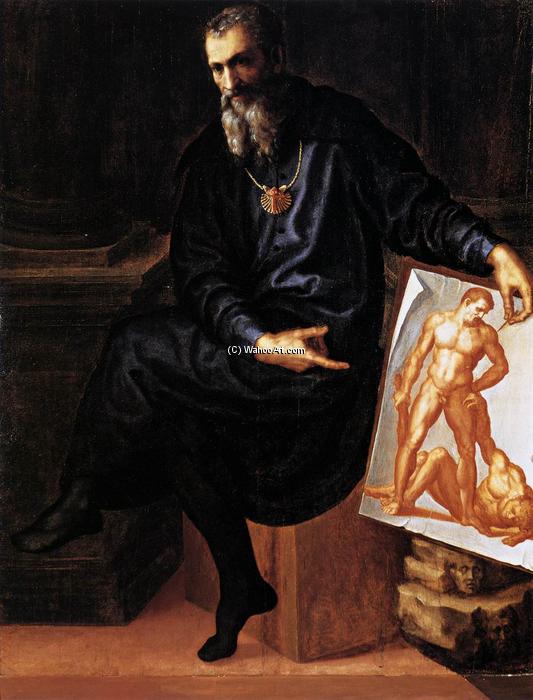
Bartolommeo Brandini’s ‘Self-Portrait,’ a captivating Renaissance oil painting from 1530, showcases the artist's skill with chiaroscuro and intricate detail. Admire this masterful depiction of a sculptor holding an inner scene of a dramatic struggle – explore exquisite reproductions.
Bartolommeo Brandini’s ‘Self-Portrait’: A Renaissance Masterpiece of Interior Drama
The “Self-Portrait” by Bartolommeo Brandini (Baccio Bandinelli), painted in 1530, is more than a simple depiction of an artist; it's a meticulously constructed meditation on identity, skill, and the very nature of representation. Executed in oil on canvas with exacting detail, this work – currently housed at the Isabella Stewart Gardner Museum – offers a rare glimpse into the mind of a pivotal figure of the High Renaissance. Measuring 147 x 112 cm, the painting immediately draws the viewer into its complex narrative through Brandini’s masterful use of chiaroscuro and his audacious inclusion of a secondary scene within a scene.
- Subject & Composition: The central figure, Bartolommeo Brandini himself, is presented in a dark robe, his long beard adding to an air of contemplative seriousness. He holds aloft a painting depicting two figures engaged in what appears to be a dramatic struggle or dance – a scene brimming with energy and movement that contrasts sharply with the stillness of the portrait itself. The crossed legs and necklace suggest a deliberate pose, inviting the viewer into a dialogue about artistic intention.
- Technical Brilliance: Brandini’s technical skill is immediately apparent in the rendering of both figures. The inner painting showcases an astonishing understanding of anatomy and musculature, reflecting the influence of his mentor, Michelangelo Buonarroti. The use of chiaroscuro – the dramatic interplay of light and shadow – creates a powerful sense of depth and volume, pulling the viewer into the scene and emphasizing the textures of the fabrics and flesh.
A Window into Renaissance Humanism
Created during a period of intense intellectual and artistic ferment, Brandini’s “Self-Portrait” embodies the core tenets of Renaissance humanism. The focus on the individual – here, the artist himself – and his capacity for skill, intellect, and emotional expression aligns perfectly with this movement's emphasis on earthly achievement and rational thought. The inclusion of a dynamic inner scene isn’t merely decorative; it’s a symbolic assertion of Brandini’s mastery over both form and narrative. It speaks to the Renaissance ideal of the ‘uomo universale,’ the well-rounded individual capable of excelling in multiple disciplines – in this case, sculpture, painting, and the art of self-representation.
- Historical Context: Born in Chianti, Italy, in 1493, Brandini lived during a time when Florence was at the heart of artistic innovation. His association with Michelangelo Buonarroti provided him with invaluable training and exposed him to the revolutionary ideas shaping the era’s art. The painting reflects the confidence and ambition characteristic of Florentine artists seeking to surpass the limitations of medieval art.
- Symbolism: The struggle or dance depicted within the inner painting could be interpreted as a metaphor for the artist's own creative process – a constant battle between control and inspiration, order and chaos. The nude figures, while potentially referencing classical ideals, also represent the vulnerability and passion inherent in artistic creation.
The Art of Reproduction: Capturing Brandini’s Vision
ArtsDot offers meticulously crafted hand-painted reproductions of Bartolommeo Brandini's “Self-Portrait,” allowing you to bring this Renaissance masterpiece into your home or office. Our skilled artisans employ the same techniques as Brandini himself – oil on canvas, precise detailing, and masterful use of chiaroscuro – to faithfully recreate every nuance of the original. Each reproduction is a testament to our commitment to preserving artistic heritage and providing collectors with exceptional works of art.
- Size & Materials: Available in 147 x 112 cm, our reproductions are created on high-quality canvas using archival pigments for lasting vibrancy.
- Investment & Legacy: Owning a ArtsDot reproduction is more than just acquiring a beautiful piece of art; it’s investing in a legacy – preserving the work of a true Renaissance master for generations to come.
Explore the Collection
Discover other works by Bartolommeo Brandini (Baccio Bandinelli) and explore our extensive collection of Renaissance masterpieces at ArtsDot: Painting by ‘Bartolommeo Brandini (Baccio Bandinelli)’