A Moment of Quietude: Berthe Morisot’s “Summer”
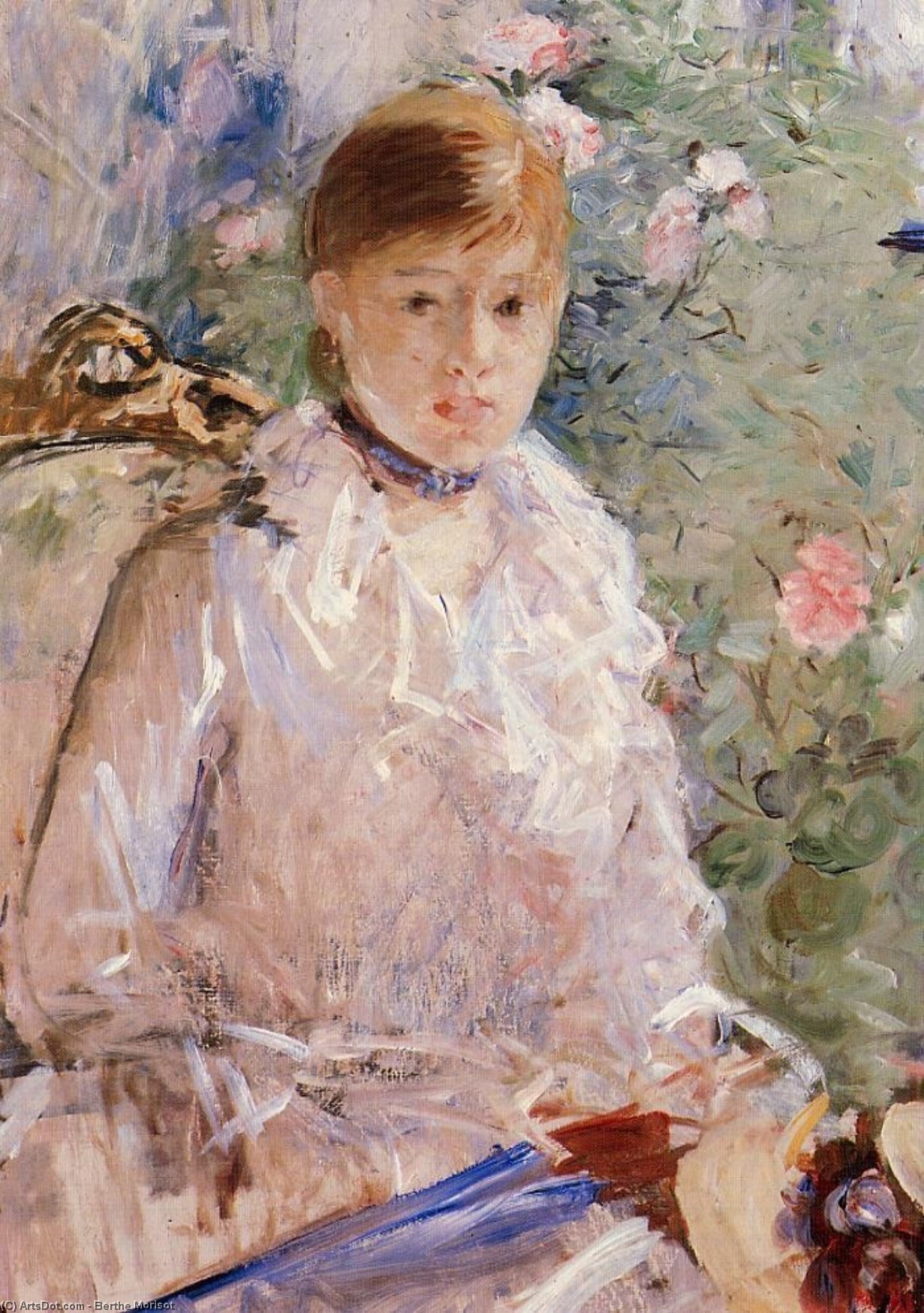
Berthe Morisot's "Summer," more accurately known as “Young Woman by a Window,” is not merely a painting; it’s an invitation to pause, to breathe, and to contemplate the delicate beauty of domestic tranquility. Completed in 1878 during her peak as an Impressionist, this intimate portrait captures a fleeting moment of serene contemplation within a sun-drenched room—a testament to Morisot's extraordinary ability to distill emotion and atmosphere onto canvas.
The scene unfolds with remarkable simplicity: a young woman, dressed in a luminous white gown accented by a delicate blue ribbon around her neck, sits bathed in the soft glow of natural light. Her brown hair is loosely arranged, framing a face that holds an expression of quiet contentment—a subtle smile playing on her lips as she gazes out the window. The room itself is subtly detailed – potted plants and vases contribute to a sense of understated elegance, hinting at a life lived within comfortable surroundings. Morisot masterfully employs loose, broken brushstrokes, characteristic of the Impressionist movement, allowing the light to dance across the fabric of the dress and creating an almost palpable sense of warmth.
Impressionism’s Intimate Lens
Morisot's work stands apart within the broader Impressionist circle. While many of her contemporaries focused on capturing grand landscapes or bustling city scenes, Morisot consistently turned her gaze inward, exploring the nuances of domestic life and the quiet moments shared between women and their families. This focus wasn’t a deviation from Impressionism; rather, it was an amplification of its core tenets – prioritizing the subjective experience of light, color, and atmosphere over precise representation.
Her artistic choices reflect this approach. The painting's palette is restrained yet vibrant, dominated by soft blues, greens, and whites that evoke a sense of serenity. Morisot’s use of *plein air* painting—working directly from nature—is evident in the subtle variations of light and shadow, lending an authenticity to the scene. The composition itself is carefully considered; the window serves as a framing device, drawing the viewer's eye outward while simultaneously emphasizing the woman’s internal state.
Symbolism and Emotional Resonance
Beyond its surface beauty, “Summer” resonates with layers of symbolic meaning. The window acts as a portal to an unseen world—a realm of possibility and reflection. The blue ribbon around the woman's neck could represent fidelity or perhaps simply a touch of elegance, while the potted plants suggest growth, life, and connection to nature. More profoundly, the painting speaks to the universal desire for peace and solitude – a longing for respite from the demands of daily life.
Morisot’s ability to convey such complex emotions with such understated grace is what makes “Summer” so enduringly captivating. It's not a dramatic or overtly emotional scene, but rather a quiet meditation on beauty, stillness, and the simple pleasures of existence. The painting invites us to step into the room, to share in the woman’s moment of contemplation, and to find our own sense of peace within its serene embrace.
A Legacy Preserved: Reproductions and Artistic Inspiration
Today, “Summer” resides at the Musée Fabre in Montpellier, France, a testament to Morisot's enduring legacy. High-quality reproductions offer art enthusiasts worldwide the opportunity to experience this masterpiece firsthand. Whether displayed as a focal point in a living room or a study, a meticulously crafted reproduction captures the essence of Morisot’s vision—a reminder that beauty can be found in the most unexpected moments.
For those seeking to delve deeper into Morisot's world, exploring related works such as “A Summer’s Day” and her portraits of family members provides a richer understanding of her artistic development. Furthermore, examining the broader context of Impressionism—including the influence of artists like Monet and Renoir—illuminates the unique contributions that Morisot made to this revolutionary movement.